
Humanoid Robotics and Cybersecurity Architecture at Scale
Trust will define adoption. Security architecture will define trust. As humanoids enter real environments, cybersecurity evolves into a system-level design discipline shaping safety, reliability, and market readiness.
🤖 System perspective: cyber meets physical reality
Humanoids extend software systems into physical environments. Every perception input and motion output creates a bidirectional risk surface. A manipulated command can translate into unintended physical action. This convergence is increasingly reflected in standards linking safety and cybersecurity requirements (https://www.iso.org/standard/68383.html). The implication is clear. Security becomes a foundational design parameter, embedded early in system architecture decisions.
🔐 Semiconductor perspective: trust anchored in silicon
Security in humanoids starts at the lowest layer. Hardware-rooted identity, secure boot, and cryptographic acceleration define whether a system can establish trust at power-up. Trusted Platform Modules and secure microcontrollers are widely referenced as anchors for integrity and attestation (https://trustedcomputinggroup.org/resource/tpm-library-specification/).
From a system design viewpoint, integrating these capabilities into control and sensing devices reduces latency and strengthens resilience. It also simplifies certification pathways as security and safety increasingly converge.
⚙️ Control perspective: separating cognition and motion
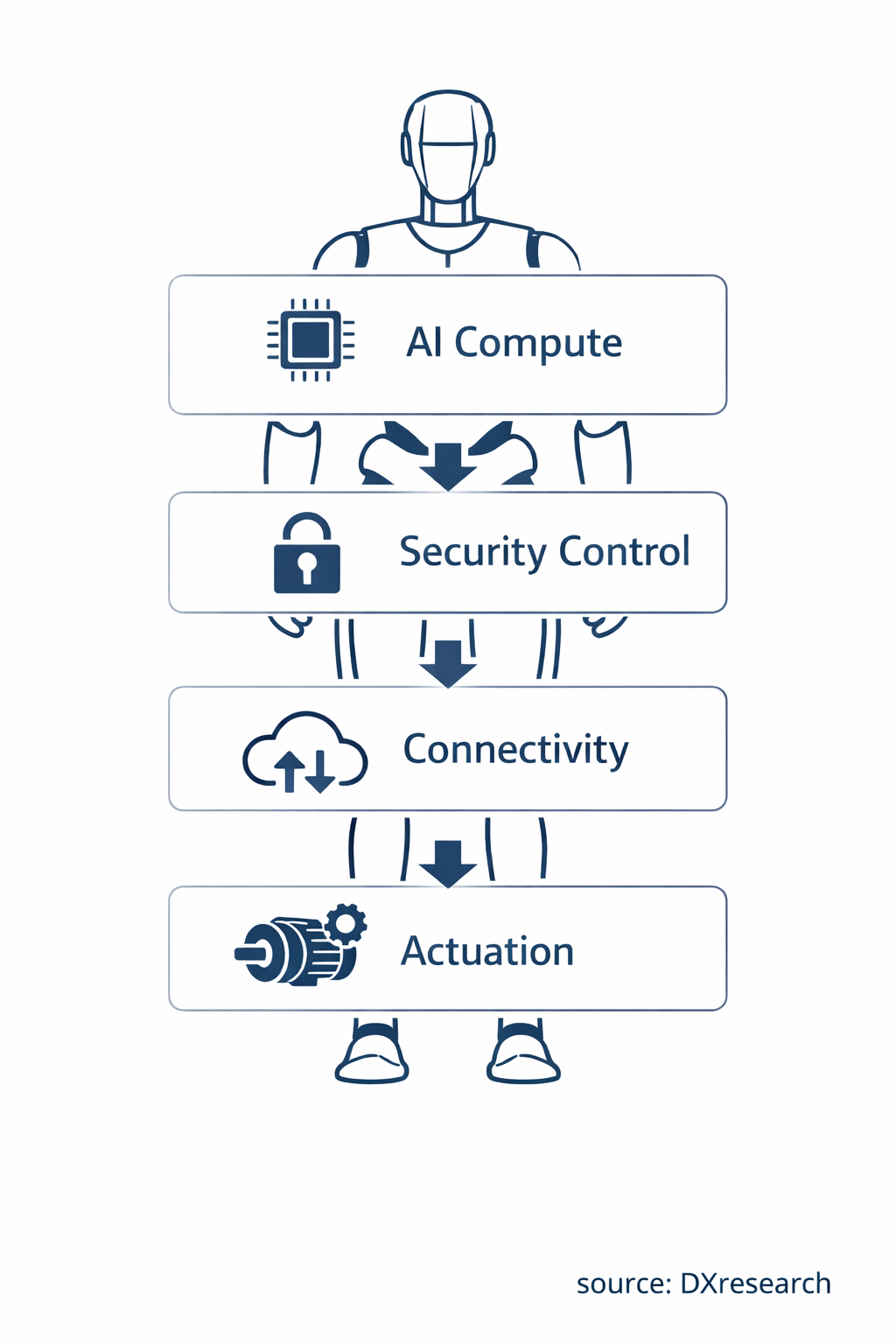
Humanoid architectures typically split high-level AI reasoning from real-time actuation. This separation creates a natural control boundary where security policies can be enforced. A safety and security supervisor validates commands before execution, ensuring constraints on motion, torque, and velocity.
This architectural pattern reflects broader industrial control principles where deterministic systems act as guardians of physical processes. It reduces systemic risk by limiting direct exposure of actuators to higher-level software domains.
🌐 Infrastructure perspective: the extended trust boundary
A humanoid rarely operates in isolation. It connects to charging stations, maintenance interfaces, enterprise networks, and cloud platforms. Each connection expands the trust boundary.
Zero-trust architecture principles are increasingly applied in such distributed systems, requiring continuous authentication and verification across all nodes (https://www.nist.gov/publications/zero-trust-architecture). This approach supports secure fleet management, authenticated updates, and controlled access to sensitive data flows.
📊 AI perspective: protecting models and data pipelines
AI introduces a new class of security considerations. Training data integrity, model provenance, and runtime behavior monitoring become critical. Manipulated datasets or adversarial inputs can influence decision-making in subtle ways.
Industry discussions highlight the importance of securing AI pipelines end-to-end, from data ingestion to deployment and updates (https://www.mckinsey.com/industries/advanced-electronics/our-insights/the-rise-of-embodied-ai). This reinforces the need for cryptographic validation and anomaly detection mechanisms embedded within the system.
🏭 Market perspective: trust as an adoption driver
Humanoid deployment in healthcare, manufacturing, and service environments depends on reliability and compliance. Decision-makers evaluate systems based on safety certification, cybersecurity posture, and lifecycle management capabilities.
Market analyses indicate that trust directly influences adoption rates, especially in human-centric environments where privacy and safety expectations are high (https://www.bcg.com/publications/2023/ai-robots-future-of-automation).
This creates a competitive dynamic where secure architectures become a differentiator rather than a background requirement.
🔄 Lifecycle perspective: security as a continuous process
Humanoids operate over long lifecycles with continuous software updates and evolving functionality. Security must therefore extend beyond deployment into operation, maintenance, and decommissioning.
Secure OTA updates, device attestation, and identity management enable controlled evolution of system capabilities. Lifecycle security frameworks emphasize continuous monitoring and response to emerging threats, aligning with broader IoT security practices (https://csrc.nist.gov/publications/detail/sp/800-207/final).
Closing perspective
Humanoid robotics brings together AI, control systems, connectivity, and power electronics into a unified platform. Security sits across all these domains as a connective layer that ensures trust, safety, and operational continuity.
As adoption accelerates, architecture decisions made today will define long-term system resilience. The industry is moving toward integrated, hardware-anchored, and lifecycle-aware security models that align with the complexity of physical AI systems.
Sources
- ISO 21434 Road Vehicles Cybersecurity Standard, 2021
Defines cybersecurity engineering requirements for connected systems, increasingly referenced for robotics safety convergence.
https://www.iso.org/standard/70918.html - Trusted Platform Module Library Specification, 2019
Describes hardware-based root of trust widely used for secure boot, attestation, and device identity.
https://trustedcomputinggroup.org/resource/tpm-library-specification/ - NIST Zero Trust Architecture SP 800-207, 2020
Framework outlining continuous authentication and verification across distributed systems and connected devices.
https://www.nist.gov/publications/zero-trust-architecture - McKinsey The Rise of Embodied AI, 2024
Explores integration of AI with physical systems and highlights importance of secure data and model pipelines.
https://www.mckinsey.com/industries/advanced-electronics/our-insights/the-rise-of-embodied-ai - BCG AI Robots Future of Automation, 2023
Analyzes adoption drivers for robotics, emphasizing trust, reliability, and system integration.
https://www.bcg.com/publications/2023/ai-robots-future-of-automation


Leave a Reply