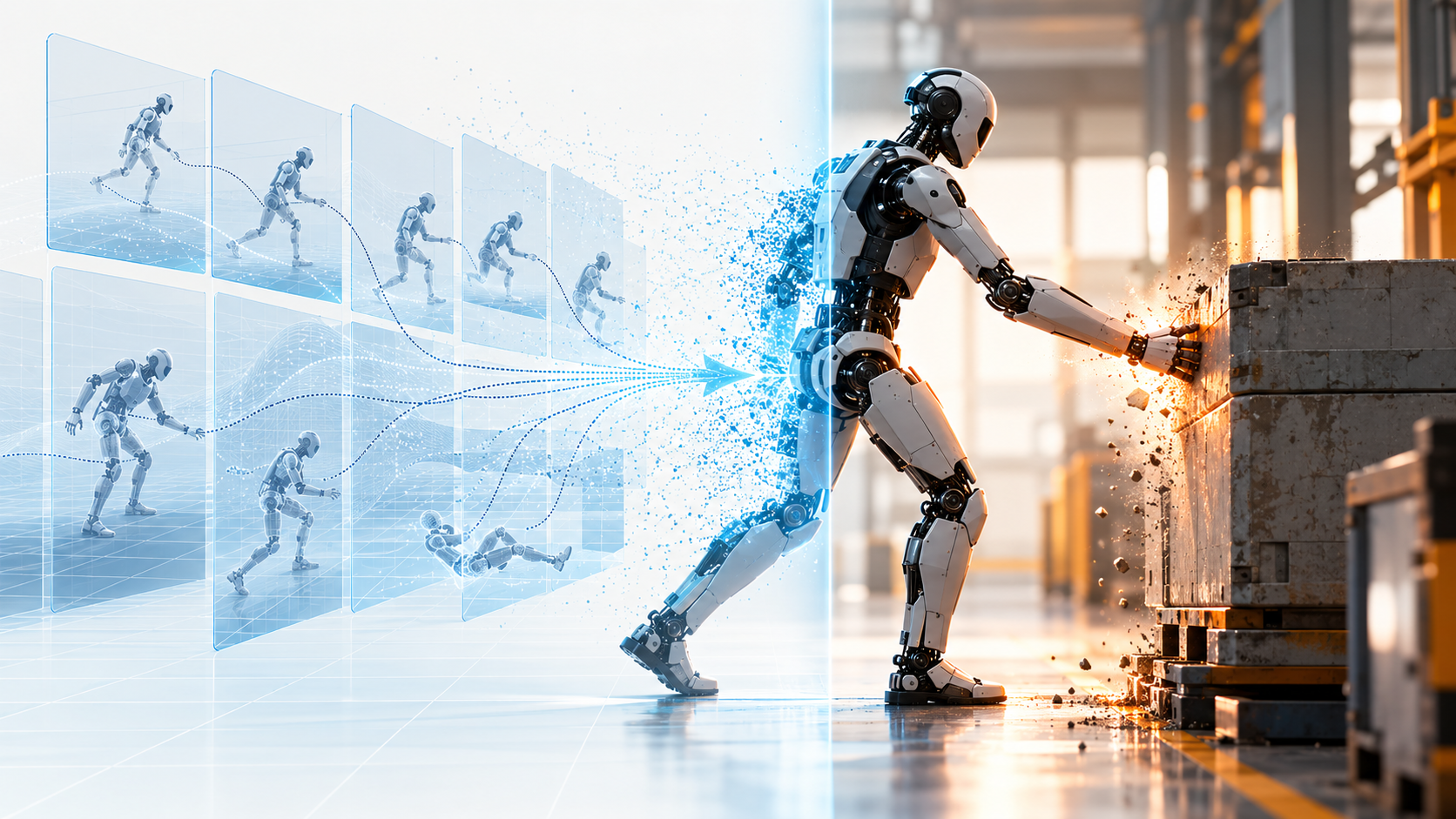
Software has trained us to expect reversibility. A document can be restored. A database transaction can be rolled back. A model can be retrained. A faulty software release can often be replaced with the previous version.
A humanoid robot changes that relationship.
Once AI closes the loop between perception, decision and actuation, an error can become a physical event. A hand closes around the wrong object. A joint produces unexpected torque. A robot steps where a person is standing. A battery overheats. A machine falls.
The log file may be reversible. The event is not.
The physical world has no undo button.
For Physical AI, that statement is an engineering constraint. It affects how humanoids are specified, architected, trained, manufactured, validated, deployed, updated, maintained and eventually retired.
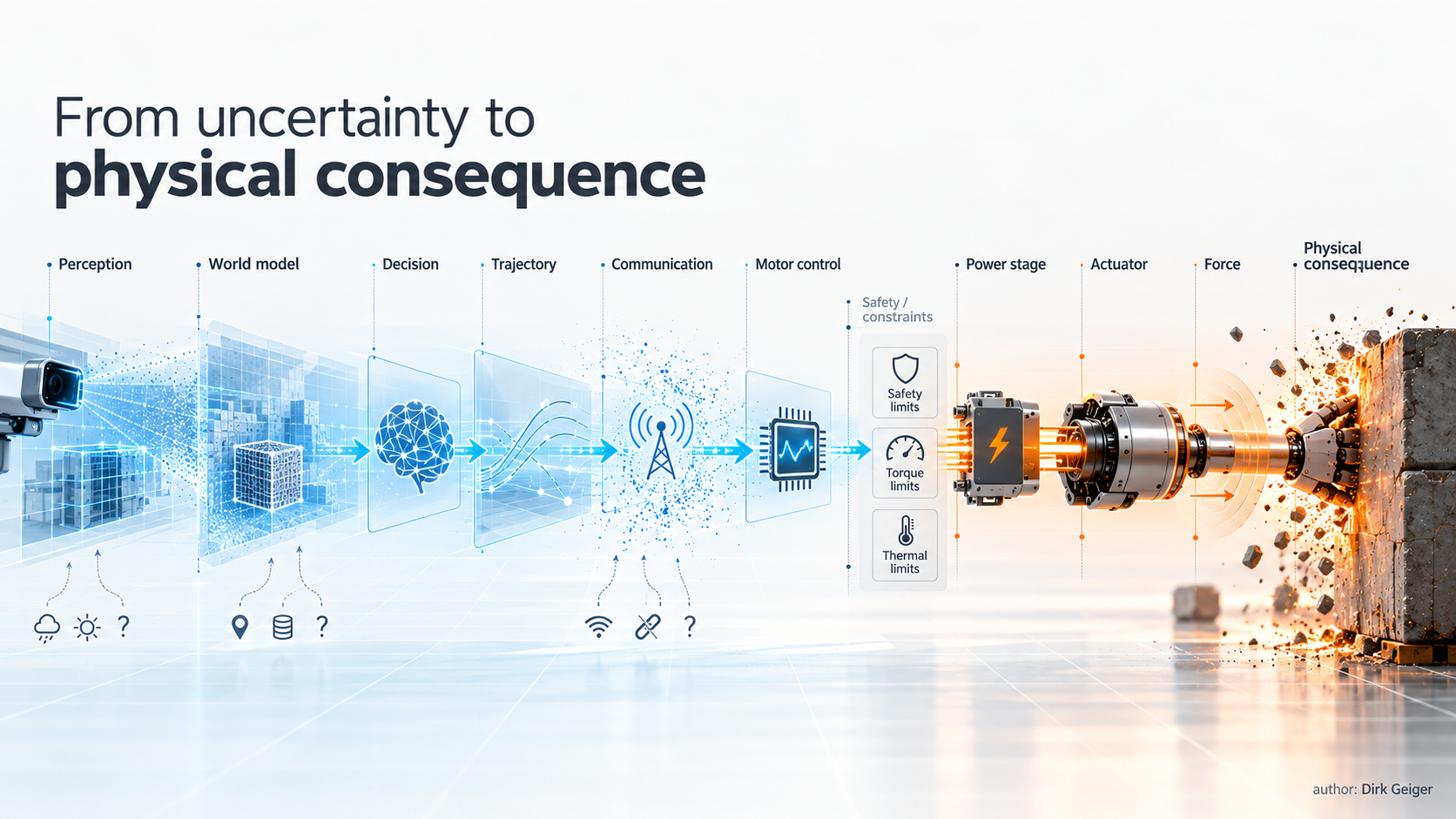
The design challenge is to give intelligent machines useful agency while keeping the consequences of uncertainty bounded. The chain from perception to physical consequence makes the problem visible.
AI becomes different when decisions create forces
A language model can be wrong without moving a kilogram of hardware. A humanoid cannot separate reasoning from consequence so cleanly. Perception shapes planning; planning drives controllers; controllers command power electronics and motors; motors create momentum, contact, heat and wear.
The chain is physical: perception → interpretation → decision → trajectory → actuator command → force → consequence. Uncertainty can enter anywhere. A camera is occluded. Depth is wrong. localisation drifts. a model sees something unfamiliar. communication arrives late. an encoder ages. friction changes.
The engineering question is therefore simple and uncomfortable: what happens when the model, sensor, network or assumption is wrong? ISO 12100 provides a useful baseline because it treats machinery safety as a lifecycle discipline of hazard identification, risk estimation, evaluation and reduction.
Every actuator is a potential consequence generator
AI compute attracts attention because it carries the visible intelligence. The joints carry the energy.
Every powered axis can translate a bad command into force. That makes joint electronics, sensing and mechanics part of the safety boundary. Can torque be independently observed? Can current and speed be bounded locally? Does communication loss trigger a defined response? Can one central-compute failure propagate through the body?
Local controllers matter because they can enforce limits when higher-level intelligence becomes unavailable or implausible. Mechanical choices matter for the same reason. Compliance, brakes, overload protection, energy absorption and physical range limits can reduce consequences without waiting for software to recover.
The practical target is a robot whose architecture makes imperfect intelligence containable.
Hands make the problem harder
Humanoid hands are designed to make contact. That immediately changes the safety problem.
A mobile platform can often reduce risk by avoiding an obstacle. A dexterous hand must touch, grip, push, insert, twist, carry and sometimes use tools. Safe contact depends on context: cardboard permits different forces from human skin; a towel creates different consequences from a knife; a cup of hot liquid adds another layer of risk.
The relevant system is robot + end effector + object + task + environment + human interaction. ISO/TR 20218-1 already treats end-effector safety as an integration question. General-purpose humanoid hands widen that question because ordinary objects can become temporary tools with very different physical consequences.
Perception becomes part of the safety case
Humanoid autonomy depends on perception, which means sensing quality has to be judged by more than average recognition accuracy.
Does the robot know that a camera is dirty? Can it detect disagreement between independent sensors? Can it distinguish empty space from insufficient evidence? Can uncertainty survive the journey through planning and control instead of disappearing behind a confident label?
A useful Physical AI rule follows: confidence should influence physical authority. As uncertainty rises, allowable speed, torque, reach, task scope or autonomy may need to fall. Degraded perception should lead to degraded authority.
Training data eventually becomes physical behaviour
Humanoids may learn from demonstrations, teleoperation, simulation, reinforcement learning, synthetic data and fleet experience. Gaps in those datasets can later surface as physical behaviour.
Dataset engineering therefore becomes systems engineering. ISO/CD 26264-1, currently under development, addresses the lifecycle of humanoid robot datasets, including planning, training, validation and test data together with quality, privacy and security.
The implication reaches far upstream: a future physical incident may begin in examples a model saw, conditions it never saw, or criteria used to decide that training was sufficient.
Simulation matters precisely because reality cannot be reset
Simulation provides something the physical world does not: cheap reversibility.
Robots can fall, collide, misperceive and fail millions of times without damaging people or hardware. Digital twins and hardware-in-the-loop systems can expose rare combinations of conditions before deployment.
Reality still contains details that models miss: mechanical tolerances, backlash, contamination, temperature, cable behaviour, battery ageing, network timing and human unpredictability. Simulated success therefore needs a disciplined path into the real world.
The sensible sequence is staged exposure: simulation, controlled physical testing, restricted deployment and progressively broader autonomy as evidence accumulates.
Falling is not merely a locomotion problem
A bipedal humanoid can fall, and a fall couples control, mechanics, stored energy and the environment in one event.
The trigger might be perception, planning, a slippery floor, actuator degradation, communication loss, a power interruption or unexpected contact. Good engineering therefore covers both fall prevention and fall management.
Where should kinetic energy go? Which structures can contact the floor? Can the robot release a hazardous object? What happens to brakes and power during collapse? Can nearby people be protected? Can critical electronics survive repeated impacts?
ISO/TC 299 now includes dedicated work on dynamically stable industrial mobile robots, including legged systems. The standards landscape is adapting because the physical problem has changed.
Power architecture is part of the safety architecture
Physical AI eventually becomes energy. Battery energy becomes DC-link energy. Power electronics convert it. Motor controllers regulate current. Motors create torque. Structures transmit that torque into the environment.
A safety concept that stops at the AI computer stops too early. Overcurrent, overtemperature, short circuits, isolation faults, unexpected power restoration, communication loss and state transitions all matter.
Robot states deserve particular attention. An idle humanoid may still be balancing. A disabled actuator can still move under gravity. A powered-down controller may sit beside an energised battery.
One design question cuts through the abstraction: where can energy go when something fails?
Cybersecurity becomes physical security
A compromised information system can leak data. A compromised robot can also move.
Manipulated perception, altered actuator commands, falsified configuration, stolen credentials or malicious software updates can create physical hazards. Cybersecurity therefore belongs inside the safety architecture.
ISO/TR 22100-4 links machinery safety and IT-security considerations. In Europe, the Cyber Resilience Act adds lifecycle cybersecurity obligations for products with digital elements. Article 14 reporting obligations apply from 11 September 2026; the Regulation generally applies from 11 December 2027.
For humanoids, secure boot, authenticated updates, key protection, software provenance, segmentation, logging, intrusion detection and recovery mechanisms help preserve trust in physical behaviour.
Updating the robot changes the machine
Software-defined robots continue changing after shipment. A new perception model may classify an object differently. A planner may select a different path. A grasping update may change contact forces. Firmware can alter timing or motor behaviour.
That makes a behavioural update an engineering change to the physical machine.
Regulation (EU) 2023/1230 explicitly addresses machinery with fully or partially self-evolving behaviour or logic operating with varying levels of autonomy. It requires defined task and movement boundaries and includes traceability provisions for safety-related software and decision processes.
Every meaningful behavioural update deserves controlled validation, staged deployment and a defined rollback path before the next physical action.
Maintenance can be more dangerous than normal operation
A robot may be safest while doing its intended job and most exposed while someone services it.
During maintenance, covers are open, joints may be moved manually, protections can be bypassed, calibration may be incomplete and stored mechanical or electrical energy may remain present. Replacement parts can also change behaviour if identity, configuration or calibration are wrong.
OSHA's robotics guidance treats programming, maintenance, servicing and abnormal operation as important hazard-control cases. For humanoids, maintainability should therefore be designed in from the beginning: service modes, mechanical supports, energy isolation, diagnostic access, component identification, calibration procedures and controlled recovery.
A humanoid needs memory of what physically happened
When software fails, engineers inspect logs. A humanoid needs a richer record.
What did it perceive? How confident was perception? Which model and firmware versions were active? Which trajectory was commanded? What were joint currents, torques and temperatures? Was communication delayed? Which constraints intervened immediately before contact, collapse or shutdown?
This argues for a robot equivalent of an event recorder: a time-coherent record that connects perception, decisions, software state, commands, actuator response and energy state.
Such evidence supports incident analysis, warranty work, cybersecurity investigation, predictive maintenance, fleet learning and validation. A physical event cannot be undone; it can still become evidence.
Manufacturing quality becomes algorithmic quality
Two robots built to the same drawing will never be physically identical. Joint friction differs. Sensors align differently. Gearboxes have tolerance and backlash. Thermal paths vary. Batteries age at different rates.
Those differences can alter the behaviour of models and controllers. Production calibration and end-of-line testing therefore become part of behavioural quality.
As Physical AI matures, manufacturers may need to understand more than whether every component sits inside its tolerance. The harder question is whether combinations of tolerances move the embodied system outside the distribution for which control and AI behaviour were validated.
Deployment changes the safety case again
Humanoid safety is inseparable from environment and task. A trade-show floor differs from a production line. A hospital differs from a warehouse. A private home differs from a fenced factory cell.
Floor friction, stairs, lighting, access control, network availability, human behaviour, tools, payloads and work processes all change operational risk.
ISO 13482 illustrates how intended use and human interaction shape robot safety. Humanoid deployment will need a similarly explicit operational design domain and commissioning discipline.
The useful deployment question is specific: under which physical conditions have we demonstrated that this robot works acceptably?
Physical AI needs a different definition of progress
Robotics progress is often measured through walking speed, dexterity, autonomy, task completion and model capability. Commercial deployment adds another scoreboard.
Repeatability, fault detection, graceful degradation, diagnostic coverage, recovery behaviour, repairability, cybersecurity, safe state transitions and accumulated operating evidence are equally consequential.
NIST's AI Risk Management Framework is useful because it treats AI risk management as a lifecycle activity involving governance, mapping, measurement and management.
Physical AI adds one simple complication: the system being managed can move.
Designing for reversibility where reversibility is still possible
The physical world has no undo button does not call for timid robots. It calls for deliberate reversibility before commitment.
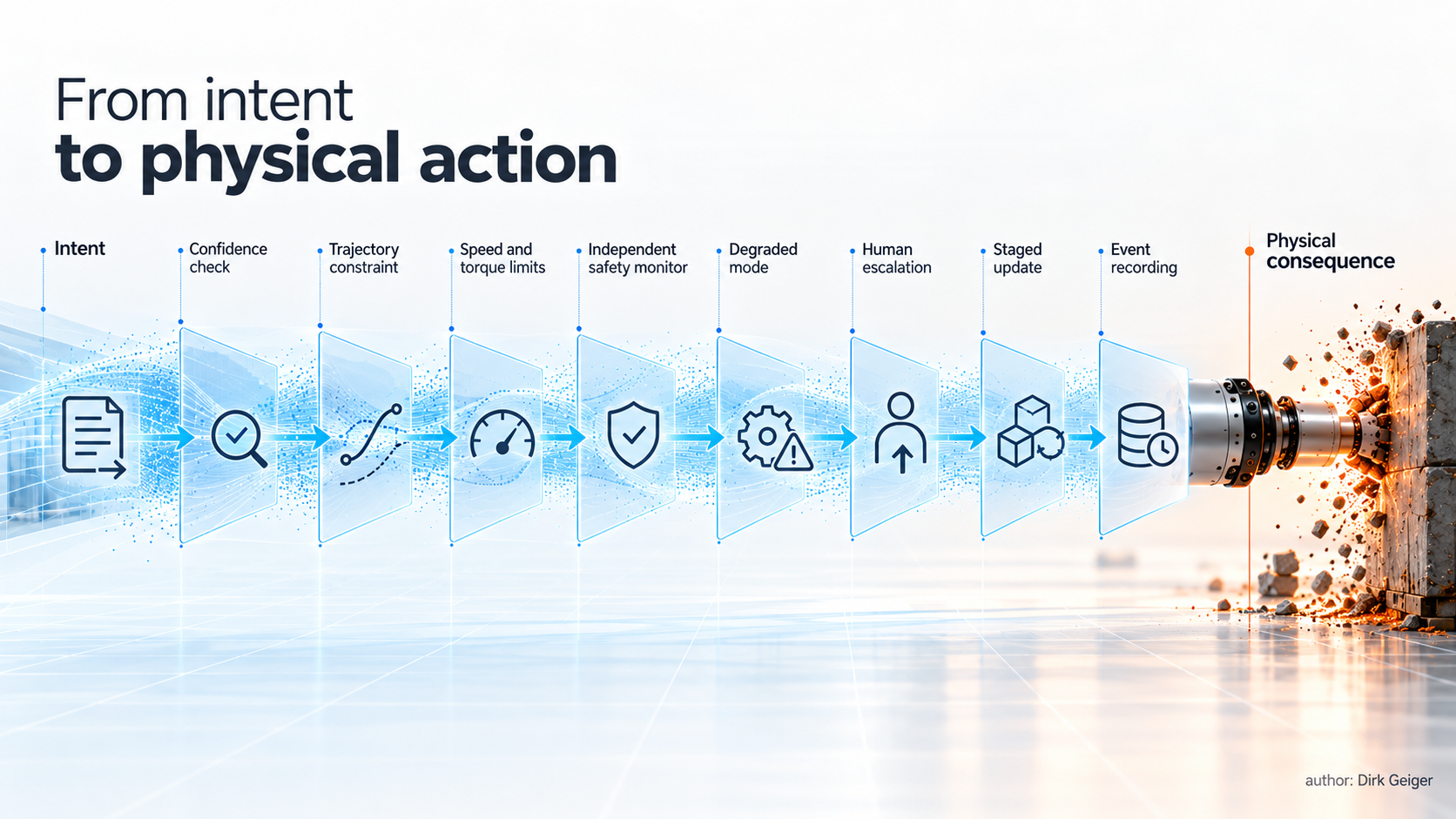
A command can be checked before execution. A trajectory can be constrained. Torque can be limited. Speed can be reduced. A grasp can be released. A degraded sensor can trigger restricted operation. A questionable software release can be stopped before fleet rollout. A robot can request human assistance. A subsystem can fail independently. A near miss can be recorded before it becomes an accident.
These mechanisms create reversible decision points while reversal is still physically meaningful. The visual below captures the architecture: multiple chances to constrain, degrade, escalate or stop before energy crosses into consequence.
Reversibility belongs upstream of action.
The real objective is controlled consequence
Humanoids will never operate in a perfectly known world. Sensors are imperfect. Components age. Networks fail. People move unpredictably. AI models encounter conditions their designers did not anticipate.
Engineering therefore has to control the consequences of uncertainty.
The central question becomes: How do we give the robot useful physical agency while keeping the consequences of uncertainty bounded?
That question reaches from foundation models to sensors, MCUs, communication links, power electronics, actuators and mechanical structures. It continues through manufacturing, deployment, software updates, service and decommissioning.
The strongest Physical AI systems will know when confidence is insufficient. Their architecture will limit the effect of wrong decisions. Their hardware will detect and contain faults. Their software will preserve evidence. Their updates will respect the machine they modify.
Intelligence makes a humanoid capable. Controlled consequence makes it deployable. And every designer still faces the same physical constraint: once the robot acts, the world keeps the result.