South America’s New Hazelnut Geography
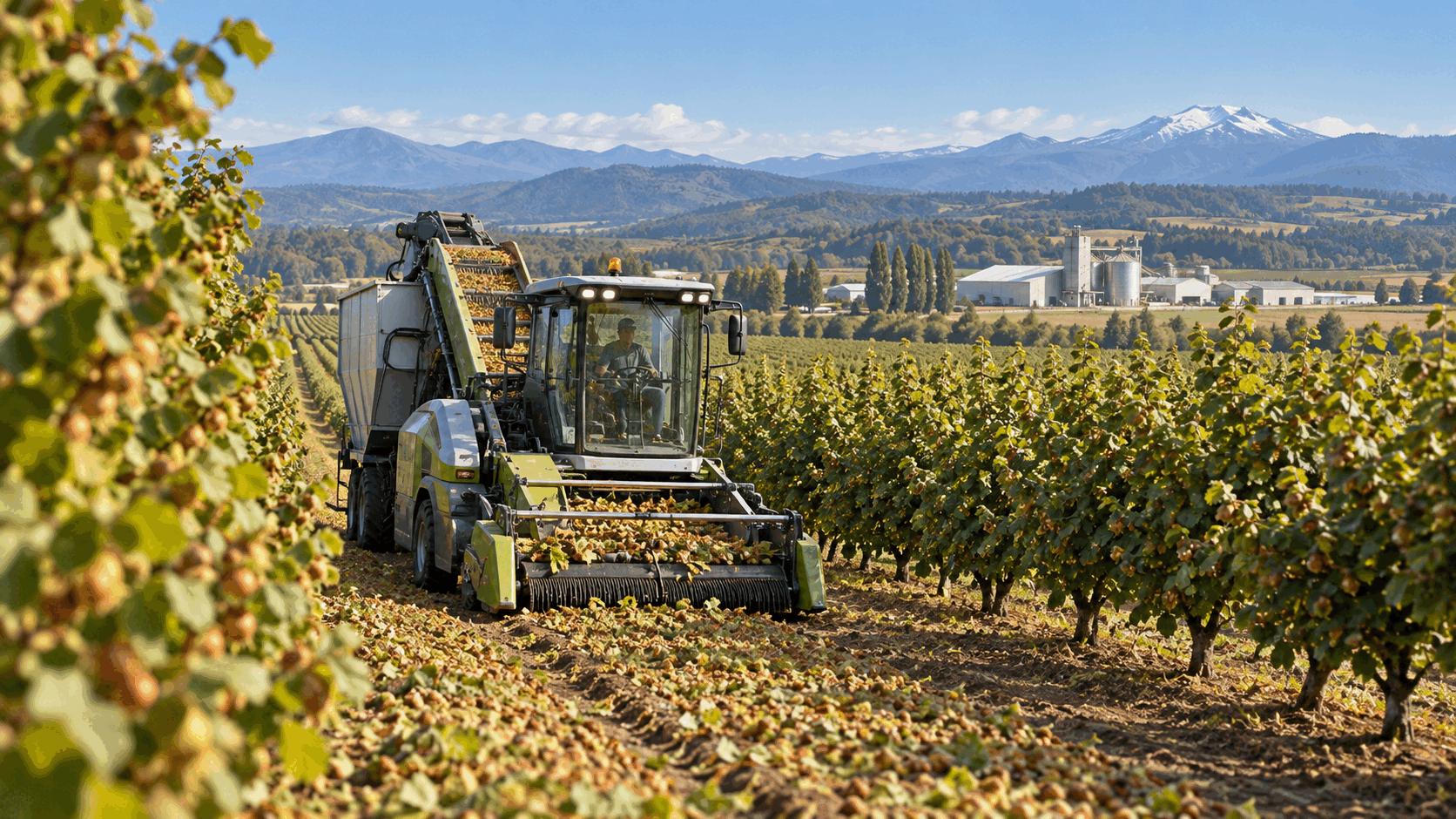
At harvest, a mature hazelnut orchard sounds less like a traditional grove than a mobile production line. Sweepers gather fallen nuts into clean rows. Harvesters lift them from the soil. Trucks carry the crop toward drying and processing. The biology still sets the calendar, yet the rhythm of the work increasingly belongs to machines.
Chile has given that scene strategic weight. European hazelnut, Corylus avellana, has moved from a specialist crop into one of the country’s largest fruit plantings. The ODEPA-CIREN 2025 estimate records 49,264 hectares, up from 24,430 hectares in 2020. Hazelnut consequently ranks second among Chilean fruit species by planted area, behind cherry. The official table combines regional surveys from different update years, so the national figure is best understood as a consolidated estimate with a clear structural signal: planted area has roughly doubled in five years.
South America’s commercial story is therefore strongly Chilean. Other countries have orchards, growers and market activity, but the authoritative evidence reviewed does not support presenting Argentina, Uruguay or Brazil as comparable industrial production clusters. Chile has assembled the ingredients that turn acreage into an industry: suitable temperate zones, export logistics, processor investment, technical support and a growing base of experienced farms.
The frontier is now operational. The first phase established a Southern Hemisphere supply base. The next phase will make the orchard more measurable: rows referenced to digital maps, plants observed individually, field operations assigned by software and machines supervised as a coordinated fleet. Progress will arrive task by task. Ground harvest already suits heavy mechanization; scouting, sucker control, pruning and disease diagnosis are moving at different speeds.
The Chilean Production Corridor
Chile’s hazelnut belt stretches through the temperate centre-south. AgriChile describes activity across the value chain from Maule to Los Lagos, with orchards and facilities in key production zones. The practical corridor includes Maule, Ñuble, Biobío, La Araucanía, Los Ríos and Los Lagos—a long geography in which winter chill, drainage, soil structure, water availability, frost and harvest-season rain vary sharply.
This diversity offers room for expansion and demands local judgement. A site that accumulates adequate cold may still carry waterlogging risk. A productive inland block can face frost exposure. A southern orchard may gain water security while encountering wetter pollination and harvest windows. Orchard establishment fixes much of that exposure for decades, which makes agroclimatic zoning, drainage design and variety-pollinizer selection strategic investment decisions.
The risk became tangible in 2026. INIA reported that intense July and August rain saturated soils and coincided with pollination. Its specialists warned of root-disease pressure and a possible production reduction near 30% in affected productive orchards for the following season. They also identified increasing rainfall constraints from La Araucanía southward and called for hazelnut-specific agroclimatic zoning. The number is an expert projection, not a completed harvest count, yet the mechanism is clear: rain can remove viable pollen from the air and leave a biological deficit that becomes visible only months later as empty nuts.
Southern Hemisphere timing still creates a strategic advantage. Chile complements traditional Northern Hemisphere origins with a different harvest window and has built processing capacity close to the crop. Seasonality broadens supply options for global buyers; climate resilience determines how reliably the country can use that position.

Area, Production and Trade
Planted area is the cleanest measure of long-term intent. ODEPA’s national estimate rises from 24,430 hectares in 2020 to 49,264 hectares in 2025 and reports a five-year average annual growth rate of 15.1%. Hazelnut trees need several years to reach meaningful production, so every planting wave creates a delayed flow of volume. The acreage curve is a pipeline.
Production figures deserve a separate label. In September 2026, an INIA specialist described Chilean output as having moved from roughly 120,000 tonnes toward a projection of 140,000 tonnes, while warning that exceptional rain during pollination could cut the subsequent crop. These estimates capture industry direction and current uncertainty; they do not constitute a final national harvest census.
Trade provides a firmer view of processed product. World Bank WITS, using UN Comtrade data, records Chilean exports of 21.66 million kilograms of shelled hazelnuts in 2024, valued at about US$230.45 million. Italy led the destinations, followed by Germany, Canada, Brazil and Mexico. This is HS 080222 trade in shelled hazelnuts. It cannot be converted directly into farm production because the figures exclude shell weight and do not cover every product form.
Current-season data point in the same direction. ODEPA’s March 2026 bulletin reported that hazelnut export value from September 2025 through February 2026 was 59% above the comparable prior-season period. ODEPA also cautions that fruit export values may be adjusted after declaration. Across these different measures, the durable conclusion is modest and strong: Chile has accumulated enough orchard area, processing investment and export volume for hazelnut to function as a material national industry.
How the Orchard Produces a Crop
A commercial hazelnut orchard is a long-lived biological factory whose layout is decided before its operating data exist. Site preparation, drainage, irrigation architecture, row spacing, cultivar choice and compatible pollinizers shape decades of performance. European hazelnut is wind-pollinated, and its winter flowering makes pollen movement highly exposed to rain and local microclimate.
The annual operating cycle mixes horticulture with disciplined floor management. Irrigation and nutrition support growth. Mowing, weed control and cover crops manage competition and soil conditions. Basal suckers must be controlled because they draw resources and obstruct access around the trunk. Pruning maintains productive structure. Pest and disease surveillance runs across the season, followed by preparation of the orchard floor before the nuts fall naturally.
That last biological step explains the crop’s affinity with machinery. Harvest does not require a robot to identify and pick every nut in the canopy. The tree releases the crop. Growers prepare a sufficiently level, clean surface; sweepers or blowers consolidate the fallen nuts; harvesters collect the windrow. Cleaning and drying then stabilize the material for storage and processing. The ground is part of the machine.
This creates a useful systems trade-off. Vegetation can protect soil and support trafficability or ecological objectives, while excessive growth interferes with collection and raises foreign-material loads. A bare, compacted floor may simplify harvest and create other agronomic costs. Better management will join these variables: soil cover, moisture, machine passage, nut recovery and downstream cleanliness. The orchard cannot be optimized as isolated operations; each decision alters the next one.
From Orchard Floor to Global Value Chain
The value chain begins years before the first commercial harvest. Nurseries supply plant material. Growers commit land, water, infrastructure, machinery and agronomy. Contractors and equipment companies provide crop-care and harvest capacity. Once nuts leave the floor, the business changes character: horticulture becomes industrial handling.
Collected nuts are cleaned and dried to control moisture and preserve quality. They can move in shell or be cracked into kernels. Processing then adds a sequence of value-protection steps: calibration, shell separation, defect removal, optical sorting, roasting, blanching, chopping and grinding. Kernels, granules, pastes and oil become ingredients for manufacturers. Each transfer creates a quality decision and a traceability event.
Chile is unusual because a major global end user is embedded in the producing system. AgriChile reports operations across the value chain and relationships with nearly 700 growers. In 2024, Ferrero opened a second processing plant at Ñiquén. The company reported a US$75 million investment, 7,000 square metres and initial in-shell capacity of 40,000 tonnes, more than doubling its previous local processing capacity. Those figures describe company investment and rated initial capacity, not national throughput.
The physical flow is increasingly shadowed by a data flow: orchard block, harvest date, moisture, dryer settings, quality grade, processing lot and customer destination. Good traceability protects food quality, supports investigations and makes operational learning possible. Field robotics attracts attention, yet drying control, optical sorting, handling automation and batch identity can preserve just as much economic value.
Where Hazelnuts End Up
Confectionery sits at the economic centre of hazelnut demand. Whole and chopped kernels enter chocolate, pralines, biscuits, bakery products, cereals and snacks. Roasted kernels are sold directly. Ground nuts become pastes and spreads; oil serves food and specialty applications. Shells and processing residues can support lower-value material or energy uses when local volumes and economics justify the route.
Chile’s destination pattern links the crop to international food-processing networks. WITS data for 2024 place Italy first among buyers of Chilean shelled hazelnuts, followed by Germany, Canada, Brazil and Mexico. ProChile had already identified Italy, Germany and Brazil as leading national markets in its 2023 trade view and highlighted the emergence of semi-finished ingredients such as granules and paste.
Value therefore depends on more than harvested tonnage. Kernel size, uniformity, moisture, flavour, defects, rancidity, foreign material and food-safety performance determine what a buyer can make and how confidently it can run a line. A grower carries weather and agronomic risk for most of the season; poor drying or handling can destroy that accumulated value in hours.
This is why automation after harvest matters. Sensors can track moisture and temperature. Optical systems can classify kernels and reject defects. Controlled material flow can reduce damage and contamination. Lot-level identity can connect a customer complaint or quality premium back to a block and operating window. The most valuable digital twin in the chain may be a humble batch record that follows the nut from orchard to ingredient.
Automation Today: Mechanized Is Not Autonomous
Hazelnut farming already contains serious machinery. Tractors mow and spray. Sweepers form windrows. Harvesters collect nuts from prepared floors. Cleaning, drying and processing lines automate material movement. Ferrero describes its Ñiquén facility as using advanced automation and safety technology. These systems replace heavy and repetitive labour at defined steps.
Autonomy adds a different capability: a machine perceives its situation, selects or executes an action within defined limits, and handles normal variation with limited direct control. A tractor-mounted sprayer mechanizes application while a person still steers, decides where to treat and responds to obstacles. A harvester removes manual collection work while relying on an operator, prepared terrain and upstream decisions about timing.
No single percentage can describe “automation” across a Chilean orchard. Maturity belongs to the task. Ground collection is strongly mechanizable. Irrigation scheduling, weather monitoring, satellite or UAV imaging and GNSS guidance are commercially accessible. Per-tree diagnosis, selective treatment and autonomous row navigation are emerging. General robotic pruning and unattended whole-farm operation remain harder because branches, terrain, weather and exceptions vary continuously.
The practical progression is visible: first reduce manual effort, then add sensing, then close a bounded decision loop, and finally coordinate several machines through one operating model. Each step must preserve agronomic quality and prove productive hours over a season. A machine that works beautifully for an afternoon demonstration has shown technical promise. A machine that completes its assigned hectares through dust, mud, foliage and maintenance cycles has started to show commercial value.
Robotics Enters the Orchard
The clearest glimpse of the next phase comes from hazelnut-specific research. Lippi and colleagues demonstrated an autonomous architecture for sucker management in a full-scale Italian orchard. Their ground robot used an RGB-D camera and machine vision to detect suckers at individual plants, reconstruct them in three dimensions, estimate treatment need and apply a selective spray. The 2024 field result shows a complete perceive–decide–act loop under orchard conditions. It remains research evidence, not proof of broad commercial deployment.
Remote sensing is developing the orchard map that such machines need. A 2023 study used UAV photogrammetry to reconstruct individual hazelnut canopies and estimate geometric characteristics in an intensive orchard. In 2026, another research team reported a data-driven framework for identifying nutritional deficiencies from leaf images, using real-orchard datasets and a pipeline intended for onboard robotic monitoring. These projects shift attention from the field average to the individual plant.
The enabling stack looks familiar to mobile-robot engineers: localization, cameras, depth sensing, edge compute, machine-learning inference, electric drives, energy storage, wireless links, safety functions and rugged electronics. Agriculture then adds its own specification sheet—dust, water, vibration, mud, branches, variable sunlight, sloping ground and long distances from technical support.
The near-term orchard robot will likely be compact, slow and useful across several jobs. A carrier that scouts rows, maps tree condition and accepts mowing or selective-treatment modules can spread its capital cost across more of the year. Human agronomists remain responsible for thresholds, treatment choices and unusual symptoms; technicians keep the fleet available; operators supervise exceptions. The intelligence moves closer to each tree while accountability stays visible.
The 2031–2036 Orchard
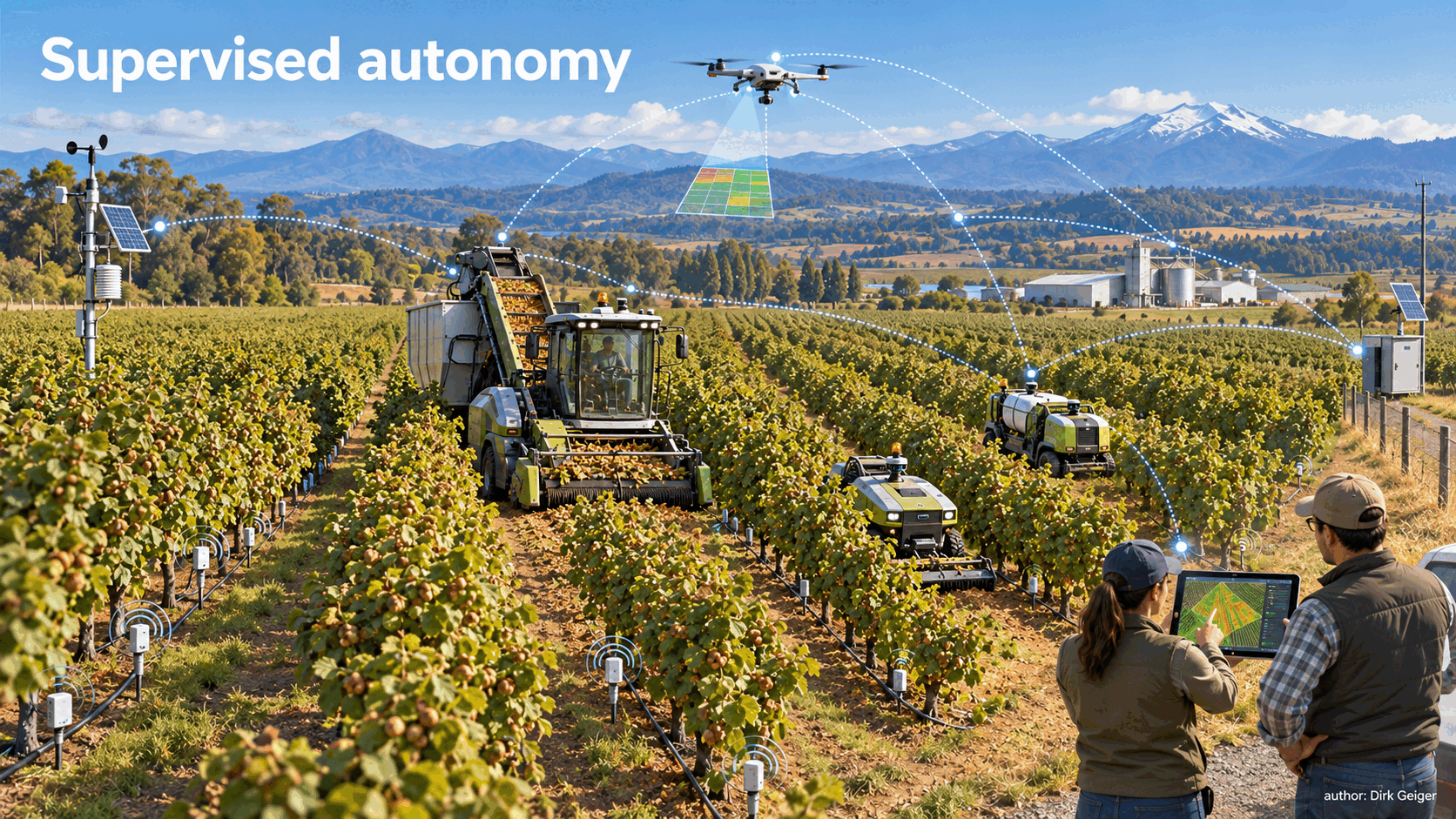
By the early to mid-2030s, a large, well-designed orchard could maintain a persistent digital identity for every row and tree. GNSS-referenced maps would anchor observations from weather stations, soil sensors, UAV surveys and ground platforms. The system would know what was seen, where it was seen, when it changed and which operation followed.
Routine work could be generated as spatially precise assignments. A scouting rover flags abnormal canopy development. Software combines imagery with irrigation and weather history. An agronomist approves a targeted inspection or treatment. A compact machine visits the affected trees, records the action and returns evidence of completion. Mowing, selective sucker treatment and some logistics offer similarly bounded loops. Irrigation and fertigation can respond more directly to measured conditions while remaining constrained by water plans and agronomic limits.
Harvest will retain the crop’s natural advantage: gravity delivers the nuts to the floor. Better localization, perception and fleet coordination can improve coverage and reduce missed areas. A coordinated harvester, sweepers and transport units could share status with a drying line so collection rate matches available intake and moisture risk.
The decisive change is orchestration. Individual machines automate jobs; an orchestrated orchard determines what work is required, assigns it, checks completion and stores the result. That operating model needs interoperable data, reliable positioning, cybersecurity, clear machine authority and a common spatial map.
Full lights-out farming remains an aggressive expectation for this horizon. Storm damage, blocked equipment, unusual disease patterns, repairs and quality exceptions create a long tail of judgement calls. Supervised autonomy offers a more credible destination: fewer repetitive operator-hours per hectare, more productive machine-hours and people managing agronomy, fleets and exceptions.
Economics, Constraints and the Adoption Test
Agricultural robotics succeeds through utilization. Hazelnut operations are seasonal, and a dedicated machine that works for only a few weeks carries its cost through the rest of the year. Viable models will combine low capital cost, several compatible jobs, contractor ownership, fleet sharing or robotics-as-a-service. Modular carriers have an economic advantage when one platform can scout, mow, spray selectively and transport tools across the season.
Orchard design determines how much autonomy a farm can absorb. Consistent rows, mapped utilities, manageable slopes, predictable headlands, robust drainage and controlled vegetation simplify machine perception and motion. Charging or refuelling points, connectivity and safe service access matter as well. An orchard planted today can be prepared for machines that may arrive years later. Automation readiness begins with civil works and agronomy.
Climate sets the outer boundary. INIA’s 2026 warning shows how rain during pollination can reduce yield before any robotic intervention has leverage. Sensors improve awareness, drainage reduces exposure and better forecasts support decisions; none can recreate a failed biological event. Technology must strengthen resilience around the crop’s physiology.
Autonomy also introduces dependencies on positioning, software, sensors, connectivity, cybersecurity, spare parts and technical service. Farms exchange some repetitive labour for a different skills base. Commercial systems need manual fallback, understandable alerts and graceful degradation when a sensor is dirty or a network disappears.
The adoption test can be stated plainly: productive hectares per season, total cost per hectare, input saved, crop or quality response, availability and time to recover from failure. A technically elegant robot earns its place only when these measures improve the farm’s economics without adding unacceptable agronomic or operational risk.
The Orchard Becomes a System
South America’s industrial hazelnut story is currently centred on Chile. Nearly 50,000 hectares in the official 2025 estimate, substantial shelled exports and dedicated processing capacity show a crop that has passed the experimental stage. The next constraint is the quality of execution across a fast-growing production base.
Mechanical harvest already offers the central lesson: the strongest automation aligns machine design with crop biology. Hazelnuts fall naturally; farms prepare the surface and organize collection around that event. Precision sensing, per-tree data and selective treatment can extend the same logic across the production year. Machines become most useful when the orchard, workflow and data model are designed with them.
The proposition for the next decade is measurable. Large operations designed for supervised autonomy should be able to reduce repetitive operator-hours and selected inputs per hectare while increasing the spatial and temporal resolution of crop management. The result must be tested in cost per tonne, quality, availability and yield response. Scale alone will not create the benefit; disciplined integration will.
The orchard is becoming a coordinated production system. Trees remain living assets exposed to weather, soil and time. Around them, a growing layer of sensing, software, processing and robotics can make decisions more precise and work more repeatable. Chile’s hazelnut corridor offers an unusually clear proving ground: a young industry with expanding acreage, established mechanization and enough scale to turn agricultural autonomy from a demonstration into an operating model.