Executive summary
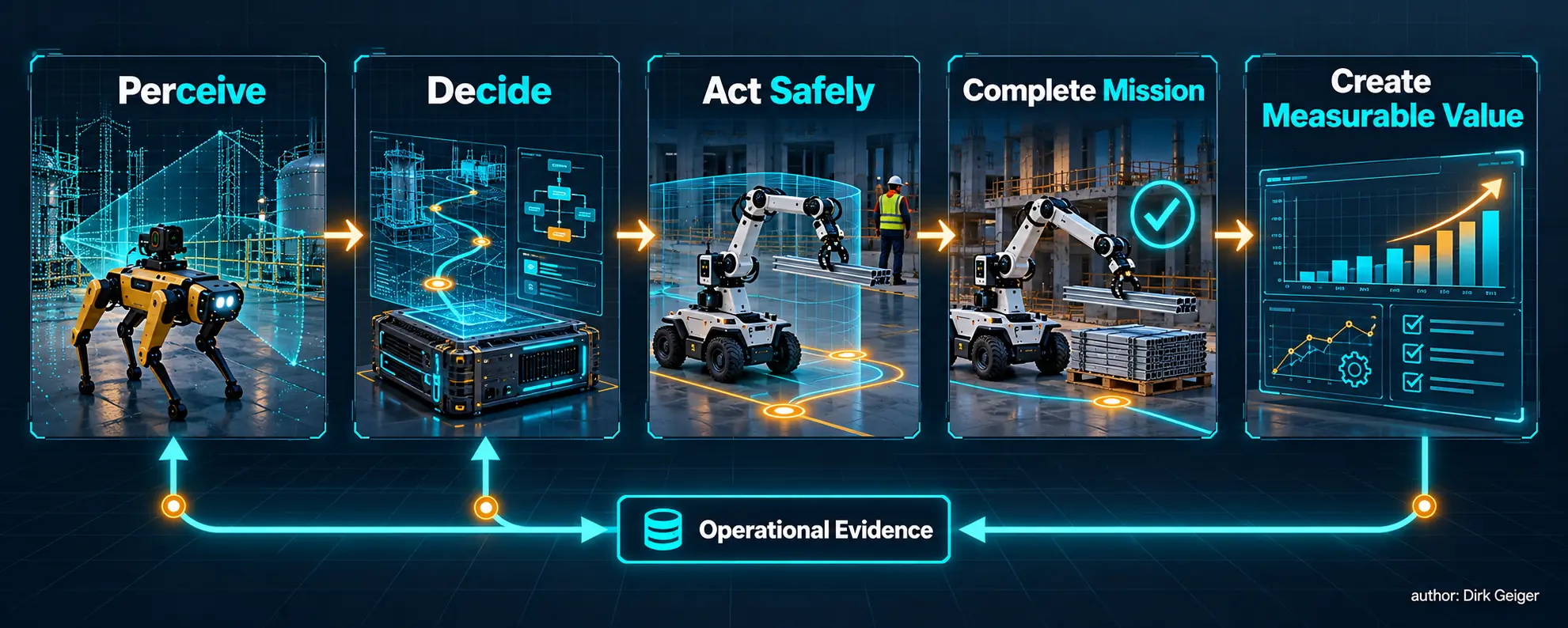
Physical AI becomes economically meaningful when perception, reasoning and controlled action complete a useful mission in the physical world. The impressive movement is only the visible tip. Value is created when the full operating loop works: the task is released, the environment is understood, the object is handled, exceptions are contained, evidence is recorded and the next task starts on time.
The strongest near-term opportunities are missions with high utilization, measurable outcomes and bounded variation. Internal logistics, machine tending, inspection, material movement and selected hazardous operations already fit that pattern. Construction, healthcare, retail, hospitality and the home contain valuable missions too, yet their environments, safety obligations and exception rates often demand tighter scope, more supervision or purpose-built infrastructure.
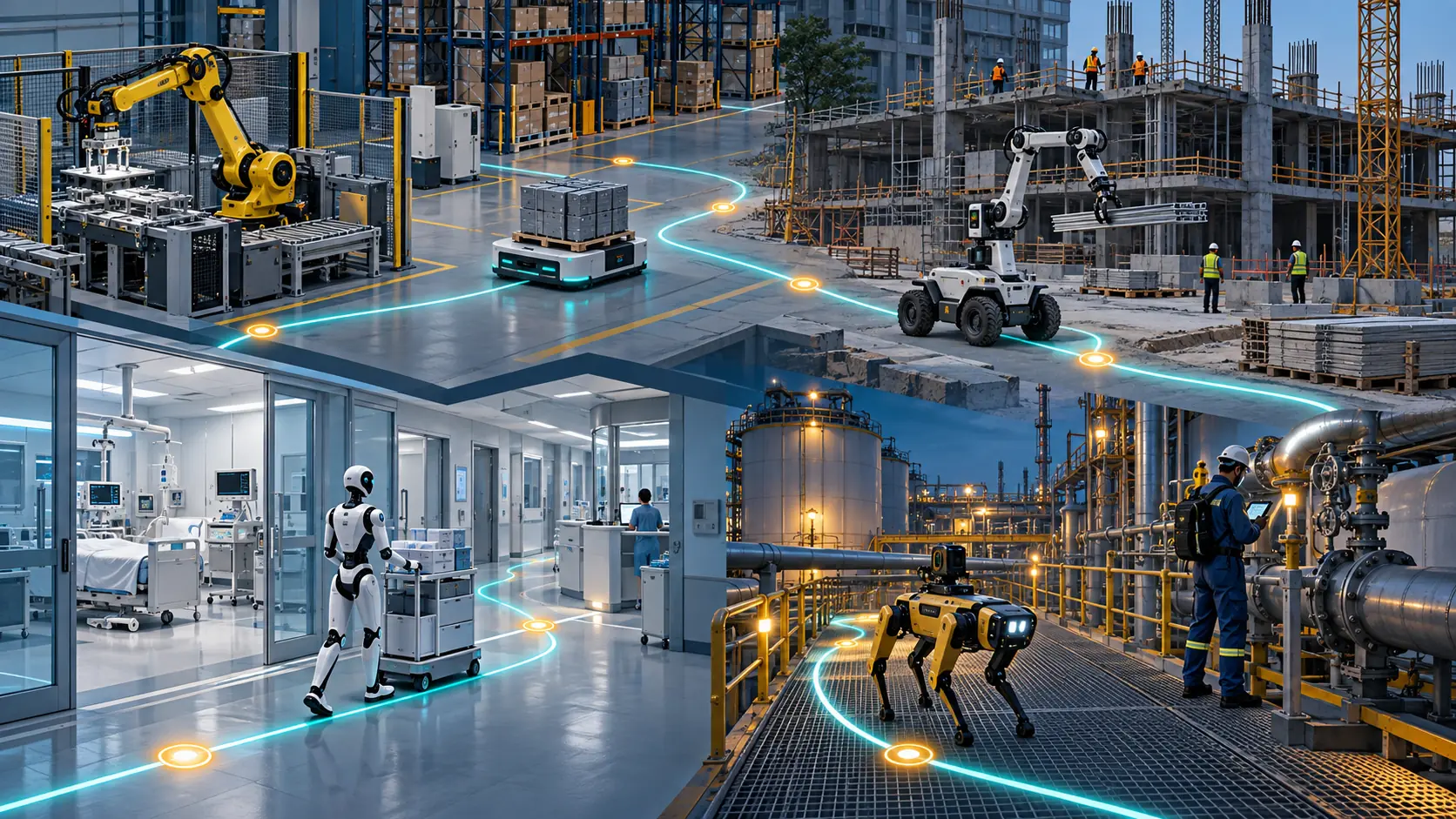
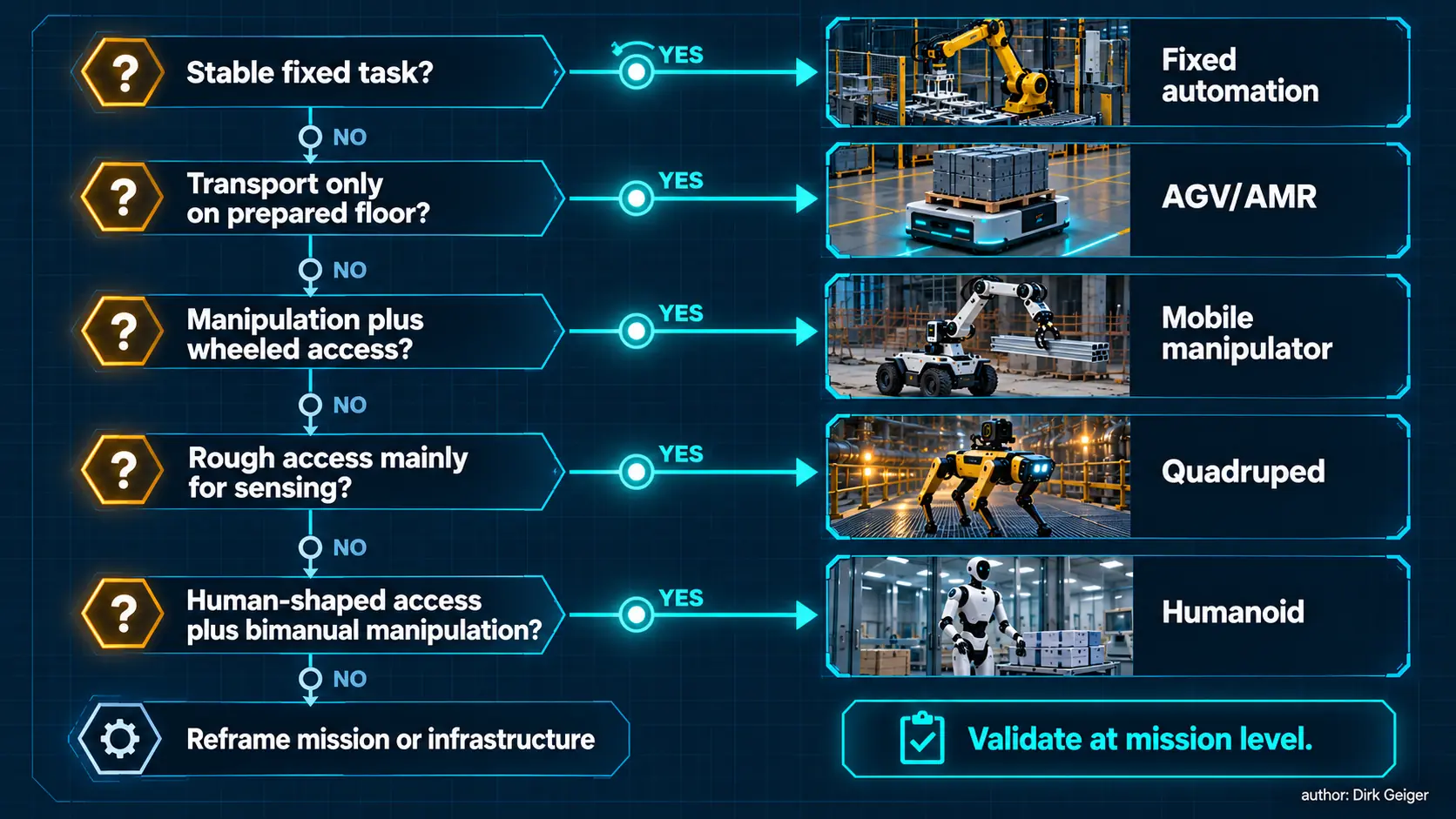
No single robot form factor wins the entire portfolio. Fixed automation dominates stable, repetitive processes. Autonomous mobile robots excel at transport across prepared facilities. Mobile manipulators add pick, place and machine interaction. Quadrupeds create access for inspection across stairs, uneven terrain and constrained passages. Humanoids earn their complexity where human-shaped access, two-handed manipulation and movement across human infrastructure are jointly required. A humanoid used only to carry totes on a flat floor is usually an expensive answer to a mobile-base problem.
The decision rule is practical: select the least complex system that can achieve the required outcome at the required availability, safety and lifecycle cost. Demonstrations should therefore be converted into controlled operational evidence. The proof is a sustained shift, week or campaign in which intervention, recovery, charging, maintenance and integration are measured alongside successful task completion.
The capability-to-value map below captures the full chain. A weakness at any link can prevent technical capability from becoming a completed mission, and operational evidence feeds directly into the next cycle of perception and decision.
The mission is the unit of value
A robot is bought as hardware and paid back as completed work. That difference is decisive. A technically capable machine may still produce weak economics if it waits for doors, fixtures, network access, charging slots, approvals or human rescue. Conversely, a modest platform can create strong value when the surrounding process is designed for it.
A mission is a bounded operational promise: move these materials from release point to destination; inspect these assets and escalate anomalies; load this machine within its cycle window; prepare these rooms to an agreed standard. Each mission has a start condition, completion evidence, exception policy and accountable owner. This makes value measurable before a procurement discussion becomes a debate about morphology or artificial intelligence.
Physical AI expands the feasible mission envelope by helping systems perceive variation, interpret context and adapt action. Its economic contribution is the additional useful variation that can be handled without unacceptable supervision, delay or risk. That value must exceed the costs introduced by more sensing, computing, validation, energy consumption and operational complexity.
Three outcome families capture most credible benefits:
- Flow: throughput, cycle time, schedule adherence, travel eliminated and asset utilization.
- Quality: first-pass yield, inspection coverage, consistency, traceability and rework avoided.
- Risk and capacity: hazardous exposure removed, scarce labor amplified, ergonomic burden reduced and operating hours extended.
The attractive mission usually improves more than one family. A robot inspecting a hazardous facility can increase coverage, protect people and build a repeatable evidence trail. A warehouse transport robot may improve flow and reduce walking while leaving dexterous handling to people. Benefits should remain separately measured so that one optimistic assumption cannot carry the whole business case.
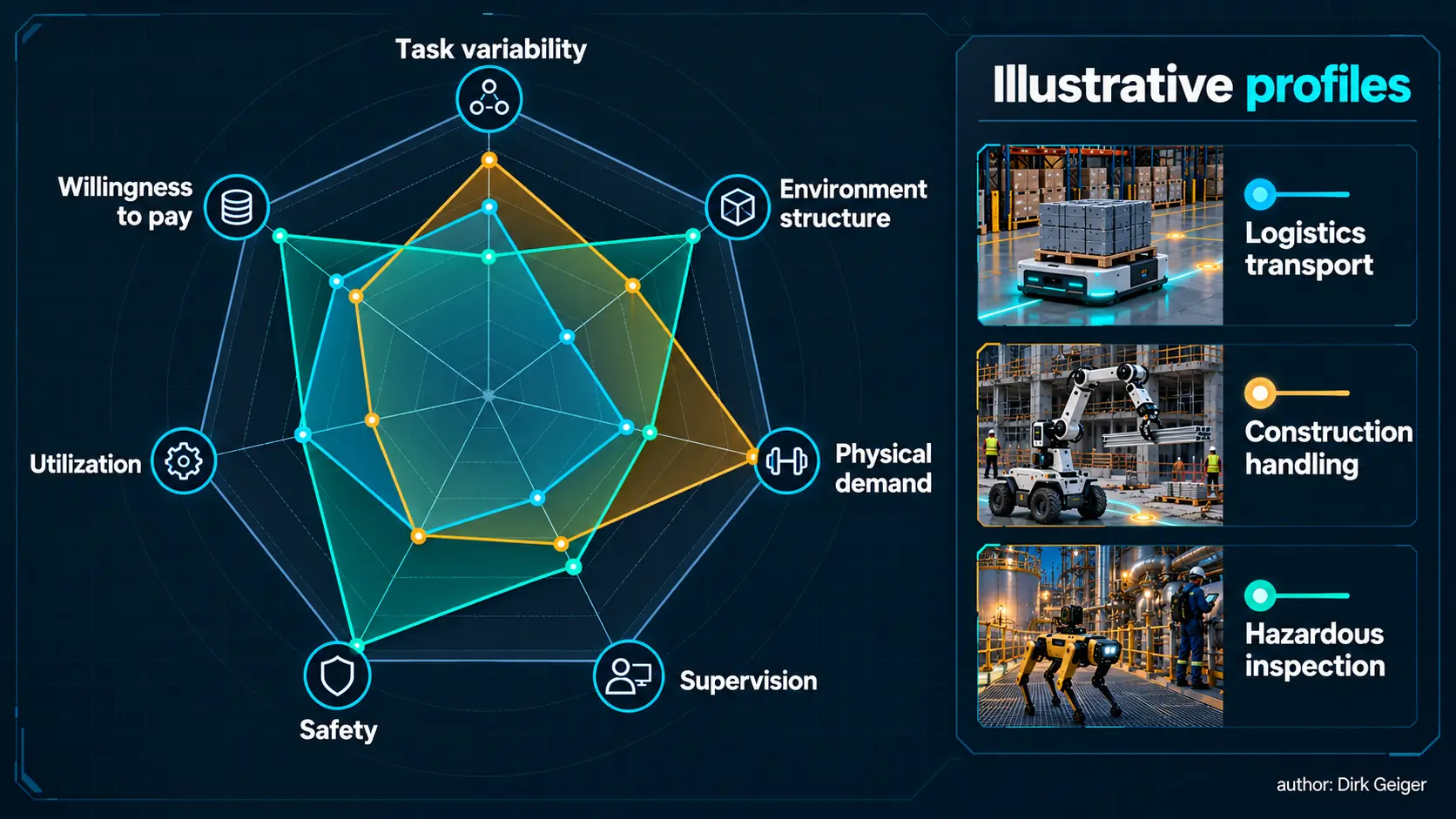
A seven-factor portfolio lens
Use cases become comparable when scored against the conditions that shape technical feasibility and economic durability. A seven-factor lens prevents enthusiasm for a polished demonstration from obscuring the operating reality.
| Factor | Question | Evidence to collect |
|---|---|---|
| Task variability | How many objects, sequences and exception classes must be handled? | Variant count, long-tail frequency, changeover time, unsupported cases |
| Environment structure | How stable are geometry, traffic, lighting, surfaces and interfaces? | Map change, obstruction rate, localization loss, human interaction density |
| Physical demand | What payload, reach, force, precision, mobility and endurance are required? | Duty-cycle distributions, peaks, thermal margin, energy per completed mission |
| Supervision | How much human attention is needed to keep work moving? | Interventions per hour, remote-assist minutes, recovery duration, staffing ratio |
| Safety and assurance | What can be harmed, and what evidence is required before deployment? | Hazards, operating modes, protective measures, residual risk, incident precursors |
| Utilization | Can the asset perform valuable work often enough? | Productive hours, queue time, charging time, availability, seasonal demand |
| Willingness to pay | Who owns the outcome and captures the benefit? | Budget owner, avoided cost, service level, risk value, payback threshold |
The factors interact. High variability is manageable in a structured environment with simple physical demands. Heavy payload is manageable in a fenced cell with purpose-built tooling. Human proximity can be acceptable when speed, force, separation and behavior are controlled. Portfolio scoring should therefore record dependencies and hard constraints, capture the relationships among the seven ratings.
A useful first filter classifies every assumption as observed, measured, contracted or estimated. The discipline is simple: confidence in the investment cannot exceed confidence in the assumptions that dominate it.
The seven-factor mission profile below makes those dependencies visible. Its shapes are illustrative decision aids, so site teams should replace them with evidence gathered from their own operating conditions.
Choose the least complex embodiment that closes the loop
Embodiment determines where a robot can go, what it can touch and how much complexity must be controlled. More degrees of freedom can widen the task envelope while also increasing cost, energy demand, failure opportunities, validation effort and recovery complexity.
| Platform | Strongest fit | Typical boundary |
|---|---|---|
| Fixed automation | High-volume, repeatable processing with controlled fixtures and predictable parts | Poor economics when variation and reconfiguration dominate |
| AGV/AMR | Transport, towing and material flow across prepared or mapped facilities | Limited value when the mission also requires complex manipulation |
| Mobile manipulator | Transport plus picking, machine interaction or service across several stations | Workspace, stability and integration constrain heavy or highly dexterous work |
| Quadruped | Inspection and sensing across stairs, rough ground and difficult access | Manipulation and payload may be secondary unless specifically equipped |
| Humanoid | Human-shaped spaces requiring bimanual manipulation, reach and mobility through existing infrastructure | Complexity is difficult to justify for narrow, stable tasks served by simpler machines |
NIST work on mobile manipulation highlights why platform combinations require disciplined measurement: coordinating base and arm can support large or complex workpieces, while added freedom introduces performance uncertainty. The right comparison is therefore mission-level performance under representative conditions, including recovery.
Interoperability can change the answer. A standardized cart, machine interface or docking station may allow an AMR or simple mobile manipulator to outperform a general-purpose humanoid. Where infrastructure cannot be changed, a human-compatible body can avoid extensive facility redesign. The trade is between complexity placed in the robot and complexity placed in the environment.
The platform decision tree applies this logic as a first pass. Its final instruction matters most: validate the selected embodiment against the complete mission, including exceptions and recovery.
The use-case portfolio
Manufacturing: value at the boundary between stable processes and changing work
Manufacturing already contains the clearest automation economics. Fixed robots remain compelling for welding, dispensing, high-speed assembly and other stable cycles. Physical AI adds value around the edges: mixed-part handling, machine tending across product variants, flexible kitting, quality inspection and recovery from common disturbances. These missions combine measurable output with data-rich environments and professional maintenance.
Mobile manipulators fit brownfield plants where work is distributed across existing machines. Humanoids become relevant when stations, tools and access were designed for people and cannot readily be converted. Their case strengthens if one platform can cover several low-volume tasks across different shifts. It weakens when each task needs unique tooling, intensive validation or frequent expert rescue.
Logistics: transport is mature; general handling is the next frontier
Transportation and logistics is the largest professional service-robot application class in IFR's 2025 statistics, with 102,900 units sold in 2024. The installed logic is clear: repeatable movement, high utilization and direct flow metrics. AMRs and automated guided vehicles remain the default for horizontal transport. Mobile manipulators extend value into depalletizing, order assembly, trailer or container interaction and exception handling.
Humanoids can address facilities built around human reach and aisle geometry, especially where varied handling and movement are inseparable. The operational proof must include grasp failures, damaged packaging, congestion, battery logistics and the time taken when humans intervene. Nominal picks per hour are only one part of throughput.
Construction: high value, high variability
Construction offers strong motives for robotics: hazardous exposure, ergonomic load, scarce skills and pressure for predictable delivery. It also presents moving layouts, uneven surfaces, weather, dust and changing trades. NIOSH identifies activities such as masonry, demolition and inspection at elevation as candidates for reducing worker risk while emphasizing safe human-robot collaboration.
Purpose-built machines can win in narrow operations such as layout, drilling, demolition or repetitive placement. Quadrupeds suit inspection and progress capture. Mobile manipulators and humanoids may support tool use or material handling when a site is sufficiently prepared. The economic unit should be a work package completed to quality and schedule, with mobilization, setup and weather interruptions included.
Energy: inspection value grows with access and evidence quality
Energy assets create missions around inspection, maintenance preparation, material movement and outage support. The strongest candidates combine expensive access with repeatable evidence: reading instruments, surveying equipment, detecting visible anomalies and carrying tools through defined routes. Quadrupeds and specialized mobile platforms can extend inspection coverage across stairs, grating and outdoor terrain. Manipulation adds value when interfaces and work permits are tightly controlled.
Hazardous work: exposure avoided can dominate labor savings
In nuclear cleanup, mines, chemical facilities and disaster response, the value of distance is substantial. The U.S. Department of Energy uses robotics, remote operation, sensing and AI in high-hazard environmental cleanup. These missions reward robust teleoperation and supervised autonomy alongside higher autonomy. Crawlers, quadrupeds and specialized manipulators often fit access and inspection; humanoids may become attractive where existing controls, ladders, doors and tools must be used.
Risk reduction requires its own economic treatment: dose or exposure avoided, protective preparation reduced, inaccessible area reached, outage time saved and evidence quality improved. A smaller number of missions can justify a specialized system when the alternative is unusually dangerous or expensive.
Healthcare: workflow assistance before broad autonomy
Healthcare combines high willingness to pay for reliable outcomes with demanding assurance, privacy and human factors. Near-term physical AI value is strongest in logistics, pharmacy movement, specimen transport, cleaning support, rehabilitation and controlled procedural assistance. FDA materials underline that computer-assisted surgical systems remain under direct professional control; autonomy claims must be matched carefully to the authorized function and supporting evidence.
Mobile bases and purpose-built devices fit many hospital missions. Manipulation adds value when it is reliable around fragile objects and people. Humanoids may support human-designed spaces, yet trust, infection control, safe contact, availability and clinical integration create a demanding adoption threshold. Staff time released and service reliability matter more than a theatrical resemblance to a caregiver.
Retail: shelf conditions turn simple movement into information work
Retail offers repetitive replenishment, inventory, shelf scanning, cleaning and back-of-house movement. AMRs and specialized cleaning robots benefit from repeatable routes and defined service windows. Mobile manipulators can support tote handling and selected replenishment when packaging, shelf geometry and customer traffic remain within tested limits. Value improves when inventory evidence connects directly with store operations.
Hospitality: service quality includes the recovery experience
Hospitality creates missions in delivery, cleaning, linen movement, simple preparation and facilities support. Mobile platforms suit structured back-of-house routes, while manipulation can expand the task envelope around standardized carts, doors and transfer points. Humanoids may fit mixed duties when safe interaction and manipulation reliability mature.
Public settings magnify exceptions. Children, luggage, spilled liquids, crowds, rearranged furniture and customer questions turn a simple route into a dynamic operating environment. Brand impact belongs in the risk model. A helpful robot creates novelty once; a blocked or confusing robot creates operational work every day. Recovery should therefore protect service quality as visibly as normal operation does.
The home: maximum task diversity, fragmented willingness to pay
The home is physically and semantically diverse. Objects move, surfaces vary, pets and people behave unpredictably, and maintenance support is limited. Single-purpose appliances succeed because the mission is narrow. A general mobile manipulator or humanoid could eventually combine tidying, carrying, appliance interaction and assistance, yet it must do so safely, quietly, privately and at consumer-level lifecycle cost.
Early value is likely to cluster around specific needs with clear sponsors: mobility support, remote presence, carrying, monitoring or repetitive household services. The route to scale runs through reliable task bundles and service models, a bounded set of promised chores.
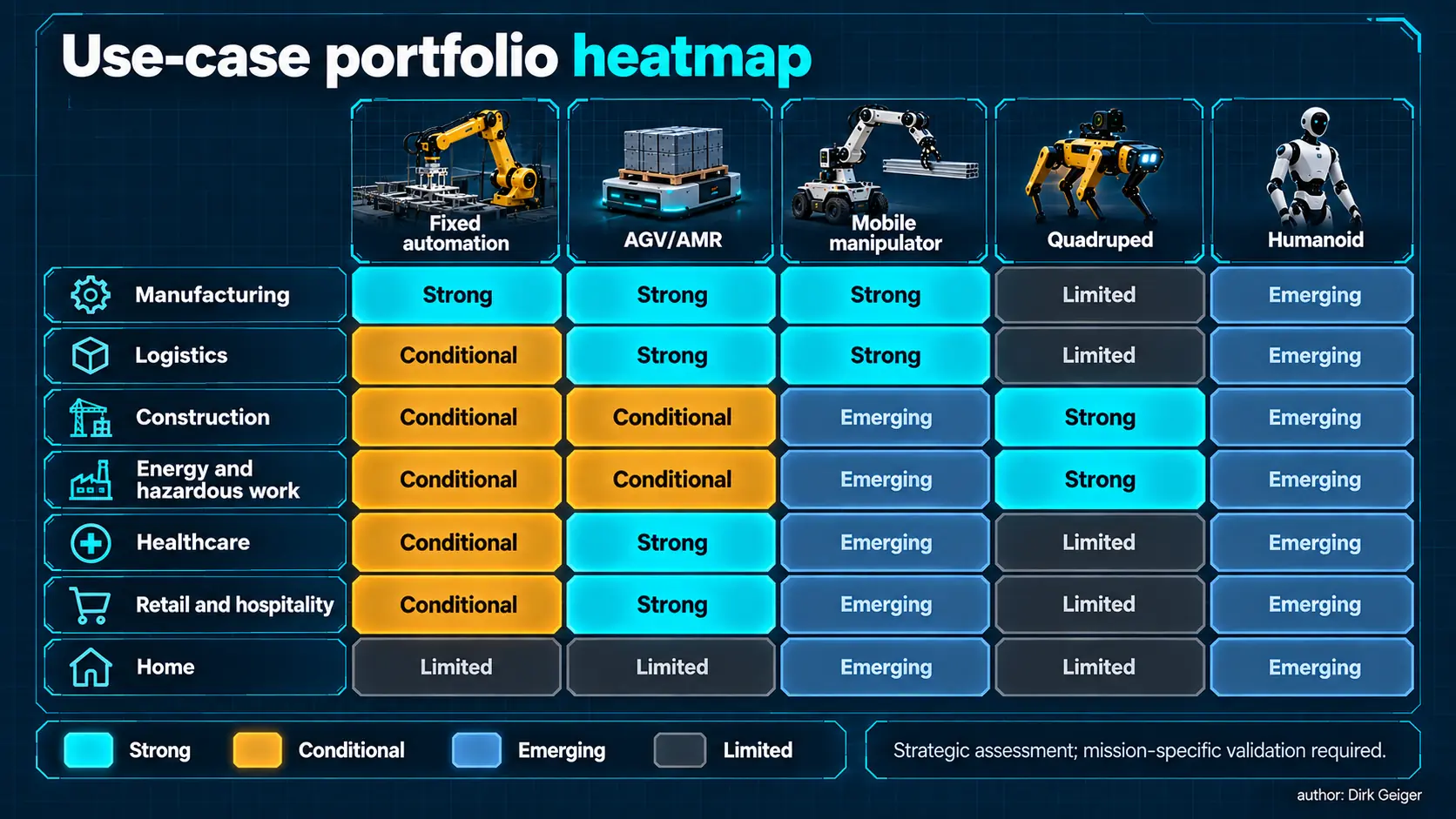
The portfolio heatmap below is a strategic screen, built to expose where platform fit appears strong, conditional, emerging or limited. Every cell remains a hypothesis until the mission is validated with site evidence.
A portfolio view across all nine domains
Portfolio ranking changes when the buyer moves from technical feasibility to operational value. Manufacturing and logistics tend to offer the clearest early scaling paths because processes, ownership and performance data already exist. Hazardous work can support high willingness to pay even at modest utilization because exposure reduction and access have material value. Construction offers substantial impact but requires mission-specific preparation. Healthcare can justify sophisticated systems where outcomes and professional workflows are tightly controlled. Retail, hospitality and the home create large addressable task pools, although fragmented processes and frequent human interaction make unattended operation harder.
The same domain can contain opportunities at every maturity level. In a hospital, autonomous transport between pharmacy and wards may be a scale candidate, mobile manipulation of standardized carts may require industrialization, and general bedside assistance may remain exploratory. In construction, robotic layout or remote demolition may be operationally credible while general-purpose material handling across an unprepared site remains conditional. Sector labels therefore provide context; the mission remains the unit of decision.
Task aggregation deserves deliberate analysis. A versatile robot can improve utilization by switching between missions, yet every added mission introduces tools, validation, training and exception classes. The bundle is attractive when missions share the same environment, interfaces and service model. A morning inspection, midday material-delivery and evening inventory sequence may increase productive hours. A bundle spanning cleanroom handling, outdoor construction and bedside care only shares a machine silhouette.
Economics: measure the operating system, not the robot
Total cost of ownership begins with the robot and continues through integration, tooling, infrastructure, validation, connectivity, charging, remote assistance, consumables, maintenance, software, cybersecurity, insurance and process ownership. The same platform can have very different economics across two sites because one supplies clean interfaces and rapid recovery while the other supplies exceptions.
A decision model should separate five quantities:
- Productive mission output per operating hour.
- Available operating hours after charging, planned service and failures.
- Human attention consumed by supervision, intervention and maintenance.
- Outcome value per completed mission, including quality and risk.
- Full lifecycle cost across the expected deployment period.
A simple annual value equation is useful for transparency:
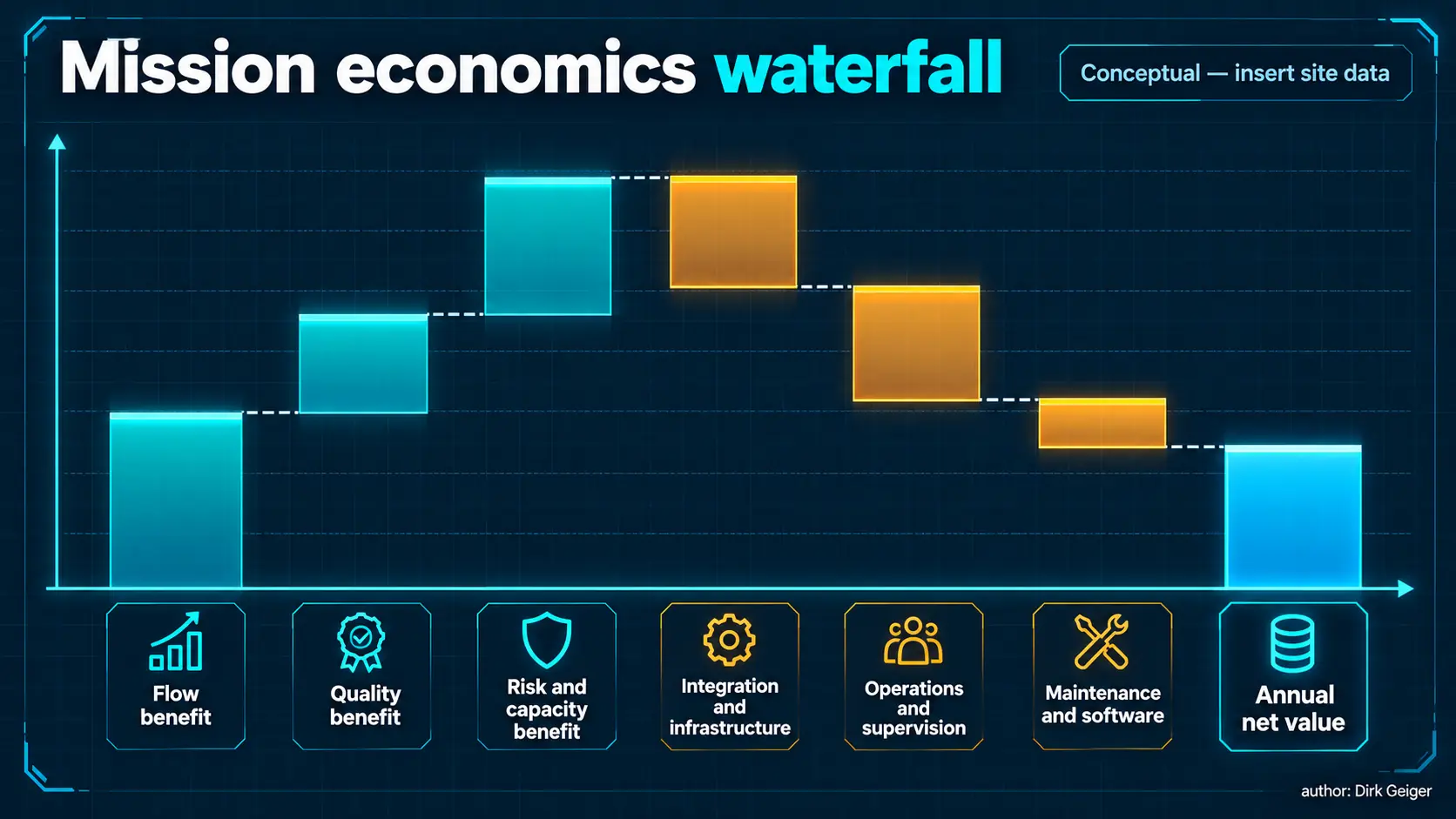
Annual net value = flow benefit + quality benefit + risk/capacity benefit − annualized lifecycle cost.
Each term should carry a confidence range. Intervention demand deserves special attention because it can hide labor inside a remote operations center. If one operator supports many robots briefly, the model may be strong. If one skilled person continuously shepherds each robot, autonomy has shifted the workstation instead of creating scalable capacity.
Utilization also requires care. A robot available for sixteen hours creates no value while waiting for released work. Productive utilization counts time spent on accepted missions. Availability counts readiness. Both matter, and confusing them inflates expected returns.
Sensitivity testing should begin with the variables most likely to move the decision: completed missions per hour, intervention minutes, productive hours, integration effort and service cost. A credible case remains attractive under conservative assumptions and makes the break-even conditions explicit. The economics waterfall below keeps benefits and lifecycle burdens visible without implying generic numerical values.
Infrastructure that converts capability into throughput
Robots operate inside a wider physical and digital system. Fleet orchestration assigns tasks and traffic. Energy infrastructure provides charging without creating queues. Maps, identifiers and machine interfaces make the environment legible. Connectivity carries the traffic whose timing and reliability matter. Cybersecurity protects identities, commands, updates and operational data. Maintenance restores capability before small faults become long outages.
Physical preparation has high leverage. Fiducials, standardized handles, accessible docking points, machine-ready interfaces, clear transfer zones and controlled floor conditions can reduce perception and manipulation uncertainty. Small changes to packaging or fixtures may remove entire classes of failure.
Evidence infrastructure is equally important. A useful deployment records task release, configuration, decisions, interventions, safety events, outcome and recovery. That trace supports improvement, incident investigation and acceptance. The data policy must define purpose, retention, access and privacy, particularly in hospitals, public venues and homes.
Safety is a system property. OSHA describes industrial robot systems as the robot together with end effectors, controls, power, sensors and communication interfaces. ISO 3691-4 similarly addresses driverless industrial trucks and their systems. Deployments should define operating zones, interaction modes, speed and force limits, protective functions, human responsibilities and degraded behavior at the mission level.
The external operating system
At fleet scale, the surrounding infrastructure behaves like an external operating system. It grants task authority, locates resources, schedules energy, manages access, records evidence and coordinates people. Its quality determines whether the robot encounters an orderly sequence of executable work or a stream of ambiguous requests.
Four interfaces should be explicit. The business interface translates orders, maintenance needs or service requests into missions. The physical interface defines transfer points, payloads, tools, doors and docking. The assurance interface defines permissible states, human control, incident response and evidence. The lifecycle interface governs configuration, updates, calibration, spares and retirement. Missing interfaces reappear as manual work during deployment.
Brownfield sites should identify the smallest infrastructure changes with the largest reliability effect. Better lighting, a standardized cart latch, a machine signal, a marked waiting zone or a reliable wireless handover can be worth more than a complex new model. This is disciplined systems engineering: intelligence is spent on valuable variation instead of avoidable ambiguity.
Adoption barriers and evidence gates
Most barriers are connected. Limited reliability raises supervision. Supervision weakens economics. Weak economics reduces fleet scale. Small fleets generate less diverse evidence, slowing improvement. The portfolio owner should break this loop with staged evidence gates.
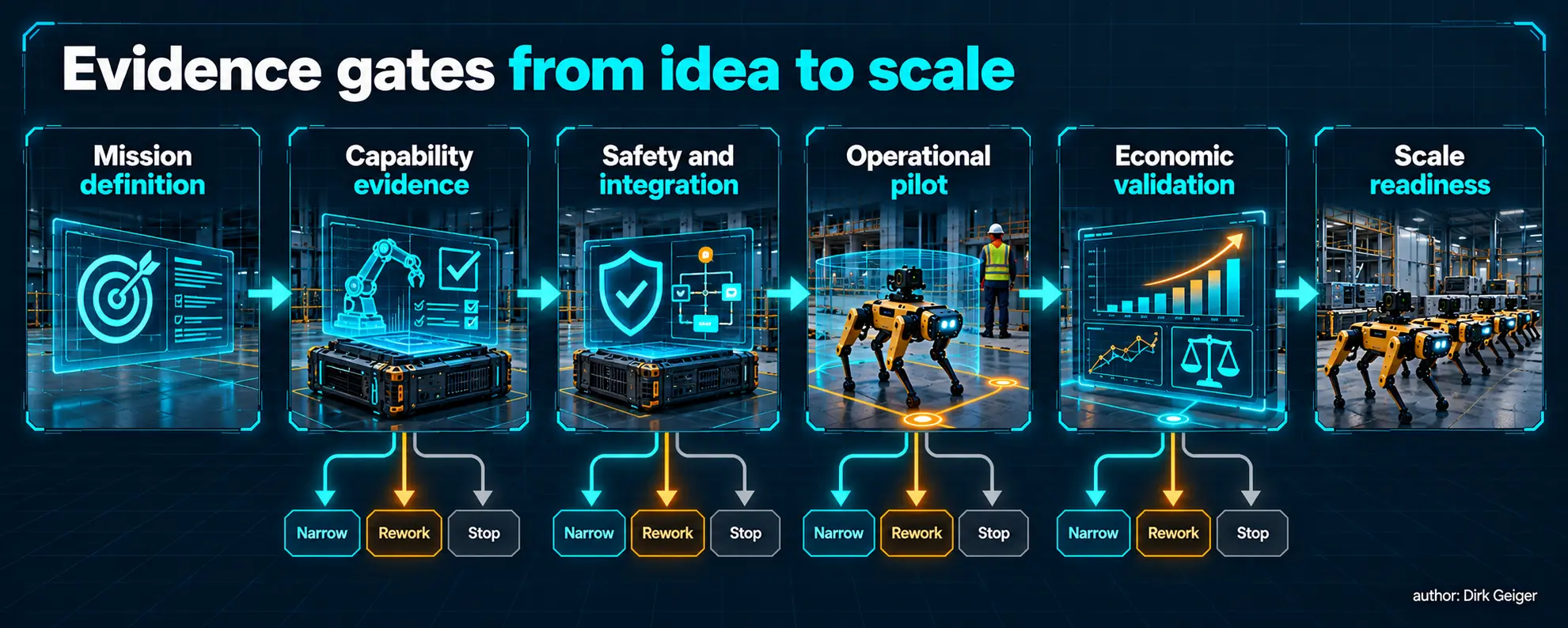
- Gate 1 — Mission definition: outcome, boundaries, owner and baseline are explicit.
- Gate 2 — Capability evidence: representative tasks are completed under controlled variation.
- Gate 3 — Safety and integration: hazards, interfaces, cybersecurity and degraded modes are accepted.
- Gate 4 — Operational pilot: the system runs across representative shifts with interventions and recovery measured.
- Gate 5 — Economic validation: sustained output and full support cost meet the investment threshold.
- Gate 6 — Scale readiness: installation, training, spares, monitoring, update and service processes can be repeated.
The pilot should be designed to fail informatively. Variation must include the conditions expected in operation: mixed objects, occlusion, traffic, depleted batteries, network interruption, shift changes and common equipment faults. A successful test is an evidence set that supports a decision, including a decision to narrow or stop the mission.
Standard test methods help translate claims into comparable capability evidence. NIST develops metrics for mobility, manipulation, perception and contact safety, including mobile-manipulator performance in dynamic and unstructured manufacturing environments. These methods complement site acceptance by improving the language used to connect platform capability with mission requirements.
The evidence-gate sequence below gives governance a visible rhythm. Advancement requires evidence; narrowing, rework and stopping remain valid outcomes when the mission no longer supports its original case.
Failure patterns that distort pilots
Several recurring patterns make pilots look healthier than the future operation. Demonstrations use curated objects while the live process contains damaged packaging and unlabeled variants. Engineers stand nearby and resolve errors before recovery time is recorded. Charging occurs outside the observation window. Network and map conditions are unusually clean. The robot performs the attractive part of the task while people prepare and finish the work.
A representative pilot records the full labor and time boundary. It includes task preparation, consumables, tool changes, blocked routes, rejected work, safety stops, software resets and escalation. It distinguishes assisted success from autonomous completion. It also samples enough operating time to expose low-frequency failures whose economic effect is disproportionate.
Cybersecurity and updateability are adoption conditions, especially where robots connect operational technology, enterprise systems and cloud services. Identity, authenticated software, access control, logging and recovery should be designed before scale. A fleet that cannot be updated or investigated confidently accumulates operational risk with every deployment.
A decision framework for portfolio owners
A portfolio should balance dependable near-term missions with options that expand as technology and infrastructure mature. Four categories keep ambition connected to evidence.
| Category | Definition | Management action |
|---|---|---|
| Scale | Validated mission with stable integration, service and economics | Standardize, replicate and optimize fleet operations |
| Industrialize | Capability works; reliability, recovery or deployment process limits repetition | Invest in interfaces, evidence, serviceability and exception reduction |
| Explore | Strategically valuable mission with unresolved technical or assurance questions | Run bounded experiments with explicit learning objectives |
| Defer | Weak outcome ownership, low utilization or a simpler solution dominates | Monitor enabling conditions and avoid demonstration-led spending |
Platform choice follows mission classification. Compare at least one simpler alternative, including process redesign without a robot. Then test whether value survives conservative assumptions for intervention, availability and integration. Finally, name the trigger that would change the decision: lower hardware cost, higher grasp success, a new safety case, standardized interfaces or sufficient task aggregation.
Portfolio governance should assign one accountable owner to each mission and one review cadence to each category. Scale candidates need operating targets and variance control. Industrialization candidates need named reliability and integration gaps. Explore candidates need learning objectives and spending limits. Defer candidates need a monitored trigger. This keeps capital, engineering effort and operational attention aligned with the maturity of the evidence.
Recommendations
- Build the portfolio around missions. Give every candidate a bounded outcome, baseline, owner, exception policy and measurable completion event.
- Use the least complex viable platform. Reserve general-purpose embodiment for missions that genuinely require its combined mobility and manipulation envelope.
- Design infrastructure with the robot. Treat fixtures, charging, traffic, interfaces, connectivity, security and recovery as part of the solution architecture.
- Price human attention explicitly. Record every intervention and distinguish supervision, remote assistance, maintenance and process work.
- Validate across representative operating time. Require shift-level or campaign-level evidence, not selected task repetitions.
- Value risk and quality alongside labor. Use outcome measures that the operational owner recognizes and can audit.
- Maintain a learning portfolio. Scale proven missions, industrialize promising ones, explore strategic uncertainties and defer use cases whose prerequisites are absent.
Evidence and ambition work best together. Physical AI will widen the feasible frontier. Strong portfolios capture that progress as improved mission economics and a growing set of dependable operations.
A 90-day portfolio action
Decision-makers can establish a credible starting portfolio in one quarter. During the first month, collect candidate missions from operations and score them using the seven factors. Reject candidates without a measurable owner or baseline. During the second month, map the least-complex platform alternatives, required infrastructure and hard assurance constraints. During the third month, select a balanced set: one scale or industrialization candidate, one strategically important exploration and one explicit defer decision that demonstrates discipline.
Every selected candidate should leave the quarter with a mission charter, baseline data, target evidence, pilot boundary and stop criteria. Technology teams gain a precise problem. Operations teams know what must change. Finance receives transparent assumptions. Safety, security and workforce representatives enter before decisions become expensive. The result is a portfolio that can absorb rapid technology progress without chasing every new demonstration.
Conclusion
Physical AI creates value where intelligence becomes dependable physical work. The opportunity spans factories, warehouses, construction sites, energy assets, hospitals, shops, hotels, hazardous environments and homes. The pattern is consistent: value rises with utilization, outcome clarity and recoverable variation; it falls with uncontrolled exceptions, hidden human effort and weak ownership.
The winning robot is the one that fits the mission and its environment. Sometimes that is a fixed cell, sometimes an AMR, a mobile manipulator or a quadruped. A humanoid becomes compelling when human-shaped access and versatile manipulation jointly solve an economically important problem. The portfolio discipline is to prove that fit through sustained operational evidence and to invest where capability, infrastructure and willingness to pay meet.