The intelligence computer is not the whole robot
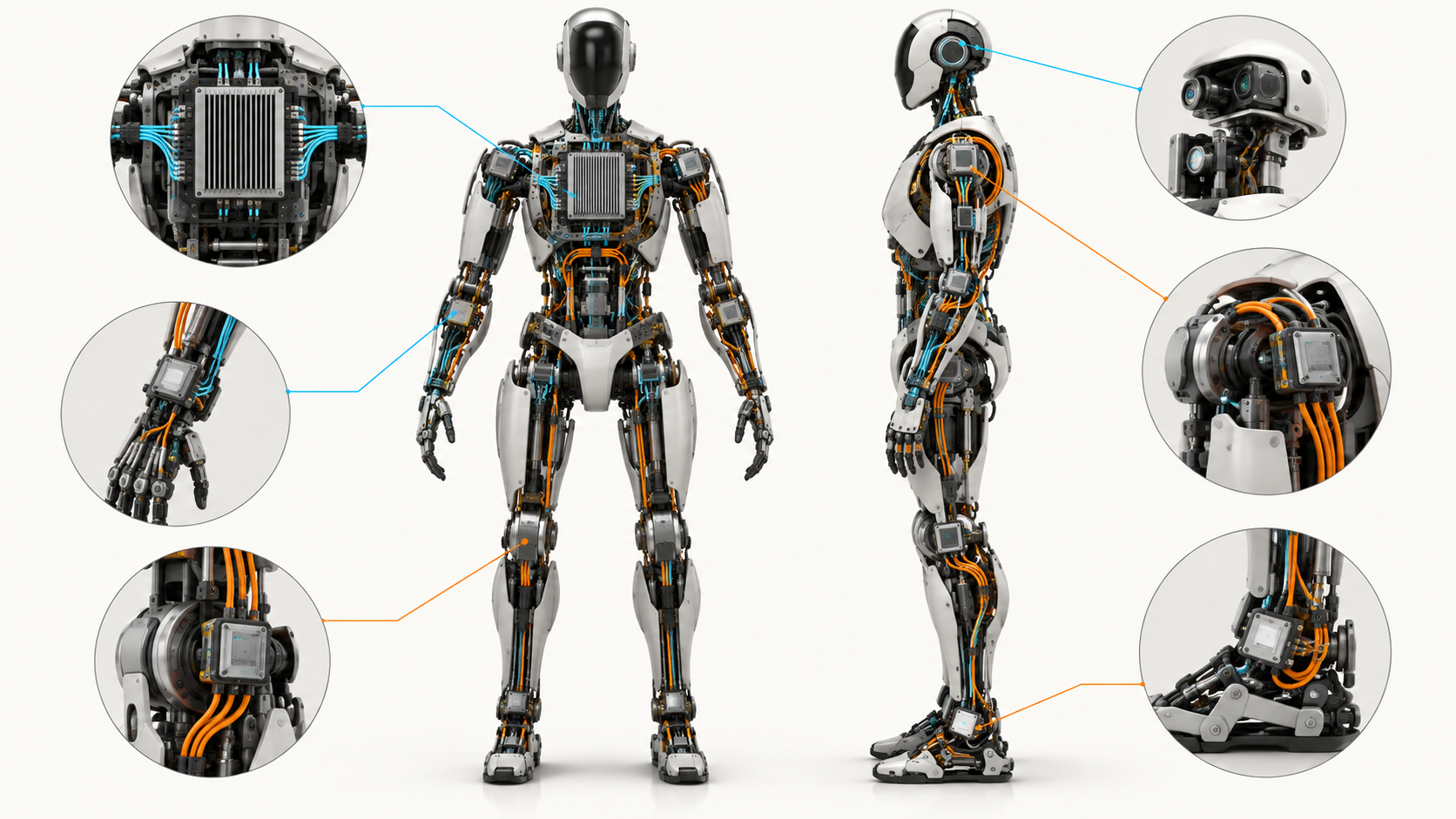
Humanoid robots are usually described from the top down. The eye is drawn to the central AI computer, foundation models, perception pipelines, motion planning and ROS 2. That is understandable: the “brain” is where the most visible intelligence appears. But a humanoid only becomes a physical machine through another software world distributed through its body. Controllers in joints, sensor clusters, power modules, hands, feet and gateways keep the robot synchronized, powered and responsive while the central computer decides what the machine should do.
That second world is not a detail. It is the robot’s embedded nervous system. A high-level command such as “take one step forward” has to become dozens of tightly coordinated physical actions: acquire joint and inertial measurements, estimate state, update torque or position targets, drive power electronics, supervise current and temperature, timestamp data, communicate status and react when something deviates from the expected trajectory. The central computer can propose the motion, but distributed electronics must execute it with timing that is predictable enough to preserve control stability and physical safety.
Humanoid control research has made this requirement visible for years. Work from the Technical University of Munich on an EtherCAT-based humanoid architecture emphasized that simultaneously controlling many joints requires high update rates and low communication latency beneath the higher-level locomotion stack. Its specific implementation is not a blueprint for every future robot, but the architectural lesson remains useful: low-level control performance constrains everything built above it. A sophisticated planner cannot compensate for a body whose measurements arrive late or whose actuators execute against inconsistent timing.
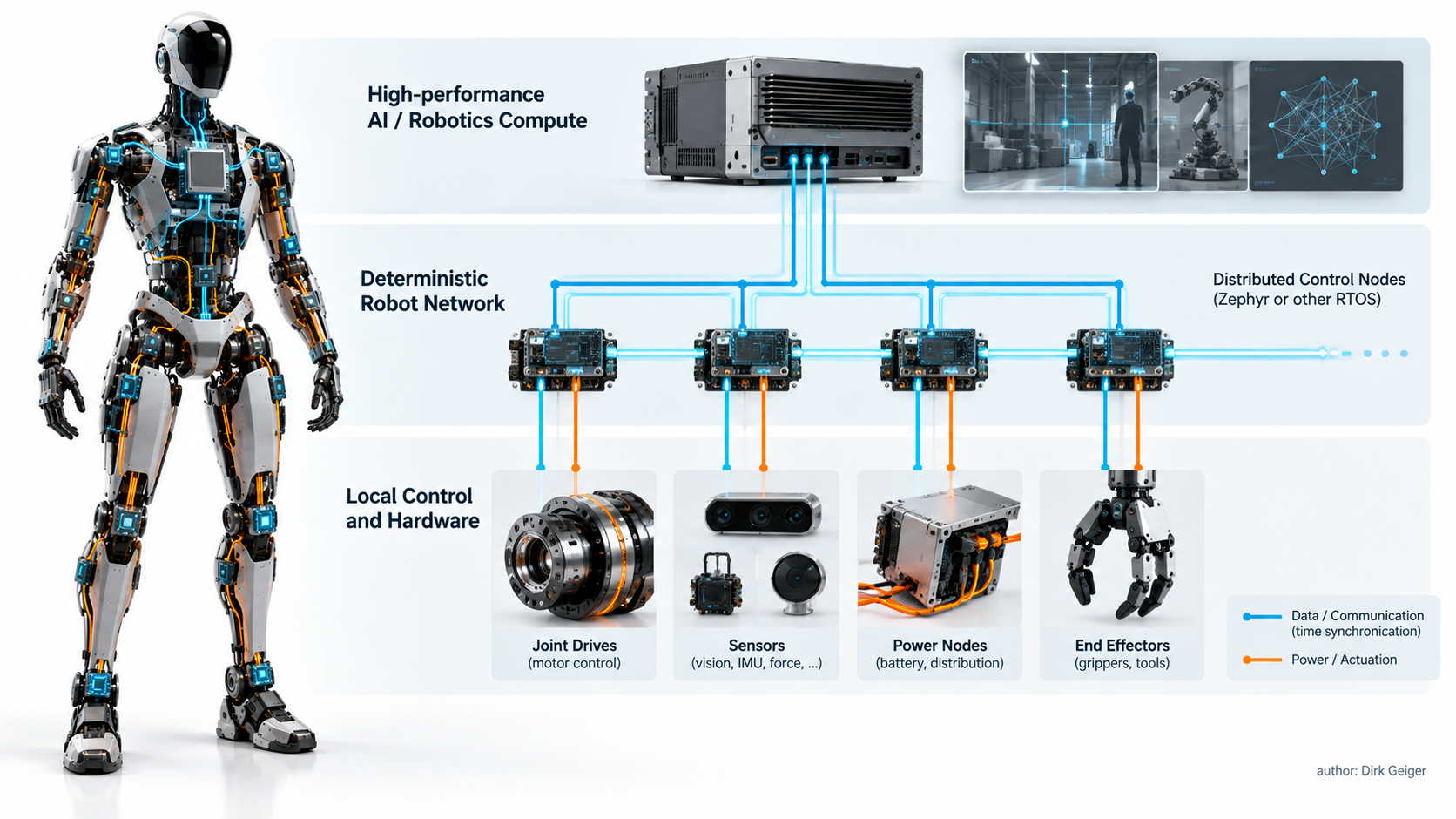
The architecture is therefore naturally layered. Central Linux-class compute runs perception, planning, model inference and broader robot coordination. Distributed microcontrollers execute time-sensitive local functions near sensors, power stages and actuators. Between them sits a network that must carry commands, state and time information with controlled behavior. The operating system on those embedded nodes is part of this system boundary. It shapes how hardware is described, how drivers behave, how tasks are scheduled, how communication is integrated, how faults are contained and how software is maintained after the robot leaves the lab.
Figure 1 makes that split explicit. It also shows an important guardrail: an RTOS such as Zephyr may host the distributed control application without owning every innermost control loop. A motor-control accelerator, dedicated safety core or bare-metal fast path can remain below or beside the RTOS when physics, latency or certification make that the better choice.
The real question is platform standardization, not another scheduler
Once a humanoid contains tens of embedded controllers, asking “which scheduler should we use?” becomes too small a question. A scheduler can provide priorities, threads, timers, semaphores and interrupt-to-task handoff. A product platform must answer a longer list: How is the board described? How are drivers structured? How does the application find a UART, timer, ADC or Ethernet controller without becoming coupled to one vendor implementation? How are features configured out when memory is tight? How are power states coordinated? How are networking, security, diagnostics and software updates integrated? What survives when a controller is replaced by another MCU generation two years later?
This is the point where Zephyr becomes strategically interesting. Its strongest proposition is not that its kernel can pre-empt a task. Many RTOSs do that well. The proposition is that the project combines the kernel with a common device model, Devicetree hardware description, Kconfig configuration, generic driver classes, networking and system services, build tooling and an upstream multi-vendor ecosystem. Zephyr’s current documentation describes more than 1,000 supported boards and exposes a device model in which applications can program against subsystem APIs instead of each hardware-specific implementation. Kconfig allows unused features to be compiled out, helping the same platform scale across different embedded roles.
For a humanoid OEM, that changes the unit of reuse. A hip drive controller and a hand sensor hub will not run the same application, but they can share conventions for device discovery, configuration, logging, networking, updates and diagnostics. A power controller can use the same operating-system vocabulary as a local I/O module even if the underlying microcontrollers come from different families. That does not eliminate silicon differentiation. It moves the differentiation lower, where it belongs: driver quality, peripheral capability, accelerator integration, safety mechanisms, timing behavior and tooling.
There is also an organizational benefit. Proprietary vendor SDKs often optimize the first design-in, because they make a particular board easy to start. The cost appears later when a robot accumulates several MCU families, multiple software teams and a decade of maintenance obligations. Every different driver model, logging mechanism, build system and update path becomes integration work. A common platform can reduce that fragmentation, especially for functions that do not gain competitive value from being implemented differently on every controller.
Zephyr’s long-term-support model strengthens that argument. The project now uses roughly six-month stable release cycles; the current stable release is Zephyr 4.4.0, released on 14 April 2026, while LTS branches are intended to be maintained for about five years. That does not automatically meet a humanoid fleet’s full service-life requirement, but it is a recognizable product baseline rather than a continuously moving development branch. For robotics manufacturers moving from prototypes to fleets, that distinction matters.
Why Zephyr is interesting for distributed humanoid electronics
The attraction becomes clearer when the requirements of a distributed humanoid are mapped against the platform rather than the kernel alone.
First, portability is built into the hardware model. Zephyr’s device framework provides generic APIs for common classes such as UART, SPI and I²C while hardware-specific drivers implement those interfaces underneath. Devicetree describes board hardware and Kconfig selects software features at build time. In practical terms, this does not make all microcontrollers interchangeable, but it can keep application logic from being unnecessarily entangled with one board support package. That is valuable when a robot family evolves faster than any single semiconductor roadmap.
Second, Zephyr brings communication into the same software environment. A humanoid’s local controllers increasingly need more than a periodic CAN message. Ethernet, IP networking, time synchronization, diagnostics and secure update paths are moving closer to the joint and subsystem level. Zephyr’s networking stack and driver model give OEMs a common place to integrate those capabilities. The project’s new Robotics Working Group is significant precisely because it is pushing that foundation toward the deterministic requirements of distributed robots rather than creating another robotics framework above the RTOS.
Third, power management can become a system function rather than a collection of driver-specific sleep calls. Zephyr provides both runtime and system-managed device power-management models. Drivers, subsystems and applications can participate in suspend and resume behavior, with explicit device states and constraints. For a humanoid, this is not yet a complete robot energy-state architecture, but it is a useful primitive. A future robot may need to distinguish full-active motion, task-active operation, attentive idle, safe standby and deep sleep. The embedded nodes must then preserve only the functions needed for the current state while respecting wake latency and state integrity. A common power-management model makes that easier to coordinate than ad hoc peripheral shutdown code scattered across many firmware projects.
Fourth, security and maintenance are becoming architectural requirements. Zephyr maintains a security process, vulnerability reporting workflow and security documentation that covers memory separation, stack and thread protection, secure boot, updates, authentication, access control and other system-level considerations. None of that makes a product secure by itself; the manufacturer still owns the end-to-end threat model, keys, hardware root of trust, update infrastructure and response process. But an upstream security process reduces the amount of foundation work that every robot OEM would otherwise have to define alone.
Fifth, the ecosystem is broad enough to matter to a semiconductor strategy. Zephyr’s current Infineon board catalog includes PSOC, TRAVEO T2G and XMC evaluation platforms. The important point is not the board count. A board listing proves neither driver completeness nor worst-case timing. It does show that a common upstream abstraction is already touching multiple MCU product families. For robot developers trying to reuse software across sensing, general embedded control, communications and other nodes, that direction is strategically relevant.
The 2026 Robotics Working Group makes the robotics case more explicit. Its charter names Time-Sensitive Networking, IEEE 802.1AS/gPTP, scheduled traffic, low-latency and low-jitter compute, IRQ characterization, cache and SMP determinism, cross-node clock discipline, deterministic transports, synchronized I/O, safety gaps and reference benchmarks. The list is revealing. It is almost a requirements document for the next generation of distributed robot electronics.
The emerging Zephyr–Zenoh work in ros2_control addresses another persistent boundary: how an MCU becomes a first-class participant in a ROS 2 control system without piling up custom bridges. Current ros2_control documentation describes an agent-less path using Zenoh and a hardware interface that exchanges state and commands with remote Zephyr nodes. The architecture includes both a packed, no-CDR path and a CDR-based option. That is technically interesting because every serialization copy, daemon and bridge in a control path adds integration complexity and can obscure latency ownership. At the same time, the integration is still evolving. Some packages are marked stable while other parts of the broader workflow and demos remain under active development. The correct conclusion is momentum, not maturity by declaration.
The gaps matter as much as the benefits
Zephyr’s strongest robotics evidence is also an admission of work still to do. The Robotics Working Group RFC states that adopters have repeatedly been solving networking, timing and transport scaffolding in isolation. That is exactly the pain a common platform should remove, but it means the removal is not complete. TSN, deterministic Ethernet behavior, hardware timestamping abstractions and robotics-grade benchmarking are active agenda items rather than capabilities that can be assumed uniformly across supported hardware.
This distinction matters because deterministic scheduling on one MCU does not create deterministic behavior across a humanoid. The control chain is end to end. A sensor may sample at the correct instant but timestamp against a drifting local clock. A joint-control task may wake predictably but receive its reference late because network traffic was delayed. An Ethernet controller may support hardware timestamps while the driver or stack does not expose them with the required semantics. A central controller may compute on time while an output queue releases packets too late for coordinated actuation. The relevant metric is therefore not “RTOS latency” in isolation but the age and timing integrity of information from physical acquisition to physical consequence.
The same caution applies to performance claims. The TUM humanoid work reported control rates beyond 2 kHz and I/O latency below 1 ms for its EtherCAT architecture, but those figures belong to that measured system. They should not be transferred to Zephyr, another network or another humanoid. A credible Zephyr adoption needs measurements on the actual MCU, interrupt architecture, cache configuration, network controller, PHY, driver and workload. Worst-case behavior under mixed communication, diagnostics and control loads matters more than a clean benchmark in an idle system.
Functional safety is a second boundary. Zephyr’s Safety Committee is working toward IEC 61508 SIL 3 / Systematic Capability 3 for a limited source scope, using an approach suitable for an existing code base. The documentation describes requirements traceability, coding rules and demanding structural test-coverage goals. That is substantive work, but it is not the same as having a generally available pre-certified SIL 3 or ISO 26262 ASIL D RTOS package today. A humanoid developer with an immediate safety case may therefore choose a different operating system for a particular partition, or isolate safety functions on a separate MCU or core.
Platform richness also has a cost. A common driver model, network stack, security services and build ecosystem reduce duplicated engineering, but they expand the code base and configuration surface relative to a tiny kernel or bare-metal loop. In the smallest controller, the right software architecture may still be a few interrupts, a motor-control state machine and a carefully bounded communication interface. The goal should not be to put Zephyr everywhere. It should be to use a common platform where the integration and lifecycle benefits exceed the added complexity.
Upstream breadth must also be separated from production depth. A board in the Zephyr catalog demonstrates that the platform can run on the target. It does not prove that every peripheral needed by a humanoid has an upstream driver, that the driver is optimized for the application, that power states are complete, that DMA behavior is characterized, or that the implementation has the evidence required by a safety case. OEMs should therefore benchmark feature depth, not count supported boards.
There is finally a governance trade-off. Open-source, vendor-neutral development reduces dependence on one silicon supplier and makes shared fixes visible. It also requires a disciplined product process: select a baseline, control configuration, track upstream changes, maintain an SBOM, assess vulnerabilities, decide which fixes to backport and define who owns unresolved issues. Open software does not remove lifecycle responsibility; it makes that responsibility more explicit.
There is no universal RTOS winner
Figure 2 is deliberately not a scorecard. The alternatives optimize different problems, and a humanoid can legitimately use more than one of them.
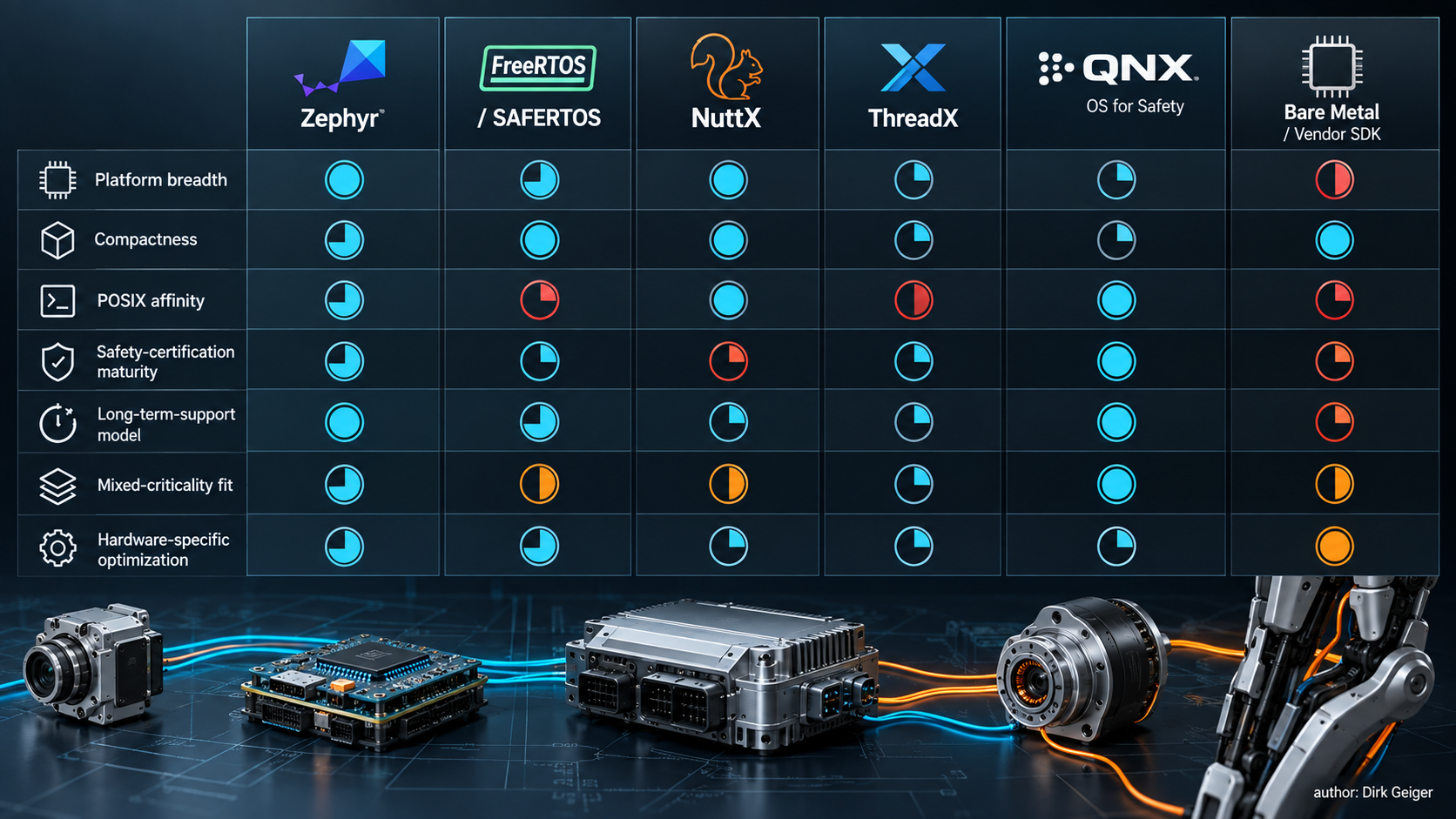
FreeRTOS remains the obvious reference point for small MCU control. Its official documentation describes support for more than 40 processor architectures, a small footprint and a broad library ecosystem. The current 202604.00-LTS line provides a maintained baseline, and FreeRTOS states that its LTS libraries receive security updates and critical fixes for two years. That support horizon is shorter than Zephyr’s approximately five-year LTS model, but the FreeRTOS kernel is intentionally compact and familiar to a huge embedded developer base. When a controller needs a proven scheduler and a focused set of libraries rather than a broad cross-vendor device platform, that simplicity is a strength.
SAFERTOS changes the safety discussion. It is a separately supplied derivative associated with the FreeRTOS ecosystem and is positioned for standards including IEC 61508 SIL 3 and ISO 26262. That can make it a more direct fit for a certified partition than community FreeRTOS or today’s general Zephyr baseline. The trade is that the safety product and its commercial lifecycle are a different proposition from using the open-source kernel alone.
Apache NuttX occupies another useful position. Its design emphasizes standards compliance and a small footprint, with POSIX and ANSI interfaces as central principles. The project describes itself as scalable from 8-bit to 64-bit environments and, as of September 2026, its documentation includes broad OS components, networking, device drivers and SMP support. For teams wanting Linux-like programming conventions on deeply embedded targets, NuttX can reduce the conceptual gap between embedded and higher-level software. Its robotics-specific momentum and explicit deterministic-networking roadmap are currently less pronounced than Zephyr’s, but that does not diminish its technical fit for certain products.
Eclipse ThreadX is attractive when compact deterministic services and established safety evidence dominate. Its documentation describes a kernel whose linked image is commonly only a few kilobytes and states certification to IEC 61508 SIL 4, along with MISRA compliance. That safety maturity is an important differentiator. Its current security policy, however, states that the project publishes quarterly releases and does not maintain long-term-support branches or backports to older releases. An OEM can build its own lifecycle policy around that model, but it is a different maintenance contract from Zephyr LTS.
QNX OS for Safety targets a higher class of compute and mixed criticality. The current QNX OS for Safety 8.0.x is assessed for IEC 61508 SIL 3, ISO 26262 ASIL D and IEC 62304 Class C, and is based on QNX SDP 8.0.x. A commercial microkernel with strong process isolation and a certification package can be compelling for domain controllers where safety and non-safety software share a powerful processor. The disadvantages are equally clear: licensing cost, greater resource requirements and a product model that is excessive for many small joint-level MCUs.
Bare metal and vendor SDKs remain the final alternative—and sometimes the correct one. The inner current loop of a motor drive may run in a timer interrupt or dedicated accelerator where direct access, fixed memory layout and minimum overhead matter more than portability. A vendor library may exploit a PWM unit, ADC trigger chain or safety mechanism better than a generic abstraction can. The mistake is not using hardware-specific code. The mistake is allowing hardware-specific code to spread upward until every subsystem becomes an isolated software island.
The architectural comparison therefore has a simple outcome. Zephyr is strongest where an OEM values one portable embedded platform across many node types. FreeRTOS is strong where compactness and familiarity dominate. NuttX is attractive where POSIX affinity matters. ThreadX and SAFERTOS bring mature safety evidence to deeply embedded roles. QNX addresses larger mixed-criticality domains. Bare metal remains appropriate at the sharpest hardware edge. A mature humanoid architecture can combine these intentionally instead of forcing one answer onto every controller.
The next requirement is robot-wide determinism
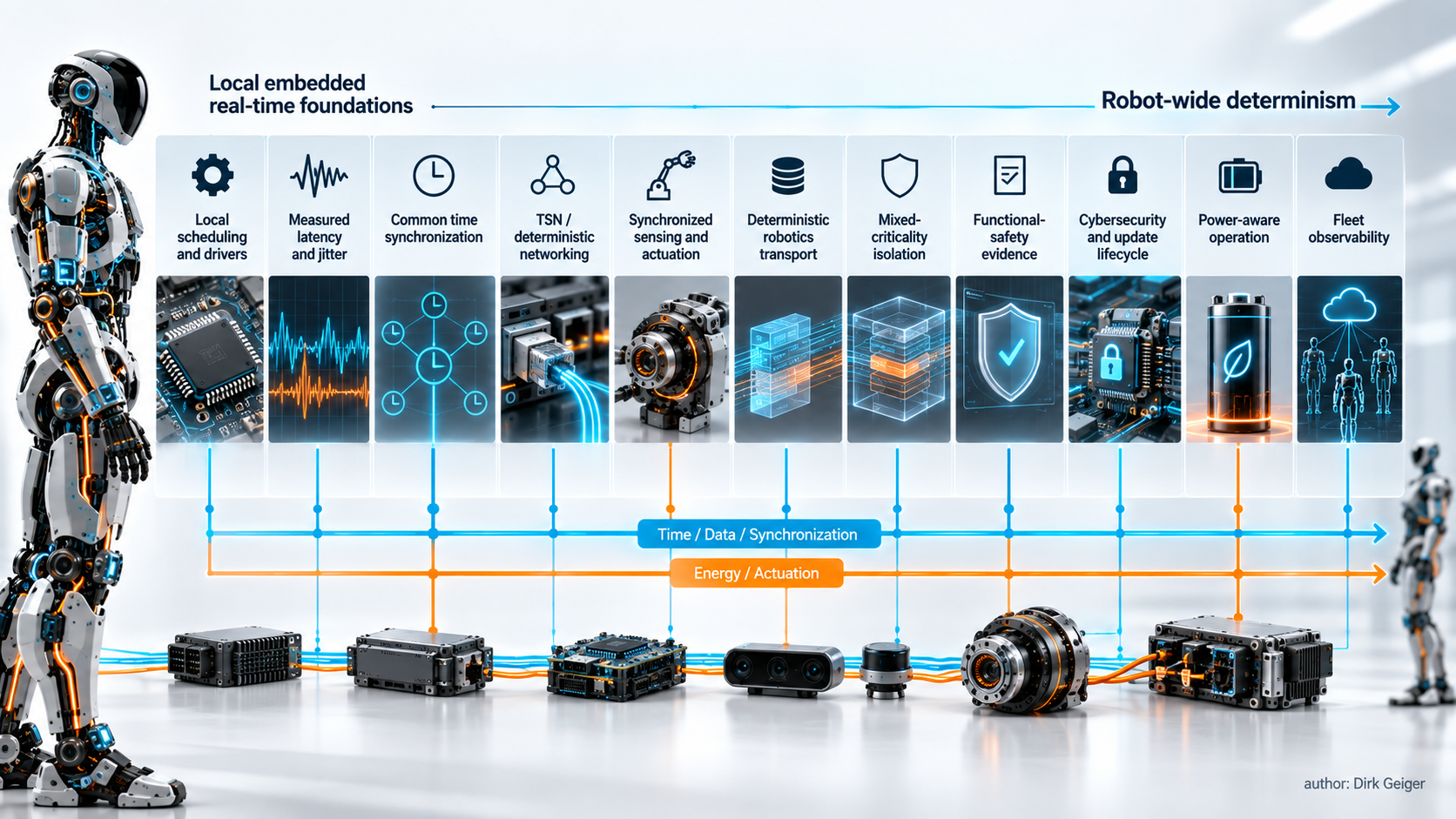
The next generation of humanoids will push the embedded platform beyond local real-time scheduling. Figure 3 summarizes the shift: from deterministic nodes toward deterministic behavior of the networked machine.
The first requirement is a common notion of time. Distributed control needs clocks that agree closely enough for measurements and commands to be interpreted in the same physical timeline. That brings PTP and gPTP, hardware timestamping and disciplined cross-node clocks into the embedded platform. Time synchronization is not only for correlating logs. In coordinated motion, synchronized action can become part of correctness.
The second requirement is deterministic networking. Ethernet is attractive because it scales bandwidth and can unify traffic, but unmanaged Ethernet does not guarantee that a control packet arrives before its deadline. TSN mechanisms such as time-aware scheduling, traffic shaping, redundancy and precise time distribution are therefore relevant to future robot backbones. Zephyr’s Robotics Working Group explicitly identifies IEEE 802.1AS, 802.1Qbv and related mechanisms as priorities. The engineering challenge is to turn standards support into an end-to-end implementation spanning MAC, hardware timestamps, driver, queue discipline, stack and application.
The third requirement is measured jitter. Product specifications need evidence for interrupt response, scheduling latency, cache and SMP effects, driver execution, network queues and cross-node behavior under realistic load. Humanoids are particularly demanding because compute, perception, diagnostics and motion do not politely take turns. They coexist. A platform that performs well only when the network and CPU are quiet is not a deterministic control platform.
The fourth requirement is synchronized I/O. Sensor sampling, encoder capture, ADC triggering and actuator updates need timing semantics that survive the software stack. “Timestamped” is not enough if the timestamp reflects message reception rather than physical acquisition. The RTOS, driver model and network stack increasingly need to preserve acquisition time, validity and data age so that estimators and controllers know what they are acting on.
The fifth requirement is a cleaner robotics transport boundary. The emerging Zephyr–Zenoh integration is one example: reduce special-purpose agents, make embedded nodes visible to higher-level control software and keep the wire format understandable. Whether Zenoh becomes the dominant answer is less important than the principle. The embedded and central worlds need a communication contract that is efficient, diagnosable and explicit about timing.
Then come mixed criticality and containment. A humanoid will combine convenience functions, high-performance motion, diagnostics, cybersecurity services and safety mechanisms. These functions should not all have the same authority. Memory protection, privilege separation, watchdog supervision, independent safety monitors and bounded degradation are needed so that a fault in logging or networking cannot freely corrupt a safety-related control path. Zephyr provides mechanisms such as userspace and memory protection on supported architectures, but a product safety case must define the actual containment boundaries.
Cybersecurity becomes equally operational. Fleet robots need secure boot, authenticated software update, rollback strategy, vulnerability response, software provenance and protected credentials. Zephyr’s security process is useful upstream infrastructure, while the manufacturer still owns product identity, backend trust, update policy and regulatory obligations. A humanoid deployed for years is not finished when the firmware boots; it enters a continuing software-maintenance relationship.
Power awareness must also move higher in the stack. A distributed robot may need controllers that remain awake for wake detection or safety supervision while high-performance compute sleeps. Some networks may need to remain available while other links power down. State restoration has to preserve calibration, security context and safe actuator conditions. Zephyr’s device and system power-management primitives can support this, but next-generation robotics needs a robot-level energy-state contract above them.
Finally, the platform needs fleet-grade observability. Logs from ten controllers are not useful if their clocks cannot be correlated. A post-event investigation should be able to reconstruct sensor state, network timing, software decisions, safety interventions and actuator commands against a common timeline. That requirement links time synchronization, diagnostics, security and functional safety more tightly than conventional MCU software often assumes.
Why Zephyr — and why not Zephyr everywhere
The strongest reason to choose Zephyr for humanoid robotics is not benchmark supremacy. It is architectural leverage. A humanoid contains enough embedded software that fragmentation itself becomes a system cost. If joint controllers, sensor hubs, power modules and gateways can share one hardware-description model, one driver architecture, one configuration system, common networking and security conventions, and a recognizable maintenance process, the robot becomes easier to evolve as a product.
That matters economically as much as technically. Prototype robots can tolerate hand-crafted firmware because the engineering team knows every board. Fleets cannot. Hardware changes, second sources, cybersecurity fixes, supplier transitions and field diagnostics turn every private abstraction into lifecycle work. A common upstream platform can move effort away from rebuilding infrastructure and toward the functions that differentiate the robot.
Zephyr is also well timed. Version 4.4 is current, the release model is settling into a predictable cadence, LTS remains a product path, and the project now has a robotics group naming the same gaps that serious robot architects are encountering: TSN, jitter, synchronized clocks, deterministic transport and safety. The ros2_control Zenoh work begins to connect those embedded nodes to the wider robotics stack. This is not proof of inevitability, but it is evidence that the ecosystem is converging on the right problems.
The limitations define where caution is appropriate. Zephyr is not yet a universal safety answer. It does not make Ethernet deterministic by being installed on both ends of the cable. It does not remove the need for measured worst-case timing. Its broad hardware list does not guarantee equal driver depth. And an RTOS abstraction should never be allowed to hide the physics of a motor-control path that needs a dedicated accelerator or a tightly bounded bare-metal loop.
The likely humanoid architecture is therefore heterogeneous by design. Linux and ROS 2-class software will continue to dominate central perception, planning and orchestration. Zephyr can plausibly standardize a large share of the distributed embedded nervous system. Certified RTOSs, microkernels, dedicated safety islands and hardware-specific control paths will coexist where their evidence or timing is stronger. The architecture should make those boundaries explicit instead of pretending that one operating system must win the whole robot.
The next decisive step for Zephyr is measurable robotics-grade integration. Success will be visible when an OEM can select supported hardware, configure synchronized networking, obtain credible IRQ and scheduler-jitter data, connect embedded nodes to the robot-control stack, maintain a product branch, build a safety argument for the relevant scope and diagnose field failures across a common timeline without constructing half of that infrastructure again.
If that happens, Zephyr’s role in humanoids will be larger than “the RTOS running on an MCU.” It will be the common software grammar that lets many embedded controllers behave like one engineered nervous system. That is why Zephyr deserves attention now—and why its future in humanoid robotics will be determined less by feature count than by whether it can turn local real-time capability into dependable robot-wide behavior.