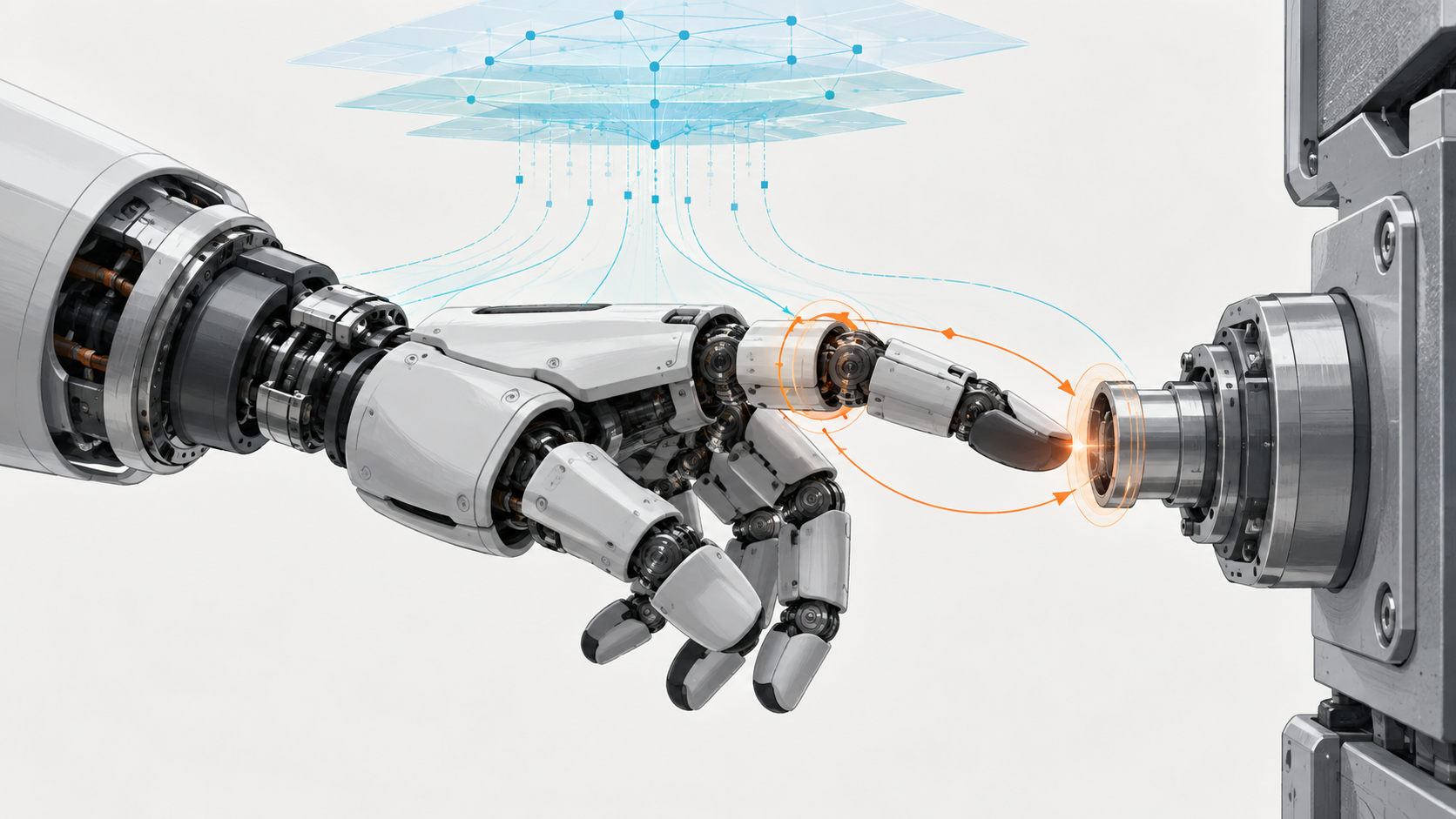
The plan becomes wrong at contact
The gripper approaches a connector with a sensible trajectory. Vision has placed the socket, the task policy has generated an action chunk, and the arm is moving as commanded. Then the chamfer catches. The planned insertion axis is wrong by a fraction of a degree. Force rises before the next semantic decision is ready. At that moment the robot does not need another interpretation of the task. It needs a reflex: observe the discrepancy, decide whether correction remains permissible, and alter only the motion that has not yet happened.
Contact-rich work exposes a structural weakness in the idea that one learned policy should own every timescale. Semantic planning answers questions such as what should happen next? Physical interaction asks different questions: what is happening now, how quickly is force changing, and how much authority remains before slip, damage or instability? These questions share a body but not a deadline.
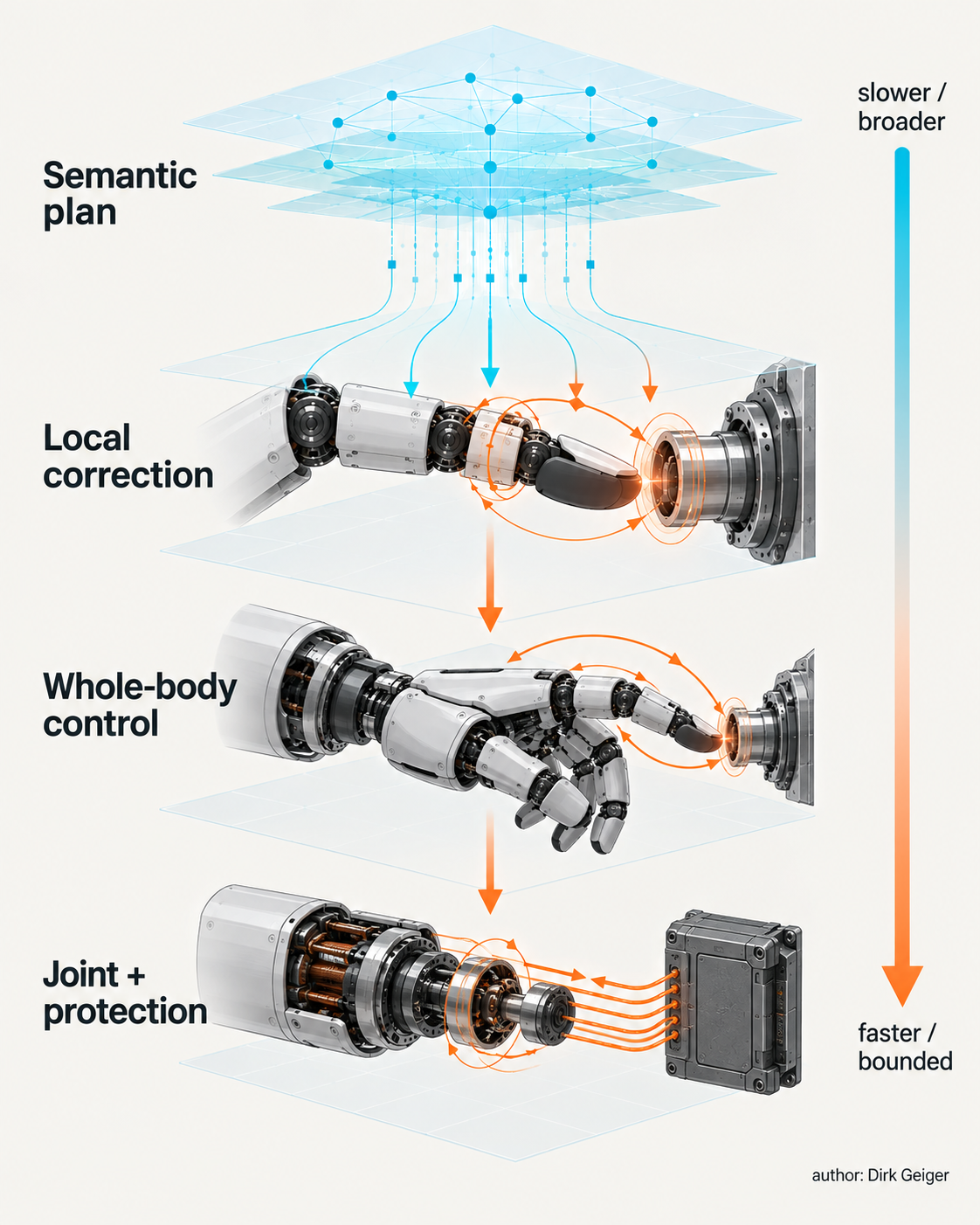
A promising architecture therefore separates intent from bounded correction. A vision-language-action (VLA) or related foundation policy generates task-level actions and predictions. A faster path close to sensing and control compares expected and observed contact, estimates dynamics, corrects the unexecuted portion of the command, and enforces limits. The split-timescale control stack in Figure 1 makes that transfer of authority explicit. The claim is testable: on matched contact-rich tasks, this split should reduce contact failures and worst-case response latency versus regenerating each action chunk, without exceeding a declared energy budget. If complete-loop measurements show no advantage, the architecture has not earned its additional interfaces.
One robot, several clocks
The important boundary is not AI on one side and conventional control on the other. It is the allocation of decisions to physical timescales. Language grounding, scene interpretation and task decomposition can tolerate more latency than collision avoidance, contact stabilization or inverter current control. Whole-body coordination sits between those extremes. Treating every layer as merely another software module hides the fact that late information has a different meaning at each layer.
The semantic layer can produce an action chunk, a predicted contact sequence, confidence and task constraints. The local correction layer can consume new tactile or inferred-force evidence while that chunk executes. Whole-body control can reconcile the correction with balance, joint limits and other contacts. Joint controllers translate feasible commands into torque, while electrical supervision independently constrains current, voltage, temperature and fault response. Each handover reduces freedom. A high-level proposal may be expressive; a low-level command must be bounded.
This hierarchy also clarifies failure. A missed cloud connection should not erase local stability. A delayed semantic update should not license indefinite execution of stale commands. A failed tactile patch should not silently turn an uncertain grasp into a confident one. The robot needs explicit degradation behavior for each loss of information, not a single generic safe state.
The clocks are coupled by mechanics. A high-level action that looks smooth at planning resolution may excite a flexible transmission, drive a contact toward friction saturation or consume actuator margin when sampled by the physical plant. Conversely, a local correction that is stable for one joint can disturb a supporting contact elsewhere in the body. The fastest layer therefore cannot be designed in isolation; it needs a constrained view of whole-body state and a clear statement of what it may change.
Frequency alone is a poor proxy for responsiveness. A loop running at a high nominal rate can still react late if acquisition, scheduling, memory access, network transfer and actuator response are not bounded. The useful quantity is the end-to-end age of the evidence when mechanical consequence begins. That age should be tracked through a common time base, including the point of physical sampling and the instant a corrected command becomes effective.
Three signals from current research
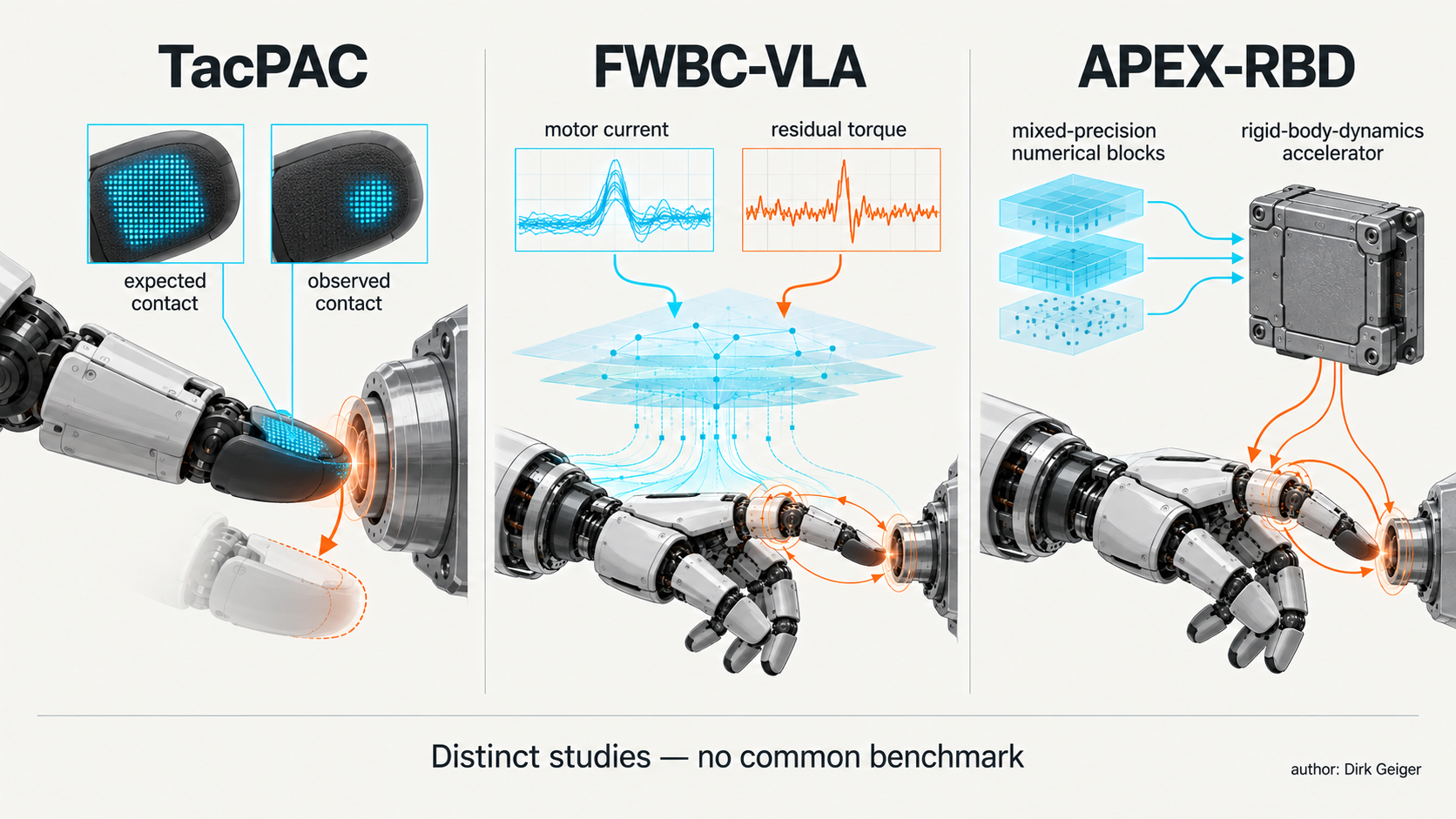
Three papers submitted in September 2026 illuminate different parts of this boundary. They were not evaluated on a common platform, and their reported numbers cannot be combined as if they were one experiment. Their value is architectural: each makes a different latency or efficiency problem visible.
TacPAC addresses the mismatch between prediction before execution and tactile evidence during execution. After a world-action model plans an action chunk, the method caches predicted contact together with the plan representation. A tactile expert compares each new tactile image with that cache and corrects actions not yet executed. The authors report that one correction is 20.7 times cheaper than regenerating the chunk. Across five real-robot tasks, their vision-only baseline averaged 22 percent success and TacPAC averaged 64 percent. These are author-reported results on the paper's tasks, not a universal performance claim [S1].
FWBC-VLA approaches contact through sensorless estimation and whole-body compensation. Its HSR-Force estimator infers contact strength and temporal change from residual torque. Force information becomes tokens for VLA action decoding, while proprioception, a Jacobian-derived body-frame force estimate and estimated contact state feed a compensation generator. The resulting correction is combined with manipulation actions before whole-body execution. The authors report real-world whiteboard wiping and door-opening demonstrations on a wheeled-legged robot and describe a dataset exceeding 5,000 episodes [S2].
APEX-RBD moves further down the stack, into rigid-body-dynamics computation. Uniform numerical precision wastes hardware when variables have different sensitivity. The framework groups variables, prunes the search space using physics-informed sensitivity analysis, predicts trajectory error with a surrogate model and searches for mixed-precision implementations under accuracy and performance constraints. The authors report designs with up to 1.9 times less area and 1.8 times lower power than uniform-precision baselines across the evaluated platforms [S3]. Kernel-level savings, however, are not automatically robot-level energy savings.
Figure 2 keeps these three signals deliberately separate. Together they suggest a direction: predict semantically, compare locally, compensate dynamically and compute only as precisely as the closed loop requires. None establishes the complete architecture alone.
The reflex needs a contract
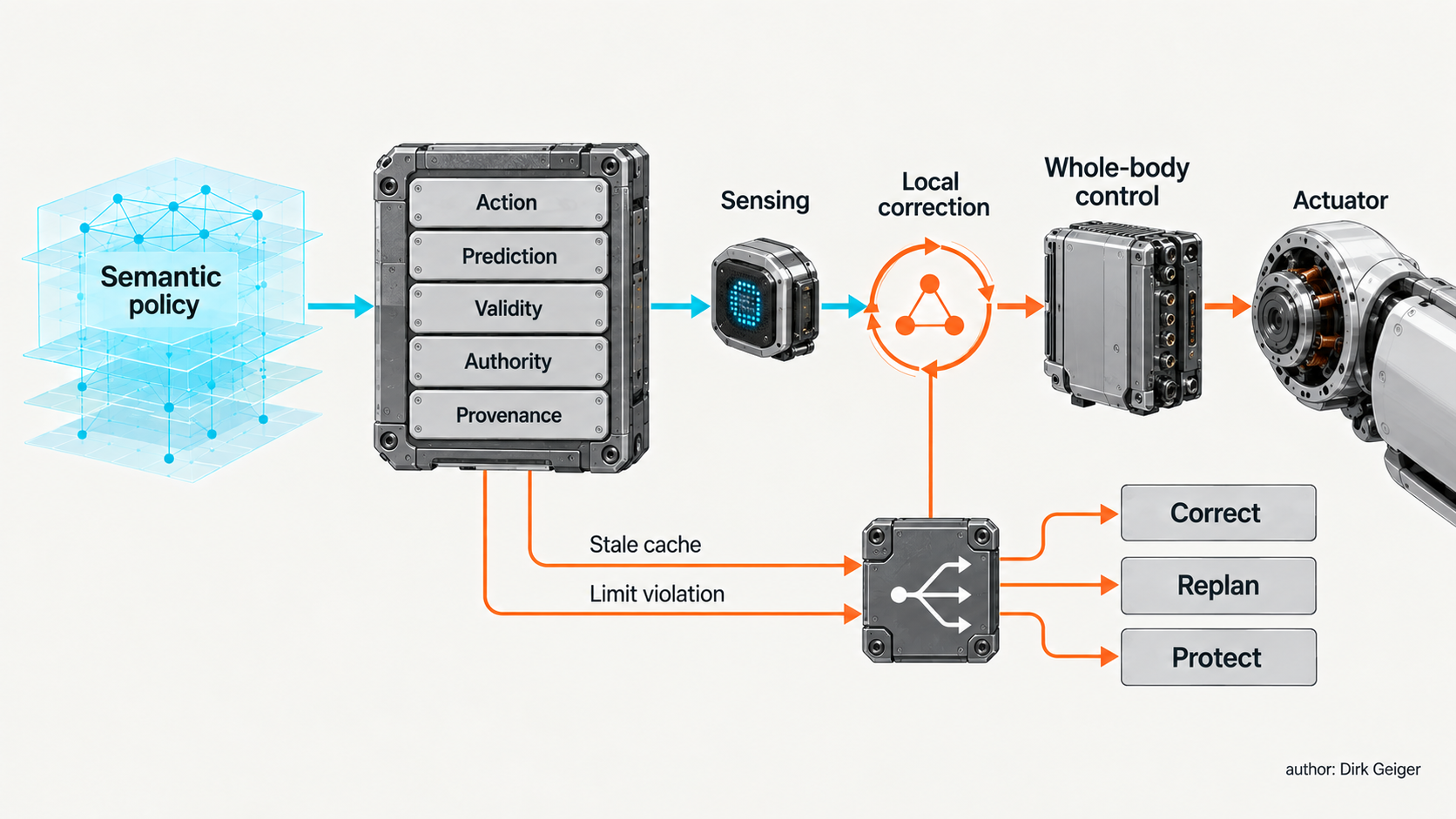
A fast path without a strict interface is merely a second controller competing for the body. The semantic layer must delegate correction through an action contract: a time-valid instruction that includes the intended motion, prediction context, confidence, applicable constraints and the amount of local deviation permitted. The local layer needs enough freedom to respond to contact, but not enough to reinterpret the mission.
Five elements deserve explicit representation. First is the proposed action: pose, velocity, force, impedance or another control target. Second is the prediction against which new evidence will be judged, including expected contact location, timing and signature. Third is validity: generation time, horizon and conditions that invalidate the cache. Fourth is authority: bounds on correction magnitude, rate, direction, energy and reachable state. Fifth is provenance: which observation, model version and constraint set produced the command and every subsequent modification.
Cache age is a physical variable. A predicted contact remains useful only while geometry, object state, calibration and robot state stay within its validity envelope. The correction layer should reject or down-weight a cache when measured motion diverges, contact occurs outside the expected window, confidence collapses or an independent limit is approached. It should never keep correcting an action merely because the next semantic chunk is late.
Disagreement must trigger a defined authority transfer. Small residuals may be corrected locally. Larger but recoverable discrepancies can pause execution and request replanning. Fast force growth, loss of contact confidence or unstable whole-body response may require withdrawal, compliant hold or protective stop. These behaviors must be designed as state transitions, not discovered after deployment.
The contract also needs a budget for cumulative correction. Many individually small deviations can move the robot far from the trajectory understood by the semantic layer. Limits should therefore cover both instantaneous change and accumulated departure. A sequence number, execution cursor and remaining horizon allow the local path to identify exactly which part of an action chunk is still eligible for modification. Once the horizon expires, the command is no longer a proposal waiting to be improved; it is stale state waiting to be rejected.
Provenance is operational, not bureaucratic. When a grasp fails, engineers need to distinguish an incorrect world prediction from late tactile evidence, an estimator bias, a saturated correction, a whole-body constraint or an actuator that did not deliver commanded torque. Recording only the final joint command erases the decision boundary. Recording every raw signal indefinitely is equally impractical. The evidence contract should preserve the causal minimum: timestamps, relevant observations, prediction identity, confidence, applied limits, corrections and observed response. Figure 3 shows the contract as an executable boundary, including the return paths for stale context and limit violations.
Contact evidence is not interchangeable
Direct tactile and force sensing observes physical interaction through dedicated transducers. It can provide spatial pressure, shear, vibration or multi-axis wrench information close to the contact. Its disadvantages are equally physical: cost, wiring, packaging, calibration, temperature dependence, overload survival and wear. A skin or fingertip sensor also creates data, synchronization and diagnostic requirements that extend far beyond the sensing element.
Sensorless estimation derives contact from motor current, joint torque, motion and a model of the robot. It can retrofit force awareness without adding a transducer at every interface, and it exploits signals already present for control. Yet residual torque is not a direct measurement of external force. Friction, backlash, cable forces, actuator temperature, payload error and model mismatch can appear as contact. Estimator confidence must therefore travel with the estimate.
The correct choice is task-dependent. Fine insertion may benefit from localized tactile images that distinguish edge contact from centered contact. Whole-body wiping may be adequately informed by an estimated contact magnitude and direction. Safety-relevant force limitation may require sensing diversity or an independent protective channel. Combining direct and inferred evidence can improve observability, but only if common dependencies are understood.
Calibration drift and sensor wear should be treated as changing evidence quality. Cross-checks can compare expected motor response, tactile distribution, kinematics and object motion. Persistent disagreement belongs in the robot's health state and may reduce permissible correction authority. A reflex that cannot estimate the trustworthiness of its own sensory path is fast, but not dependable.
The boundary becomes an electronics architecture
Once timescales and authority are separated, the semiconductor requirements become more concrete. The semantic policy needs high-throughput AI compute and substantial memory bandwidth for perception, multimodal inference and action generation. The local correction path needs predictable latency, efficient tensor or signal processing, low-overhead access to cached representations and deterministic communication to the control layer. Rigid-body dynamics may justify specialized acceleration when general-purpose compute cannot meet timing and energy constraints.
Memory architecture matters because the cache is active control state, not merely stored data. It needs timestamps, configuration identity and bounded access time. Moving large representations repeatedly can cost more energy than the arithmetic that consumes them. Compression or mixed precision can reduce bandwidth and power, but an acceptable embedding error is not automatically an acceptable trajectory error. Quantization must be evaluated through controller and plant, including worst-case contacts.
Sensing requires synchronized acquisition, analogue front ends where applicable, local preprocessing and diagnostic coverage for open circuits, saturation and implausible patterns. Motor control requires fast current measurement, position feedback, field-oriented control, gate drivers and power switches sized for the mission profile. Protection needs independent limits so a late or corrupted AI command cannot defeat electrical containment.
The network must carry different traffic classes without pretending they are equivalent. Semantic context may be large and bursty. Tactile streams may be dense or event-driven. Whole-body states and joint commands need bounded timing. Fault and health messages need assured delivery. A common time base links contact observations, cached predictions, corrections and physical outcomes; without acquisition timestamps, causality becomes guesswork.
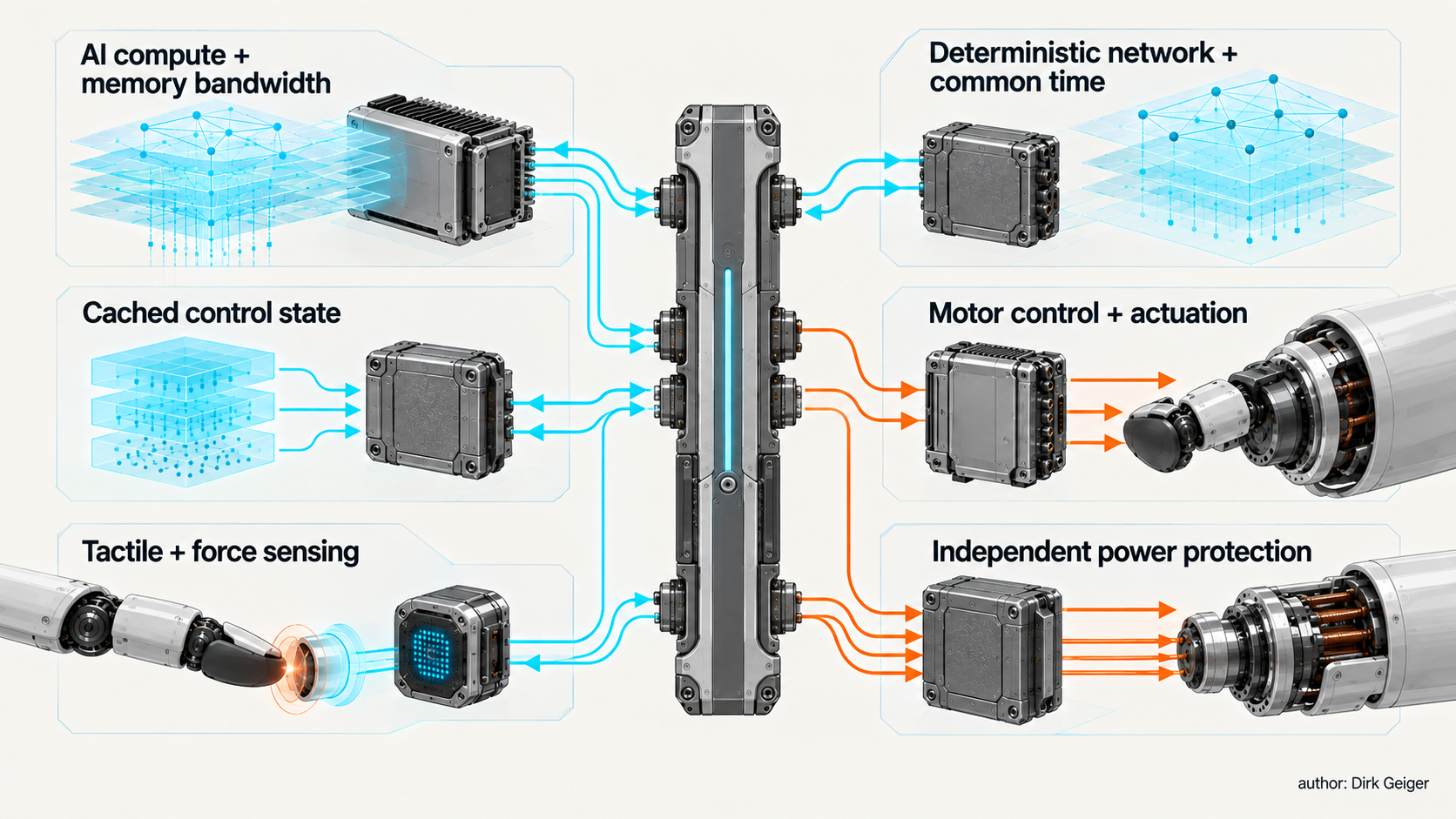
Power must be measured per accepted task, not per isolated inference. A cheaper correction pass may avoid regeneration, but added sensors, always-on accelerators, memory traffic and network activity consume energy continuously. The relevant budget includes sensing, data movement, compute, actuation consequences and fallback attempts. Figure 4 maps that complete path from AI compute and cached state through sensing, communication, actuation and independent protection.
Partitioning creates a trust boundary as well. The semantic model may be updated frequently and may operate on rich, partially unstructured inputs. The reflex path should have a smaller attack surface, controlled configuration and deterministic startup. Commands crossing the boundary need freshness and integrity checks. A validly signed but stale action is still physically wrong; cybersecurity cannot substitute for temporal validity.
Thermal design closes the loop between computation and motion. Local acceleration can reduce execution latency, yet concentrated compute near an actuator adds heat where motor and inverter losses already consume thermal margin. Moving the accelerator centrally may improve cooling but increase network traffic and response uncertainty. The preferred placement depends on duty cycle, data locality, cooling path and failure containment—not merely peak operations per second.
Measure the complete loop
A fair experiment needs identical robots, tasks, initial conditions and success criteria. Compare at least three variants: chunk execution without local correction, regeneration after new contact evidence, and bounded local correction using the same high-level policy. Direct tactile sensing and sensorless estimation should be treated as separate evidence configurations rather than declared equivalent in advance.
Latency begins at physical acquisition, not when software receives a message. Measure acquisition-to-estimate, estimate-to-correction, correction-to-command and command-to-observable mechanical response. Report distributions and worst cases, including contention and degraded modes. Average inference time alone can conceal the tail event that damages a part.
Outcome metrics should include task success, peak and integrated contact force, slip, object damage, recovery count and unintended motion. Stability metrics should track constraint violations, oscillation, balance margin and saturation. Accuracy metrics for mixed precision must propagate numerical error into motion and contact outcomes rather than stopping at a kernel output comparison.
Energy measurement should cover the entire attempt from perception through accepted completion or failure recovery. A useful normalization is joules per accepted task, accompanied by elapsed time and thermal state. A fast method that causes more retries may consume more energy overall. A low-power accelerator that keeps additional memory and sensors awake may move consumption elsewhere.
Deliberately inject stale caches, calibration offsets, dropped tactile frames, force-estimator bias, delayed semantic updates and disagreement between layers. Verify that correction authority shrinks or transfers as designed. The architecture succeeds only if its fallback behavior is measurable as well as its nominal performance.
The experiment should also separate workload classes. Precision insertion, deformable-object handling, sustained surface contact and loco-manipulation create different evidence needs. A local reflex may deliver a large benefit when contact changes faster than semantic replanning, yet add little when the task is dominated by free-space motion. Reporting results by contact regime prevents a narrow success from becoming a universal architecture rule.
Acceptance thresholds should be declared before testing. The split path might be required to lower the 99.9th-percentile response time, reduce damaging contacts, remain within a specified energy increment and preserve stability under injected faults. It should be rejected if its apparent gain depends on hidden sensing power, relaxed success criteria or a baseline denied access to equivalent observations. This discipline turns an attractive diagram into a falsifiable engineering decision.
Freeze authority before frequency
Robot teams are often tempted to choose a controller frequency, processor or bus before defining which layer owns which physical decision. That reverses the dependency. The first architecture freeze should establish the action contract, cache-validity rules, evidence quality, correction bounds, independent protection and degradation states. Timing and hardware can then be derived from hazards, mechanical dynamics and measured workloads.
The recent papers do not prove that every Physical AI system needs the same reflex. They show why the question can no longer be deferred. TacPAC makes in-execution tactile correction visible. FWBC-VLA connects force awareness to whole-body compensation without assuming dedicated force sensors. APEX-RBD exposes precision as an architectural resource rather than a fixed numerical habit. Their common implication is that intelligence becomes useful only when it arrives at the right physical time and under the right authority.
The decisive interface is not between a foundation model and a controller box. It is between a proposal and permission. Semantic intelligence can suggest what the robot should do. A dependable reflex decides what may still be done now.