The expensive handoff
The carton was where the perception system said it would be. The arm arrived within tolerance. The fingers closed, the load cell rose, and the robot declared a secure grasp. Half a second later the carton rotated inside the fingertips, clipped the edge of the tote and opened along a damaged seam. Nothing in the event looked dramatic. That was precisely the problem. A manipulation failure can emerge from several individually reasonable decisions: a grasp chosen for geometric stability rather than the next motion, a wrist near its torque limit, a surface whose friction had changed, and a controller that interpreted force without knowing where contact occurred.
The end effector is where software acquires physical consequences. It is also where an apparently small component choice propagates through the robot. A heavier hand increases wrist load and arm inertia. More fingers add actuators, cables, sensing channels, calibration states and failure modes. A rigid tool can deliver excellent process capability but only for a narrow task. Compliance tolerates uncertainty, yet can reduce positional stiffness. Tactile sensing reveals contact, but only if its signals survive packaging, calibration drift and real-time interpretation.
The central design decision is therefore not whether a robot should have a human-like hand. It is how much physical versatility the mission can economically use. The best end effector is the least complex mechanism that can reliably create the required object states across the specified environment, cycle time and service life. Human resemblance is not a requirement. It is, at most, one possible consequence of a broad task portfolio.
Research on artificial hands reinforces this tension. A century-scale review found two persistent trends: softer structures and simplified actuation, both attempts to gain useful adaptability without reproducing every anatomical degree of freedom. The same review observed that highly actuated anthropomorphic hands have produced remarkable prototypes but comparatively limited real-world deployment [Piazza et al., 2019]. The gap is not caused by a single missing algorithm. It reflects the economics of an entire manipulation system.
Four ways to meet the object
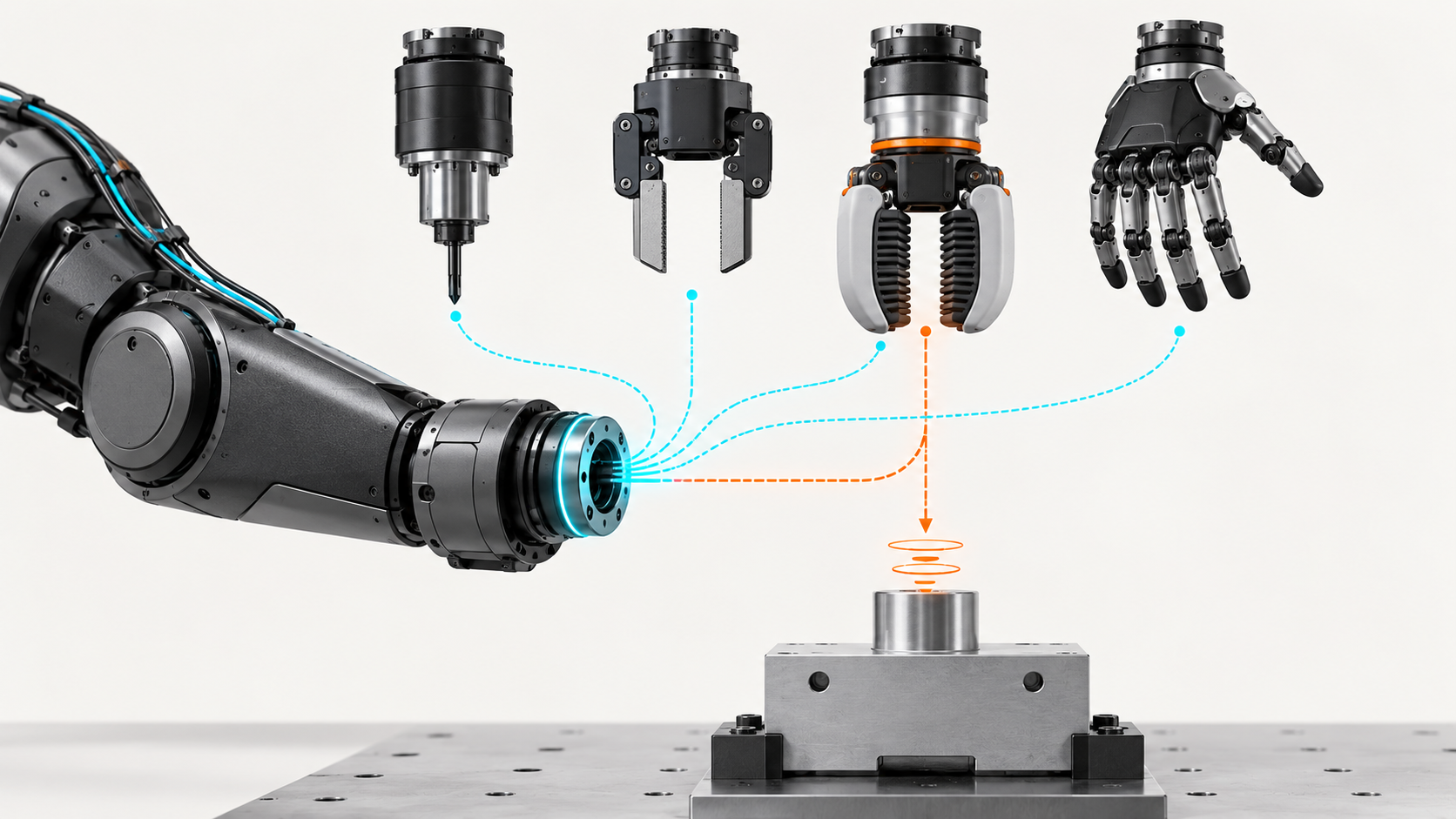
A robot can interact with the world through four broad end-effector strategies: a dedicated tool, a parallel gripper, an adaptive gripper or a dexterous hand. The boundaries overlap, but the categories reveal where complexity enters.
Dedicated tools transform an open-ended manipulation problem into a controlled process. A welding torch, screwdriver, suction cup, magnetic pickup or custom nest does not imitate a hand; it establishes a predictable interface. When the workpiece family, approach direction and process are stable, specialization usually offers the highest payload-to-mass ratio, fastest cycle, simplest validation and clearest maintenance concept. Its weakness is change. A new product, package or process may require another tool, a tool changer or manual conversion.
Parallel-jaw grippers add a useful degree of generality while retaining simple mechanics. Two opposing fingers can grasp boxes, cylinders, machined parts and many household objects when finger geometry, opening range and friction are suitable. Position control can command width; current or force sensing can limit squeeze; interchangeable fingertips can adapt the same mechanism to several part families. The grasp configuration remains low-dimensional, which reduces planning, calibration and verification effort. Yet a two-jaw gripper struggles when access is obstructed, surfaces are fragile, the object must be reoriented within the hand, or the task demands several distinct contact patterns.
Adaptive grippers use underactuation, differential mechanisms, compliant joints or soft materials so one or a few actuators produce multiple contact motions. The mechanism closes around local geometry rather than commanding every joint independently. Dollar and Howe demonstrated how a highly adaptive underactuated hand could tolerate positioning error and acquire varied objects with simple feed-forward control [Dollar and Howe, 2010]. Mechanical intelligence is doing part of the computation: contact redirects motion, compliance distributes force, and the object helps determine the final configuration.
Dexterous hands provide several fingers, multiple controllable joints and the possibility of changing object pose after acquisition. They can form power grasps, precision grasps, lateral pinches and tool-related configurations. That repertoire matters when the robot must operate equipment built for people, recover from restricted approach directions or manipulate an object without putting it down. It also multiplies the state space. More independent motion requires more actuators, transmissions, sensors, wiring and coordinated control. A hand that can theoretically form many grasps is not automatically able to execute them robustly under uncertainty.
The practical continuum is not simple versus advanced. It is constrained certainty versus managed variability. Dedicated tooling removes variability from the interface. A parallel gripper tolerates modest variation. An adaptive gripper absorbs part of the uncertainty mechanically. A dexterous hand attempts to sense, model and control more of it.
Figure 1 makes the exchange explicit. Each step toward broader object coverage transfers more work into sensing, coordinated control, calibration and service. The direction is qualitative, not a universal ranking: a tool changer can give a robot substantial task variety while preserving simple, inspectable interfaces at each station.
Visual pending: Systems concept
The wrist changes the answer
End-effector selection often begins too late, after the arm has been chosen. That reverses the causal chain. The task defines the contact and object motion; those define the required grasp and wrist wrench; the wrench, reach and cycle define the arm.
Payload is not merely the object mass. The wrist supports the object, hand, adapters, sensors and cabling while accelerating them through the trajectory. Their centers of mass create moments, especially when a long tool or extended fingers move the load away from the flange. A nominal payload rating at a favorable center of gravity says little about a fast, off-axis manipulation cycle. A larger hand may reach around more objects yet consume the wrist margin needed to lift them.
Wrist degrees of freedom also determine whether the hand must create orientation changes internally. A six- or seven-axis arm with adequate reach may present a simple gripper from many directions. In a shelf, cabinet or machine enclosure, the arm may lose that freedom near joint limits or collision boundaries. Dexterity then migrates outward: a roll-capable wrist, articulated fingers or in-hand manipulation can recover orientations that the arm cannot achieve. The correct partition depends on the workspace, not the robot silhouette.
The wrist is also the natural location for force-torque sensing. A six-axis sensor can estimate the net wrench between arm and tool, supporting insertion, surface following and collision detection. It cannot, by itself, tell which fingertip is slipping or how pressure is distributed across a deformable package. Conversely, fingertip tactile arrays resolve local contact but do not replace accurate knowledge of arm-level loads. The two measurements answer different questions and operate at different spatial scales.
Tool changers add another architectural option: replace intrinsic versatility with a portfolio of simple effectors. This can outperform one universal hand when tasks cluster into a few stable families. It introduces its own requirements—repeatable mechanical coupling, utilities, identification, safe locking, storage, contamination control and recovery from a failed exchange. Emerging interface work illustrates how even the electrical side becomes a system concern: ISO/AWI 24112 addresses compatibility for robot-side electrical connections to end effectors up to a stated 200 W scope, while explicitly separating mechanical-interface and higher-layer communication questions [ISO/AWI 24112]. Interchangeability is an architecture, not just a flange.
A grasp is a controlled hypothesis
Before contact, every grasp is a hypothesis about geometry, friction, mass, compliance and the motion that follows. Grasp planning turns perception into candidate hand poses and contact configurations, evaluates them, rejects collisions and unreachable approaches, and selects an action under uncertainty. A major survey divides the field broadly between analytical methods, which use geometric and physical models, and data-driven methods, which learn from examples; it also distinguishes known, familiar and unknown objects because available prior knowledge changes the problem [Bohg et al., 2014].
Analytical planners can evaluate properties such as force closure: whether allowable contact forces can resist disturbances in all relevant directions. The concept is powerful but conditional. It depends on contact locations, friction assumptions and the fidelity of the object model. A mathematically stable grasp may be impossible for the arm to reach, may collide during approach, may crush the object, or may leave the object in the wrong orientation for the next operation.
Learning-based planners can propose grasps directly from images or point clouds and generalize across object instances. Their apparent simplicity at runtime moves complexity into data coverage, training, validation and confidence management. Transparent objects, reflective surfaces, deformable packaging, occlusion and clutter can produce uncertainty that is not well represented by a single score. The system must know when to approach cautiously, gather another view, use a fixture, switch tools or decline the attempt.
Task context resolves many otherwise ambiguous choices. A power grasp spreads contact over fingers and palm to maximize stability. A precision grasp uses fingertips to preserve object mobility. Experiments by Lu and Hermans showed that explicitly modeling grasp type improved the execution of intended power and precision grasps compared with a type-free model; the work also emphasizes that task requirements and object attributes jointly determine the grasp [Lu and Hermans, 2019]. The same tool may be held differently for carrying, presenting, operating or placing.
The full plan must extend beyond acquisition. It should include pre-grasp, contact establishment, lift, transport, use, placement and release. Each phase has different failure modes. A secure lift can become an unstable acceleration. A grasp that survives transport can block the required insertion. A fingertip that grips well may prevent clean release because of adhesion or deformation. Manipulation quality is therefore a property of the whole action sequence, not the moment the fingers close.
Figure 2 follows that sequence. Occlusion threatens the initial object belief; collision constrains the approach; slip challenges contact; inertia appears during lift; finger placement can obstruct use; adhesion or deformation can defeat release. A controller that reports “grasp complete” after closure has measured an intermediate state, not task success.
Visual pending: Systems concept
Touch closes the final millimeter
Vision gets the hand near the object. Contact sensing explains what happened when the geometric model met reality. Motor current can provide a coarse indication of closure force. Encoders reveal finger positions. Wrist force-torque sensing measures the net interaction. Tactile sensors can localize pressure, incipient slip, shear or contact-area changes. No single modality is sufficient across all tasks.
Force control regulates interaction rather than pose alone. In a rigid position loop, a small alignment error against a stiff environment can generate a large contact force. Impedance control instead commands a dynamic relationship between displacement and force, making the robot behave like a selected mechanical impedance. This is useful for mating parts, turning handles, wiping surfaces and handing objects to people, where controlled compliance can absorb uncertainty without surrendering directionality.
Compliance can be mechanical, software-defined or both. Passive compliance reacts without computation or communication latency and can protect hardware during unexpected contact. It also stores energy, changes precision and can hide the exact contact state. Active compliance uses measured force and controlled motion, allowing the behavior to change by task. Its performance depends on sensor quality, loop bandwidth, stability margins and the combined dynamics of arm, wrist, hand, object and environment.
Tactile feedback becomes decisive when vision loses observability at contact. A camera may see a finger cover the target but cannot reliably infer local pressure. A tactile array can detect that only one edge is loaded, that a soft object is deforming or that tangential force is approaching slip. High-resolution tactile sensing also creates demanding electronics: compliant sensor stacks, analog or optical acquisition, embedded processing, calibration, temperature compensation, time synchronization and robust flex interconnects must fit into a moving fingertip.
The signal is valuable only if the controller can act on it. Fast protection and slip response belong close to the hand, where latency and network loss cannot turn a recoverable contact into a dropped object. The supervisory planner can operate more slowly, updating grasp strategy, object belief and task progress. This hierarchy lets local loops preserve contact while whole-body control protects balance and the high-level system decides whether the manipulation remains worthwhile.
Dexterous manipulation demonstrates the reach and the cost of this stack. OpenAI's 2018 hand experiment learned in-hand object reorientation in simulation and transferred the policy to a physical Shadow hand, using domain randomization to bridge model mismatch [OpenAI, 2018]. It was an important demonstration that complex contact behavior could be learned without reproducing every real-world condition exactly. It was not evidence that any anthropomorphic hand can generalize to arbitrary industrial work. Hardware limits, observation, reset strategy, object set and success definition remain part of the claim.
Complexity must pay rent
A hand earns its place in production through useful task coverage, not demonstrations per actuator. Every added joint creates a chain of engineering obligations: mechanism, transmission, drive electronics, sensing, calibration, software state, diagnostics, sealing, wiring, thermal paths and replacement procedures. The chain is only as robust as its least serviceable element.
Reliability should be measured at mission level. A gripper that succeeds on 99 percent of isolated grasps may still underperform if the remaining failures stop a line, require human recovery or damage high-value objects. Conversely, a simple tool with narrower coverage may deliver superior availability when tasks are scheduled around its capability. Average grasp success conceals the distribution of failures and the cost of recovery.
Serviceability changes the optimum. Replaceable fingertips can treat wear surfaces as consumables. Modular fingers can isolate damage. Accessible cables and known calibration procedures reduce mean time to repair. A dexterous hand sealed as one expensive unit may be acceptable in a laboratory and untenable in a distributed fleet. Contamination, impact and repeated flexing are not secondary concerns; they define which sensing and transmission concepts survive.
Adaptive mechanisms offer an instructive compromise. Underactuation reduces the number of independently controlled axes while preserving geometric accommodation. Softness can protect against collision and spread contact forces. The iHY hand work framed the design around target tasks and produced a five-actuator hand intended to combine durability, moderate dexterity and cost control [Odhner et al., 2014]. That task-centric method matters more than the anatomy: capability was selected, then embodied.
The business case for dexterity strengthens as the object and task portfolio broadens, the environment resists fixtures, and human infrastructure must remain unchanged. It weakens when throughput is high, variation is controlled, loads are heavy, hygiene demands simple surfaces, or failures are costly. A humanoid body does not reverse this logic. Human-compatible reach and mobility may bring the robot to a workstation, but the workstation can still favor a simple gripper or dedicated tool.
Failure consequence changes the acceptable experiment. A low-value item in a guarded cell may justify exploratory grasps and automated retries. A sharp tool, fragile assembly or human handover demands tighter limits, better contact evidence and a credible minimum-risk response. Figure 3 therefore places dexterity where variability is high and failure can still be bounded. High consequence combined with stable work often favors dedicated tooling because it makes the contact contract easier to verify.
Visual pending: Systems concept
Select from the mission
A defensible selection begins with the work, expressed as a manipulation mission profile. List the objects and their variation in geometry, mass, stiffness, surface, fragility, temperature and cleanliness. Describe the required state changes: lift, orient, insert, actuate, pour, cut, hand over or release. Add the environment, approach constraints, cycle time, allowable damage, human proximity, recovery concept and maintenance interval. Only then assign an end-effector class.
The decision can be made through seven gates. First, ask whether the task can be solved by a process-specific tool. Second, determine whether a parallel grasp covers the object family. Third, test whether passive adaptation can absorb remaining geometric uncertainty. Fourth, identify motions that truly require in-hand reorientation or multiple grasp types. Fifth, allocate sensing according to observability: wrist wrench, finger position, contact force, tactile distribution or vision. Sixth, calculate wrist and arm consequences using the complete moving mass and center of gravity. Seventh, evaluate uptime with realistic fault detection, cleaning, calibration and module replacement.
Prototype comparisons should use the same mission sequence and score more than successful pickups. Useful measures include task completion, cycle-time distribution, dropped or damaged objects, recovery rate, energy, peak wrist wrench, calibration stability, intervention time and wear. Tests should deliberately vary object pose, friction, compliance and perception error. A mechanism that succeeds only after the environment has been normalized is not necessarily poor; it is simply a system whose fixtures carry part of the intelligence.
The decisive architecture often combines approaches. A humanoid may use a robust adaptive hand for general logistics, exchange it for a process tool at a skilled workstation, and reserve a dexterous hand for low-volume tasks where reconfiguration time dominates. The manipulation stack can share perception, planning, safety and interface services while the physical endpoint changes. Modularity becomes more valuable than anatomical consistency.
The hand at the end of the arm is not the end of the design. It is a negotiated boundary between uncertainty and control. Specialized tooling pushes certainty into the environment. Adaptive mechanics absorb uncertainty in structure. Tactile and force control measure it at contact. Dexterous hands expose more of it to software. The right choice is the one that assigns each kind of uncertainty to the cheapest layer capable of managing it reliably.
That conclusion is less cinematic than five articulated fingers closing around an unknown tool. It is also more consequential. Robots become useful when their physical interface is chosen for the work they must complete, the faults they must survive and the service organization that must keep them moving. The mission should decide how human the hand needs to be.