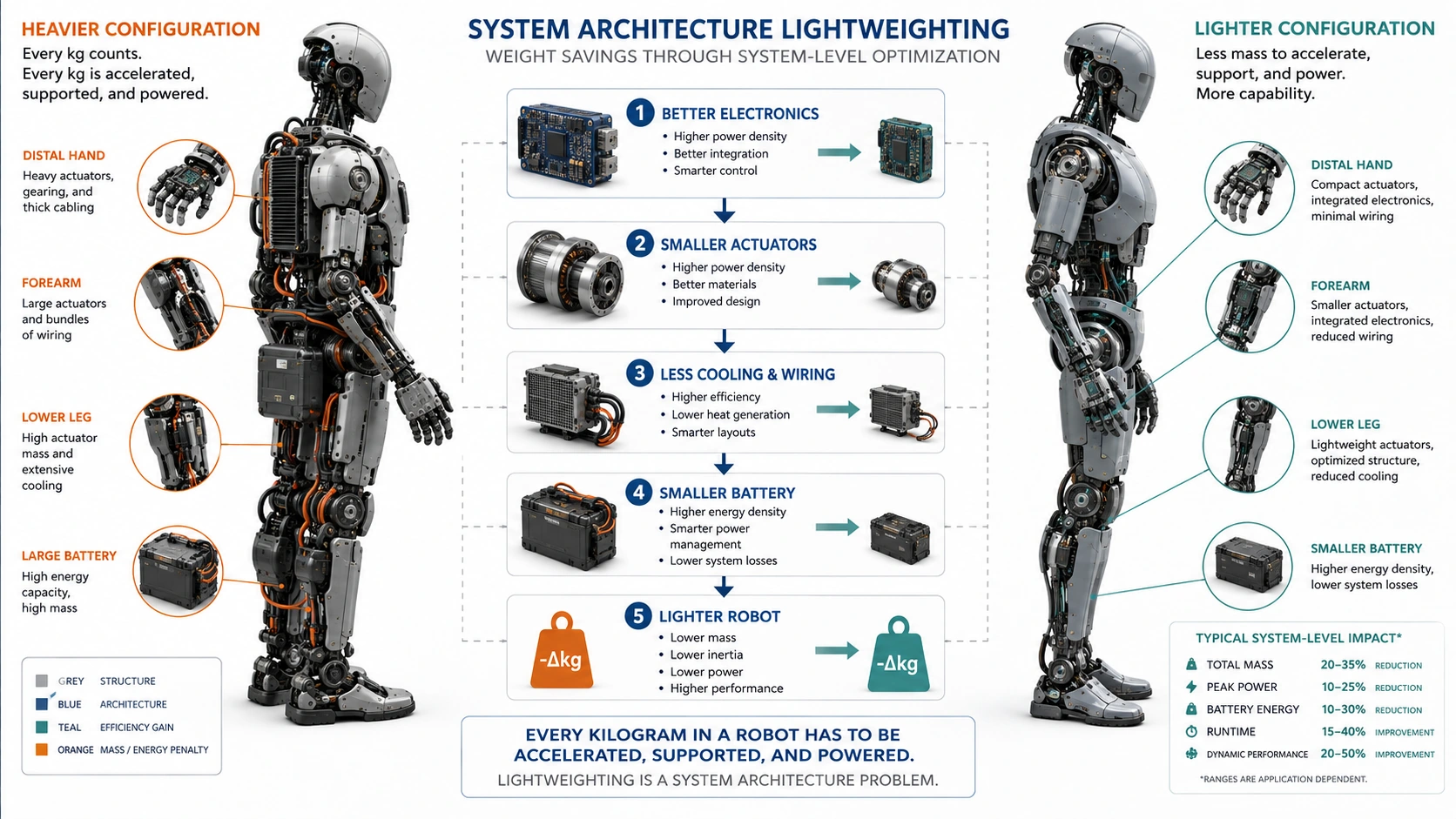
Mass Is a System Constraint, Not a Specification
Robot mass is commonly listed beside height, payload, speed and degrees of freedom. For a mobile robot, however, mass participates in nearly every physical event. It must be manufactured and transported before deployment; supported against gravity while standing; accelerated and decelerated during motion; stabilized during disturbances; and managed again during service, repair and recycling. A robot therefore pays for its own mass repeatedly.
The effect is especially important in humanoids because much of the body is articulated. A kilogram added to a torso is already costly, but a kilogram added to a hand, forearm or lower leg is usually more expensive dynamically. Rotational inertia grows with both mass and the square of its distance from the joint axis. The same distal mass must then be accelerated by one joint while being carried by several joints upstream. Reviews of bipedal humanoid hardware explicitly identify concentrated proximal mass and low-inertia limbs as design advantages for dynamic performance. Humanoid hardware review
This is the foundation of the mass cascade: reducing mass in one place can reduce required torque, which can permit a smaller actuator, lighter structure, smaller inverter, thinner conductors, less cooling and lower energy demand elsewhere.
One Kilogram Is Not Always One Kilogram
The location of mass matters. For a simplified point mass, rotational inertia follows I = mr². Doubling the distance from the axis quadruples the inertia contribution. The same reasoning applies through a kinematic chain: a wrist motor or heavy end-effector is carried not only by the wrist but also by the elbow, shoulder and torso structure. This is why distal mass has disproportionate architectural leverage.
Humanoid design research has repeatedly moved actuators toward the root of a limb or used lightweight couplings, belts, tendons and parallel mechanisms to keep distal inertia low. The objective is not merely to make the link lighter. It is to reduce the torque, energy and control effort required across the chain. Bipedal humanoid hardware review
This leads to a useful design principle: lightweighting should be valued not only by kilograms removed but by where those kilograms disappear. A gram removed from a hand, wrist or lower leg can be strategically more valuable than a gram removed close to the center of mass.
Weight Determines Energy, Payload and Agility Together
The energy relationship is direct. Translational kinetic energy scales with one half of mass times velocity squared. Rotational kinetic energy scales with one half of inertia times angular velocity squared. Every gait cycle, reach, swing and recovery repeatedly stores and releases these energies. A 2025 review of industrial robot energy consumption identifies reduced moving mass and inertia as hardware strategies that lower joint torque requirements and actuator effort. Energy-consumption review
Lower mass can therefore improve runtime with the same battery, or maintain runtime with a smaller battery. The second option is strategically important because battery mass itself then disappears, reinforcing the original reduction. The same logic applies to cooling: lower electrical and mechanical losses reduce heat, which can reduce heatsinks, fans, ducts, pumps or thermal structure.
Mass also competes with useful payload. A robot spends most of its actuator capability moving itself before it moves a tool, part or package. The payload-to-mass ratio is therefore a useful complement to absolute payload. It does not replace task-specific measures, but it exposes whether additional actuator capability is being converted into useful work or consumed by the robot’s own structure.
Agility follows the same physics. For a given torque, lower rotational inertia permits greater angular acceleration. Faster balance recovery, more responsive manipulation and more precise high-bandwidth motion can therefore come from removing inertia rather than simply installing a larger motor.
Recent broad humanoid reviews similarly identify mass distribution, compact high-power-density actuation and efficient dynamics as central hardware challenges. Humanoid robotics review
Mass Becomes a Materials and Supply-Chain Question at Scale
At prototype volumes, a few kilograms may appear to be an engineering detail. At one million robots, each kilogram represents one thousand tonnes of finished product mass before considering manufacturing scrap, refining losses, transport and service logistics. The scaling question is therefore not only cost per robot but material throughput per installed robotic workforce.
Robots combine structural metals, copper conductors, battery materials, electronic materials and often permanent magnets. The International Energy Agency identifies magnet rare earths as strategically exposed materials and notes that automation and robotics are expected to become increasingly important demand drivers beyond 2030. IEA rare-earth analysis The IEA’s 2026 Critical Minerals Outlook also highlights supply concentration and vulnerability across several materials relevant to electrified and automated systems. IEA Critical Minerals Outlook 2026
Lightweighting does not automatically reduce every critical material in equal proportion. A carbon-fibre structure, for example, can lower mass while changing cost and recycling behavior. A smaller motor may reduce magnet and copper demand, but only if the design actually allows the electromagnetic system to be downsized. The correct conclusion is therefore narrower: system mass influences the quantity and type of material that must be secured, processed, transported and recovered, making mass efficiency increasingly relevant to industrial resilience.
Semiconductors Create Mass Leverage Indirectly
The semiconductor package is rarely a dominant part of total robot mass. Its importance is that semiconductor performance changes how much surrounding hardware is required. This distinction separates direct component lightweighting from semiconductor-enabled system lightweighting.
| Semiconductor capability | Immediate effect | Possible robot-level mass consequence |
|---|---|---|
| Lower conduction and switching loss | Less heat generated | Smaller cooling hardware and potentially smaller energy storage |
| Higher switching frequency | Smaller filter and energy-storage passives | Smaller inverter and actuator electronics |
| Higher integration | Fewer packages, connectors and PCB functions | Smaller joint or zonal controller |
| More precise sensing and control | Lower uncertainty and tighter torque control | Reduced engineering margin and actuator oversizing |
| Distributed control | Shorter phase wiring and local feedback | Reduced harness mass and centralized electronics |
| Higher distribution voltage | Lower current for the same power | Reduced conductor cross-section where insulation and safety trade-offs permit |
The relevant metric is therefore not semiconductor grams saved. It is the total robot mass made unnecessary by better electrical architecture.
Power Density Can Move Electronics Into the Joint
Power density matters because joint electronics compete directly with mechanics for space and thermal headroom. Compact motor drives make it possible to place switching, current sensing and control closer to the motor instead of routing long motor phase cables from a centralized inverter bank.
A 2024 PCIM Europe paper demonstrated a complete 48 V gallium-nitride motor drive including power stages, sensing, protection, auxiliary supplies and control support on a 29 × 51 × 9 mm board, reporting roughly 2 kW maximum power and 200 W/cm³ power density. PCIM GaN motor-drive paper The specific implementation is one example rather than a universal prescription, but it illustrates the architectural opportunity created by high-density power electronics.
Wide-bandgap semiconductors such as gallium nitride and silicon carbide can support fast switching and high power density in suitable voltage ranges. Advanced silicon MOSFETs remain highly competitive for many low-voltage robot joints. The correct technology depends on voltage, power, cost, switching frequency, thermal path, EMC and motor characteristics. Lightweighting is therefore a system trade rather than a material slogan.
When power density permits a distributed motor drive, motor phase wires can become short local connections while a DC bus and communication network span the robot. That may reduce harness mass and electromagnetic complexity while making actuator modules more self-contained. The benefit must be balanced against additional local electronics, sealing, serviceability and thermal constraints.
Control Quality Can Replace Mechanical Margin
Robot mechanisms are often oversized because uncertainty has to be absorbed somewhere. Current measurement error creates torque uncertainty. Position error creates commutation and kinematic uncertainty. Poor thermal knowledge creates temperature margin. Slow or non-deterministic control creates transient margin. Designers compensate by adding copper, magnet volume, gearbox capacity, structural stiffness or cooling.
Better electronics can reduce some of that uncertainty. High-bandwidth current sensing, accurate position sensing, synchronized acquisition, deterministic motor-control microcontrollers and robust estimation can allow a joint to operate closer to its validated physical limits. That does not eliminate safety margin; it replaces unknown margin with characterized margin.
This is an important distinction. A smaller actuator is not justified because control software is sophisticated. It becomes justifiable only when sensing, modeling, diagnostics and validation demonstrate that required torque, thermal and lifetime limits remain satisfied. Semiconductor-enabled lightweighting therefore depends on evidence as much as efficiency.
Voltage Architecture Is Also a Weight Decision
Electrical power is the product of voltage and current. For a fixed transmitted power, higher voltage reduces current. Resistive conductor loss scales with current squared, so a higher distribution voltage can reduce either loss or conductor cross-section. In robots with several kilowatts of peak power and long articulated harnesses, this can become a meaningful mass trade.
The optimum voltage cannot be selected from copper mass alone. Higher voltage increases requirements for insulation, creepage, connectors, fault isolation, pre-charge, switching devices and safety procedures. The architecture therefore balances conductor mass against protection and insulation mass. The important point is that semiconductor voltage capability and protection technology influence a mechanical quantity: harness weight.
Regeneration Changes Both Energy and Thermal Mass
Humanoid joints do not only consume power. During deceleration, lowering and disturbance absorption they can perform negative mechanical work. If this energy is dissipated as heat, the robot pays twice: once through lost battery energy and again through thermal-management requirements. If the architecture captures regenerative energy, part of that burden can be reduced.
Regeneration is mission-dependent. Battery charge acceptance, bus voltage, simultaneous joint activity and state of charge determine whether recovered energy can be reused. The energy benefit should therefore be measured over representative mission profiles rather than inferred from peak regenerative power. Locomotion researchers often normalize energy expenditure using cost of transport, which relates energy use to body weight and distance travelled. The broader lesson is that mass, motion and energy have to be evaluated together.
Lightweighting Has Limits
Mass is not intrinsically bad. Structural mass provides stiffness, impact resistance, thermal capacity and sometimes stability. A heavier base can improve manipulation reaction forces. Larger conductors can improve transient performance and reliability. Heatsinks can provide passive cooling without fans. Mechanical compliance, topology optimization and lightweight materials can introduce vibration, fatigue, manufacturing or service challenges.
Balanced-manipulator research demonstrates another path: gravity compensation can reduce actuator torque without necessarily minimizing every component’s mass. Balanced manipulation review Likewise, published lightweight humanoid platforms show that successful designs still need to integrate robustness, locomotion, electrical architecture and cost rather than pursue minimum mass in isolation. Lightweight humanoid mechatronics
The objective is therefore not the lightest possible robot. It is the lowest mass that still satisfies payload, stiffness, thermal, safety, lifetime, environmental and service requirements.
Measure Mass by Leverage, Not Only by Scale
A future robot architecture scorecard should include total robot mass, payload-to-mass ratio, battery mass fraction, actuator mass fraction, distal limb mass and electronics power density. A further metric can capture the cascade itself:
Mass leverage factor = total robot mass avoided / direct subsystem mass avoided.
If a 200 gram electronics reduction permits another 800 grams of actuator, cooling, wiring and structure to disappear, the electronics change has a mass leverage factor of five. The value will vary by location and architecture, but the concept forces teams to look beyond the component boundary.
The same logic can be applied during design reviews. Instead of asking only whether a new semiconductor is more efficient, ask what system requirement changes because it is more efficient. Does the heatsink shrink? Can the bus capacitor shrink? Does the cable cross-section change? Can the motor operate at a higher utilization? Does the battery requirement move? If nothing else changes, the semiconductor improvement may be electrically valuable but it has not yet created a mass cascade.
Conclusion
Every kilogram in a robot has consequences beyond the scale. It consumes material before assembly, logistics during deployment, torque during motion, energy during acceleration, control authority during disturbances and recycling effort at end of life. In humanoids, the cost of distal mass is amplified because several upstream joints must carry and accelerate it.
That makes lightweighting a system-architecture discipline. Mechanical structures, transmissions, motors, batteries, conductors, cooling and electronics cannot be optimized independently. Better semiconductor technology contributes most when it changes the boundary conditions of those neighboring systems: lower loss reduces thermal hardware; higher switching frequency shrinks passives; integration reduces electronics and connectors; precise control reduces oversizing; distributed drives shorten wiring; and optimized voltage architecture reduces current.
The strategic design question is therefore simple: not how many grams a semiconductor package saves, but how many kilograms of robot become unnecessary because the complete electrical and mechanical architecture improved.