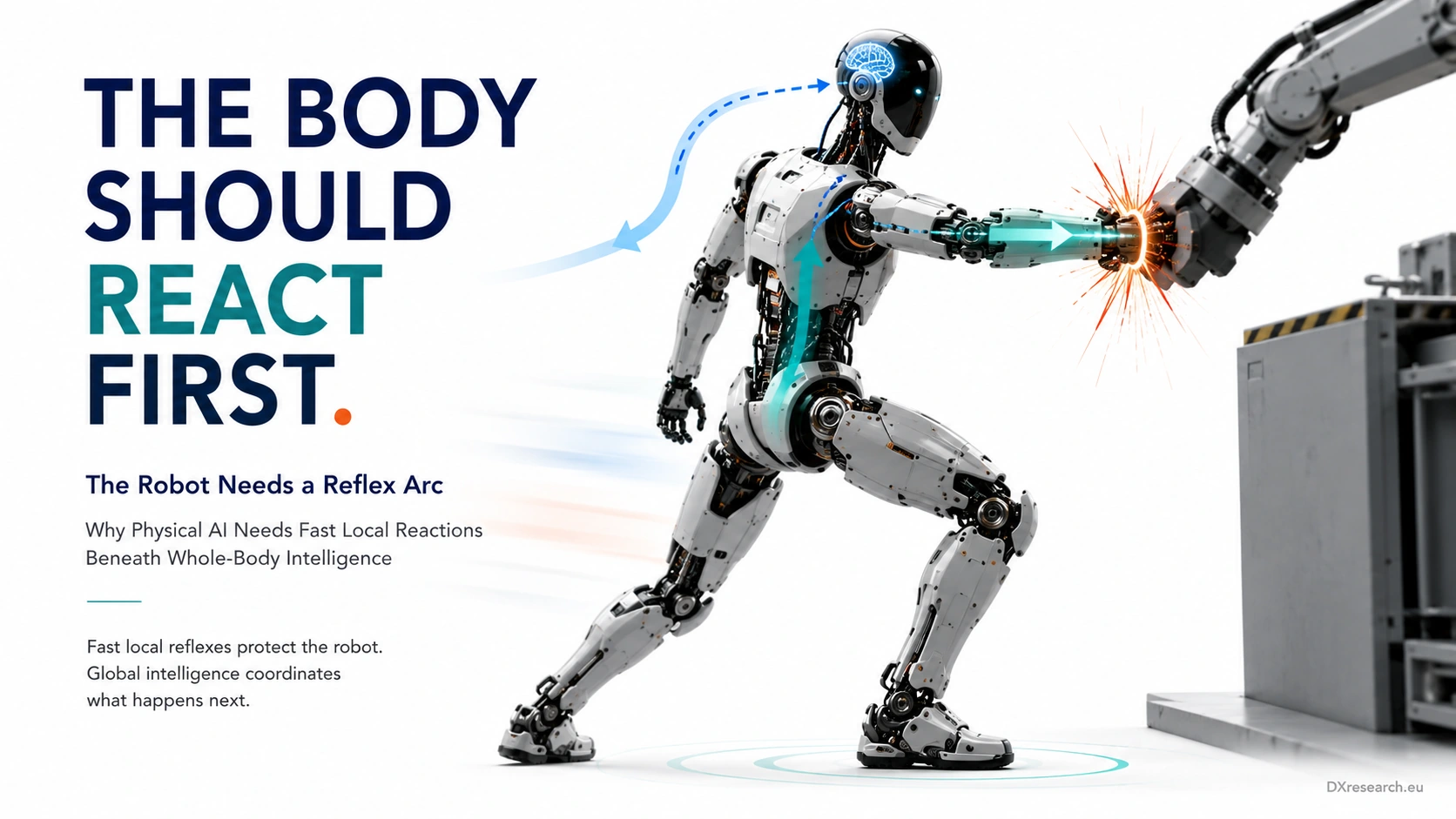
Physical Events Do Not Wait for Deliberation
A humanoid operates where software decisions become forces. When a forearm hits a fixture, a foot begins to slip, a joint is back-driven, or a carried object shifts, the physical state can change before a perception-planning-control chain completes another cycle. Reaction latency includes acquisition, conversion, filtering, transport, scheduling, estimation, decision, command transport, motor-control execution and mechanical response. Semantic interpretation needs many of those stages; the first bounded physical response often does not. A scalable architecture therefore separates immediate mitigation from subsequent understanding and whole-body recovery.
A Reflex Is Not a Smaller AI Model
A robot Reflex arc is a deliberately short sensor-to-action path. It need not identify the object or infer intent before producing a limited response. Tactile-reflex research demonstrates distributed skin forces being converted through kinematics into interaction joint torques and reflex behavior represented by a virtual mass-spring-damper system. [1] Earlier humanoid self-protection work combined precoded Local reflex behavior, intended to reduce impact at an individual limb, with a coordinated Global reaction intended to reduce whole-body damage. [4] Local control owns immediacy; global control owns consistency.
The Sensing Problem Is Evidence, Not Just Detection
A reflex cannot be better than its evidence. Tactile feedback can localize contact; force/torque sensors provide direct mechanical evidence; motor current contributes torque evidence; encoders expose motion inconsistency; IMUs reveal body disturbance. Whole-body tactile research shows that distributed skin resolves contact information that can be ambiguous with wrist or ankle force sensing alone, and integrates tactile and proximity feedback into real-time compliance, force regulation and collision avoidance. [2] Distributed tactile sensing has also enabled intermediate forearm and thigh contacts in humanoid multicontact motion. [3] The trigger should therefore encode validity and confidence, not merely one threshold.
The Semiconductor Reflex Chain
The shortest useful loop passes through real electronics: sensor interface, analog front end where required, ADC or digital acquisition, hardware timing, real-time MCU, motor-control algorithm, PWM, gate driver, power semiconductor stage and actuator. Current sensing already needed for field-oriented control can contribute disturbance evidence; position sensing establishes joint state; tactile or force interfaces add direct contact evidence. Locality reduces transport dependence, but the node must report event type, estimated External torque, reflex action, confidence and fault state upward through Deterministic communication. A local controller should be fast, not invisible.
Reflex, Motor Control and Protection Are Different Layers
Normal motor control regulates current, torque, velocity or position. A reflex modifies physical behavior after a defined external event. Independent protection reacts to electrical or execution faults that software must not be trusted to manage alone. A gate-driver overcurrent response or Watchdog is therefore not the reflex itself. This separation makes verification possible: reflex software can request lower torque, increased compliance or retreat; hardware still enforces absolute limits; Whole-body control still enforces balance, contacts and robot-level constraints.
Why the Reflex Must Be Bounded
Fast action without explicit Control authority can make the robot worse. A local elbow retreat can conflict with a whole-body controller using that arm as a stabilizing support. The solution is a Reflex envelope defining maximum torque change, response duration, allowed direction, joint limits, current and thermal limits, sensor confidence and operating mode. Within that envelope the local node can act immediately. Outside it, authority escalates. This turns a vague hierarchy into an engineering contract that can be tested.
Whole-Body Control Must Absorb the Consequence
A reflex changes joint torque, momentum, contact force or configuration. The global controller must receive that changed state and coordinate balance and task recovery. Real-time humanoid tactile control demonstrates contact information entering weighted objectives and hard constraints rather than remaining a disconnected protective signal. [2] The useful sequence is detect locally, mitigate locally, report immediately, coordinate globally. Minor contact may use Impedance control or Admittance control; larger disturbances can require posture changes, new contacts or stepping. If physical consistency cannot be preserved, supervision moves toward a Minimum-risk response.
Timing Is Part of the Architecture
Locality does not remove timing requirements. Acquisition, detection, actuation and the state reported upward need credible temporal relationships. Otherwise the supervisor can react to an event whose local mitigation has already changed the robot. Hierarchical control therefore needs bounded event-to-actuation delay, bounded information age and deterministic handoff between layers. Average bandwidth is a weak KPI; latency distribution, jitter, missed deadlines and reconciliation time are stronger measures.
Testing the Reflex Arc
Verification should use repeatable physical disturbances at hand, forearm, torso and leg; vary impact direction and speed; inject sensor latency, packet jitter and stale timestamps; remove one evidence source; force saturation; and deliberately create conflicts between local retreat and a global support task. Measure peak contact force, impulse, event-to-torque latency, overshoot, recovery time, balance disturbance, false triggers and unnecessary stops. Then test the envelope itself: duration expiry, supervisor override, low-confidence behavior, watchdog independence and recovery to useful work.
The Architectural Payoff
The reflex arc is not primarily about copying biology. It partitions Physical AI by timescale and scope. Semantic interpretation belongs where context is richest. Whole-body coordination belongs where robot state and contacts can be considered together. The fastest bounded reactions belong near the sensors and actuators experiencing the event. That partition creates a semiconductor architecture spanning sensor interfaces, ADCs, current sensing, real-time MCUs, deterministic networking, gate drivers, power stages and independent supervision—and prevents every millisecond-scale event from waiting for deliberation.
Conclusion
Physical AI needs both thought and reflex. Central intelligence should understand goals, environments and consequences. Whole-body control should preserve physical consistency. But selected contacts, impacts, slips and overloads deserve a shorter path from evidence to bounded action. The design principle is simple: react locally, expose the reaction globally, and keep authority explicit. The body should react first when waiting would only allow the physical problem to grow.
Glossary Concepts
Reflex arc; Local reflex; Global reaction; Hierarchical control; Reaction latency; Reflex envelope; Control authority; External torque; Tactile feedback; Whole-body control; Impedance control; Admittance control; Watchdog; Deterministic communication; Minimum-risk response.
References
- Mechatronics. A tactile reflex arc for physical human–robot interaction. 2025. https://doi.org/10.1016/j.mechatronics.2025.103307
- Advanced Intelligent Systems. Real-Time Control of a Humanoid Robot for Whole-Body Tactile Interaction. 2025. https://doi.org/10.1002/aisy.202500149
- arXiv. Whole-body Multi-contact Motion Control for Humanoid Robots Based on Distributed Tactile Sensors. 2025. https://arxiv.org/abs/2505.19580
- Neural Networks. Self-protective whole body motion for humanoid robots based on synergy of global reaction and local reflex. 2012. https://doi.org/10.1016/j.neunet.2012.02.011