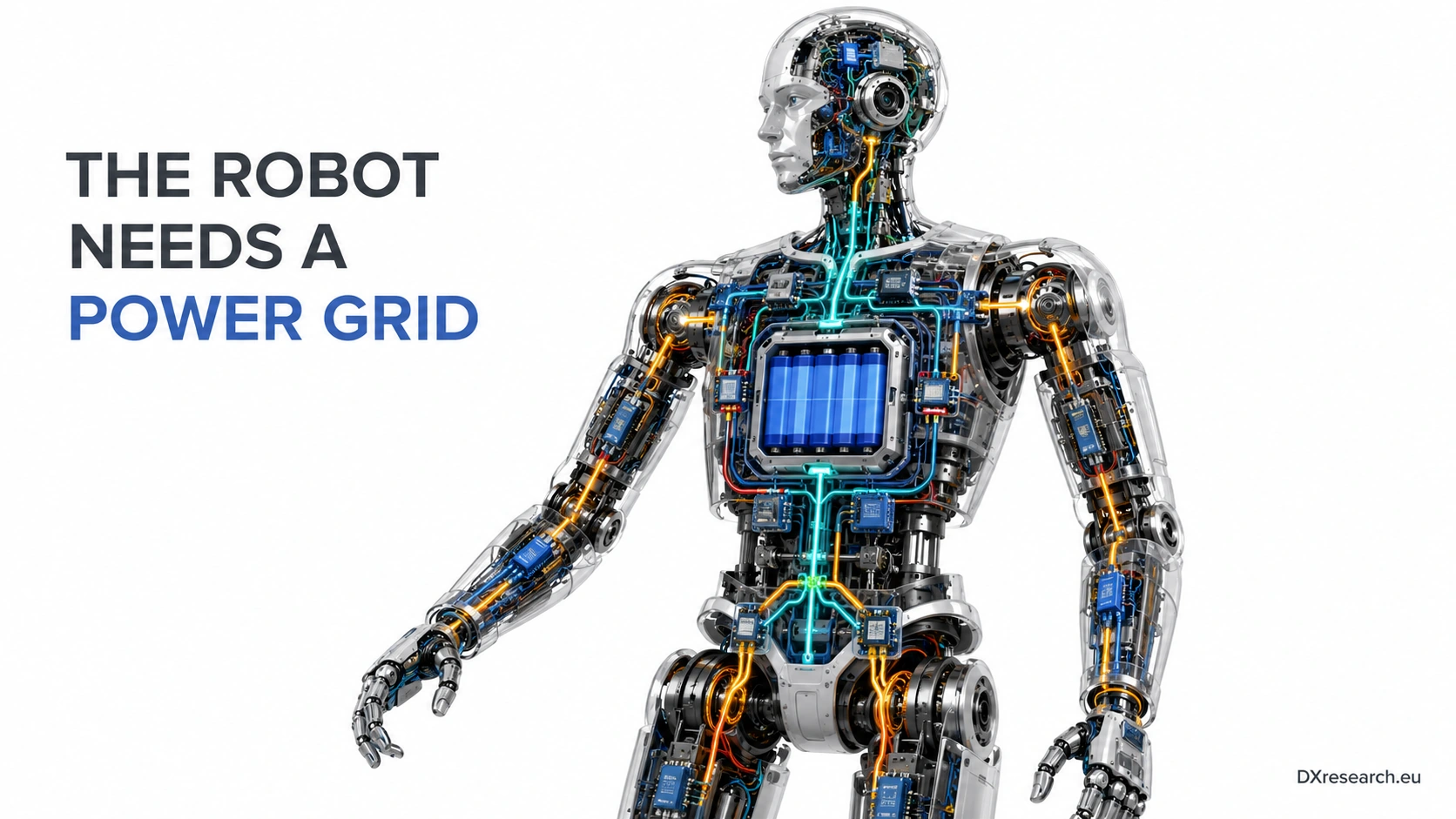
The central thesis of this chapter is that the humanoid body needs a robot power grid: a hierarchical, protected, observable, and bidirectional architecture that connects the battery to every electrical function. The battery stores energy. The grid determines whether that energy arrives at the right voltage, with acceptable noise, sufficient transient capability, controlled fault behavior, and useful diagnostic context.
The Missing Architecture Between Battery and Motion
Discussions of robot runtime often move directly from battery capacity to actuator efficiency. That shortcut misses the architecture between source and motion. A humanoid contains many actuator inverters, local controllers, perception sensors, safety functions, communication interfaces, cooling devices, memories, and compute modules. Their electrical requirements are not equivalent. A knee drive may demand a large pulse of current; a camera may require a quiet rail; a safety controller may require availability even when a nonessential limb is isolated.
Existing robots already illustrate this hierarchy. The TOCABI humanoid used a 48 V motor level together with 24 V, 12 V, and 5 V rails for other functions, demonstrating that a full robot naturally becomes a multi-rail electrical system [1]. Recent power-distribution discussions for dexterous humanoids likewise describe battery-derived intermediate buses, including 48 V-class architectures, followed by conversion closer to constrained subsystems such as hands [7]. The durable lesson is not that every humanoid should use one particular voltage. It is that energy distribution should be intentionally layered.
Why a Wiring Harness Is Not Enough
A conventional harness is primarily a passive transport structure. A humanoid needs more. Whole-body motion can shift load rapidly between joints. A stalled actuator can turn a valid peak into a sustained overload. Compute can enter high-power states abruptly. Cable and connector resistance can change with bending, vibration, contamination, wear, and service cycles. One branch can therefore disturb another through shared impedance even when both subsystems are individually functional.
This is a robot-scale power integrity problem. Excessive voltage sag can reduce available torque or trigger undervoltage behavior. Fast switching edges can couple into sensitive sensing and communication circuits. Protection that reacts too slowly can expose semiconductors, connectors, or conductors to damaging energy; protection that reacts too aggressively can shut down the machine during valid motion peaks. Electrical design must therefore consider transient load envelopes, fault energy, rail interaction, and recovery behavior as system properties.
IEC 60204-1 provides a useful machinery-level reference for electrical equipment, including protection, control circuits, protective bonding, and power-drive-system considerations [5]. A humanoid will not map perfectly onto every industrial-machine assumption, but the design principle transfers directly: electrical protection and controlled behavior belong in the architecture, not as an afterthought attached to the wiring diagram.
From Central Distribution to Zonal Power Nodes
The humanoid body already provides a natural segmentation model: left and right legs, torso, arms, hands, head, battery, and compute. Zonal power distribution places switching, measurement, protection, and selected conversion functions close to these physical regions. The central bus carries power over longer distances; local nodes establish controlled electrical boundaries around modules that also make sense mechanically and for service.
Zonalization creates several benefits at once. Higher distribution voltage can reduce current for a given transferred power and therefore reduce conductor cross-section, while local conversion prevents low-voltage high-current rails from being routed unnecessarily across the body. Local measurement makes load behavior visible. Fault isolation can occur near the source of the problem. Diagnostics can name the affected zone instead of reporting only a pack-level anomaly.
Infineon’s humanoid application architecture spans motor control, battery management, power distribution, sensing, compute interfaces, connectivity, memory, and security, illustrating how semiconductor functions increasingly meet at system boundaries rather than remaining isolated product categories [3]. A practical zonal node can therefore combine power switches, sensing, local conversion, a microcontroller, a network interface, and nonvolatile diagnostic storage.
Protection Must Understand Dynamic Loads
Traditional fuses remain valuable as irreversible protection devices, but robots also benefit from controllable branch protection. An electronic fuse or protected semiconductor switch can measure current, enforce configured thresholds, disconnect a branch, retry under defined conditions, and report the event. This matters because a humanoid's valid operating envelope is dynamic. A large current spike during acceleration can be legitimate; the same current sustained during a blocked joint can indicate a fault.
The correct architecture is layered rather than purely software-defined. Semiconductor devices need fast local protection against destructive electrical and thermal stress. Branches need protection fast enough to limit cable, connector, and switch fault energy. Zonal controllers need enough intelligence to sequence loads, classify events, and coordinate retries. At the robot level, energy management and safety logic decide how the machine should degrade, stop, or redistribute work.
ISO 10218-1:2025 reinforces the broader need for inherent risk reduction and predictable protective behavior in industrial robot design [6]. Electrical architecture is only one contributor to that behavior, but it is the layer that determines whether a local electrical event remains local.
| Protection layer | Typical responsibility | Representative semiconductor functions | Robot-level value |
|---|---|---|---|
| Device | Protect switch or converter | Overcurrent, thermal and gate protection | Prevents local semiconductor destruction |
| Branch | Protect conductor, connector and load path | Current sensing, eFuse, protected switch | Contains a subsystem fault |
| Zone | Manage local voltage, sequencing and health | MCU, ADC, DC/DC, telemetry, memory | Enables controlled degradation and diagnostics |
| Robot | Coordinate total energy and safe state | BMS, safety controller, communications | Maintains mission-aware electrical behavior |
Regeneration Changes the Direction of Power Flow
Actuators do not only consume energy. During deceleration, lowering, impact absorption, or externally back-driven motion, an electric motor can operate as a generator. The resulting regenerative energy returns toward the DC bus. Measurements and modeling of a Unitree G1 arm include negative net-power states on some trajectories, a direct reminder that humanoid electrical power cannot be modeled as a one-way battery-to-load stream [4].
Returned energy is useful only if the system can accept it. The battery may be able to absorb it within state-of-charge, temperature, and current limits. Another load may consume it at the same instant. A converter may redirect it. If no receiving domain can safely accept the energy, DC-bus voltage rises and the architecture must respond through clamping, braking, load activation, or motion intervention. Regeneration is therefore not merely an efficiency feature; it is a power-flow control problem.
The Battery Management System Is Necessary but Not Sufficient
The battery management system remains the electrical authority for the pack. It monitors cell voltage and temperature, estimates battery state, supports balancing, controls charge and discharge protection, and communicates available capability. Infineon’s mobile-robot development platform demonstrates a 12-series-cell BMS using the TLE9012DQU battery-monitoring and balancing IC in a 44.4 V nominal architecture, with modular hot-swappable batteries [8]. The TLE9012DQU itself provides multi-channel cell-voltage and temperature measurement, balancing, diagnostics, and isolated communication functions [9].
Renesas similarly frames a humanoid BMS as a coordinated system containing monitoring, balancing, pack protection, current and voltage measurement, communications, auxiliary power, and thermal supervision [2]. Yet the pack cannot resolve every downstream event. A connector in one arm can develop resistance and heat while total battery current still looks plausible. A short transient can disappear before a central observer can identify the affected branch. Battery intelligence and distribution intelligence therefore solve different problems: the BMS protects and characterizes the energy source; zonal nodes observe and protect how energy is delivered and returned throughout the body.
Power Telemetry Becomes a Sensor for Physical AI
Electrical measurements have value beyond protection. Motor current is related to electromagnetic torque. Converter temperature reveals sustained load. Bus sag exposes source and path impedance. Repeated current spikes can reveal friction, binding, poor tuning, connector degradation, or changing task conditions. Energy accumulated by zone can quantify the electrical cost of a mission profile rather than estimating it only from battery depletion.
This turns the power grid into part of the sensing architecture. Motion planning can incorporate energy headroom. Maintenance systems can correlate changing resistance or thermal patterns with service history. Safety logic can combine electrical anomalies with joint state and commanded motion. Fleet analytics can compare electrical signatures across robots performing the same work. Observability makes the grid useful to Physical AI because electrical behavior becomes machine-readable evidence about the physical system.
Semiconductor Architecture: From Components to Power Nodes
There is no single semiconductor that constitutes the robot power grid. The architecture is assembled from coordinated layers: power MOSFETs or other power devices, gate drivers, protected switches, current and voltage sensing, battery-monitoring ICs, DC/DC converters, microcontrollers, communication transceivers, isolation where necessary, security functions, and memory. The system challenge is to expose sufficient control and telemetry without adding excessive wiring, cost, software complexity, or conversion loss.
| Grid function | Required behavior | System-defining semiconductor layer |
|---|---|---|
| Battery authority | Cell supervision, state estimation, pack protection | Battery-monitoring IC, MCU, current sensing, isolation |
| Main-bus switching | Inrush control, disconnect, fault isolation | Power switches, gate drivers, sensing |
| Zonal distribution | Branch control, measurement and telemetry | MCU, eFuse, ADC, transceiver, NVM |
| Local conversion | Create load-specific rails efficiently | DC/DC control and power stages, integrated regulators |
| Actuator interface | High peak current, regeneration, fast protection | Three-phase inverter, gate driver, current sensing, motor-control MCU |
| Low-noise sensing | Stable rails isolated from large transients | Low-noise regulation, filters, supervision, references |
Design Rules for a Scalable Humanoid Power Grid
First, choose the distribution voltage from whole-robot tradeoffs, not motor convenience alone. Raising voltage reduces current for a given power, which can reduce copper and conduction loss, but it also raises device-voltage requirements, insulation demands, switching constraints, and available fault energy. Second, align electrical zones with mechanical modules and service boundaries so that power isolation, replacement, and diagnostics describe the same physical structure.
Third, make major current paths observable. A branch that cannot report current, voltage, temperature, or fault state becomes difficult to diagnose across a fleet. Fourth, define availability classes. Essential communication, safety control, and selected perception functions may need to remain alive while a hand, joint group, accelerator, or cooling load is intentionally disabled. Fifth, model regeneration explicitly in the energy and overvoltage strategy instead of treating it as free efficiency.
Sixth, coordinate startup, shutdown, and recovery. A robot should not assume that every rail and load can connect simultaneously after battery insertion or a hot swap. Sequencing reduces inrush stress and makes fault localization clearer. Finally, log power events with temporal context. A fault code without the current, voltage, temperature, motion state, and sequence leading to it is weak evidence for root-cause analysis.
What Changes Over the Next Five Years
As humanoids move from demonstrations toward deployed fleets, internal power architecture will become more modular and more software-visible. Wiring mass, assembly effort, and service cost will push designers toward structured buses and zonal electronics. Rising actuator power density will increase transient and regenerative demands. Battery exchange and hot-swap concepts will make isolation and sequencing more important. Energy-aware planning will require telemetry that is faster and more granular than a single pack state-of-charge value.
The direction resembles changes already visible in vehicles and industrial automation: value shifts from isolated conversion components toward managed power domains with communication, diagnostics, and coordinated protection. Humanoids add a distinctive constraint because their grid bends, accelerates, absorbs impacts, and must fit inside a structure optimized for motion. Electrical architecture therefore becomes part of mechanical architecture and control architecture at the same time.
Conclusion: Intelligence Needs an Electrical Backbone
A humanoid is not a battery connected to motors. It is a distributed electrical machine whose physical intelligence depends on stable, protected, and observable energy delivery. The internal grid must route power efficiently, preserve critical rails, contain faults, support regeneration, expose health information, and scale across modular limbs and changing compute loads.
That makes the robot power grid a semiconductor-defined system problem. Power devices determine efficiency and fault energy. Sensors create observability. Controllers apply local policy. Communication connects zones. Battery-monitoring devices protect the source. Memory preserves diagnostic evidence. Together, these functions create an electrical backbone that knows where energy is moving, whether the path remains healthy, and how the robot should respond when the electrical state changes.
For Physical AI, every watt is both energy and information.