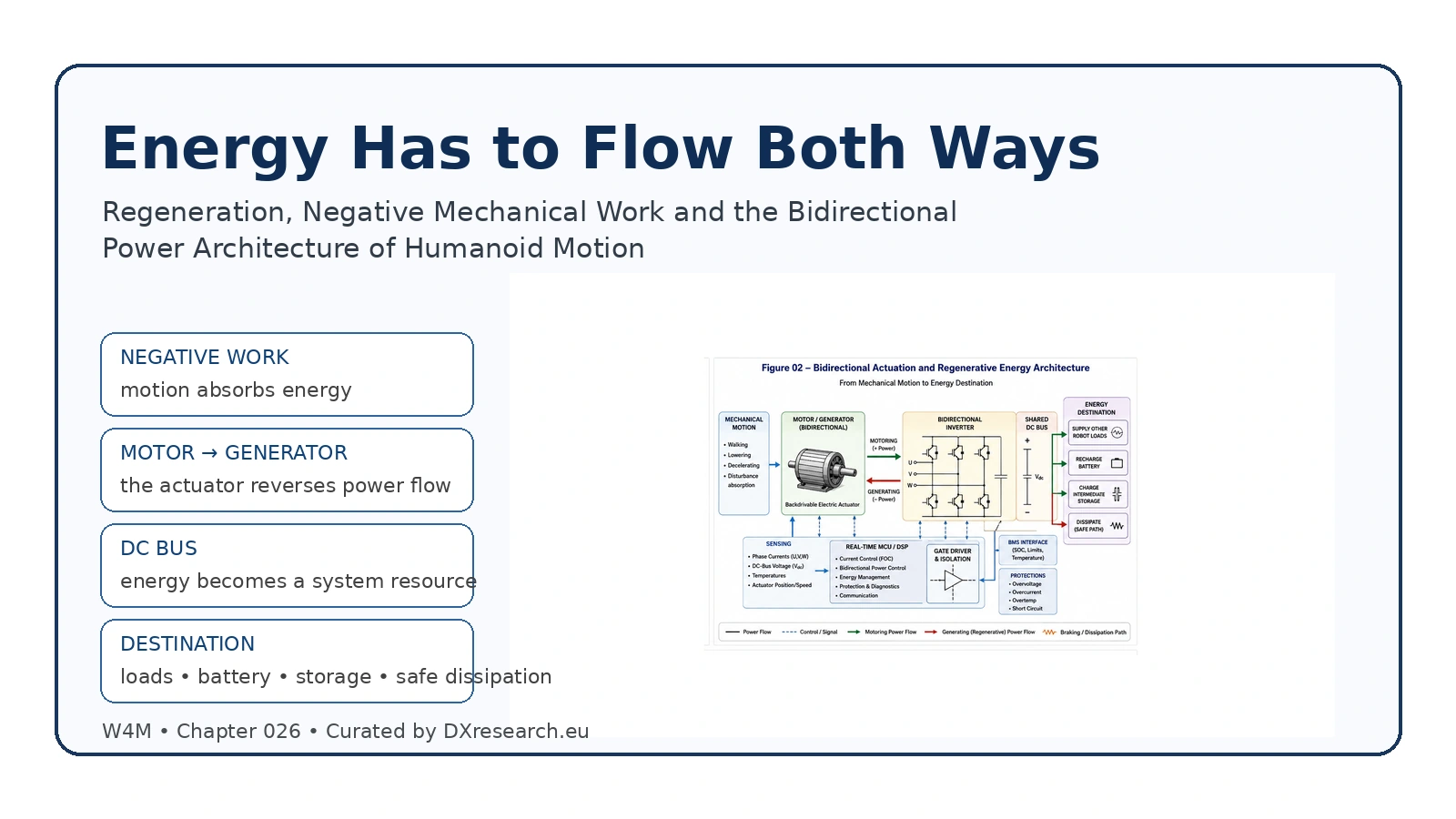
Executive Summary
Humanoid robots do not only consume mechanical power. During walking, lowering loads, decelerating limbs and absorbing disturbances, many joints perform negative mechanical work. If the drive architecture dissipates that energy as heat, the robot loses runtime while increasing thermal stress. This chapter treats regeneration as a whole-body energy-flow problem rather than a motor feature. It explains how backdrivable electric actuators can shift from motoring to generating, how bidirectional inverters return current to a shared DC bus, and how the system must decide whether recovered energy should feed concurrent loads, recharge the battery, enter an intermediate storage element, or be dissipated safely. Battery state, temperature, charge acceptance, bus voltage, semiconductor losses and simultaneous joint events constrain what can be recovered. The semiconductor architecture therefore needs bidirectional power stages, current and voltage sensing, coordinated control, protection, braking paths and energy-aware software. Efficient humanoids must manage energy in both directions across motion cycles.
Motion Is Not a One-Way Energy Problem
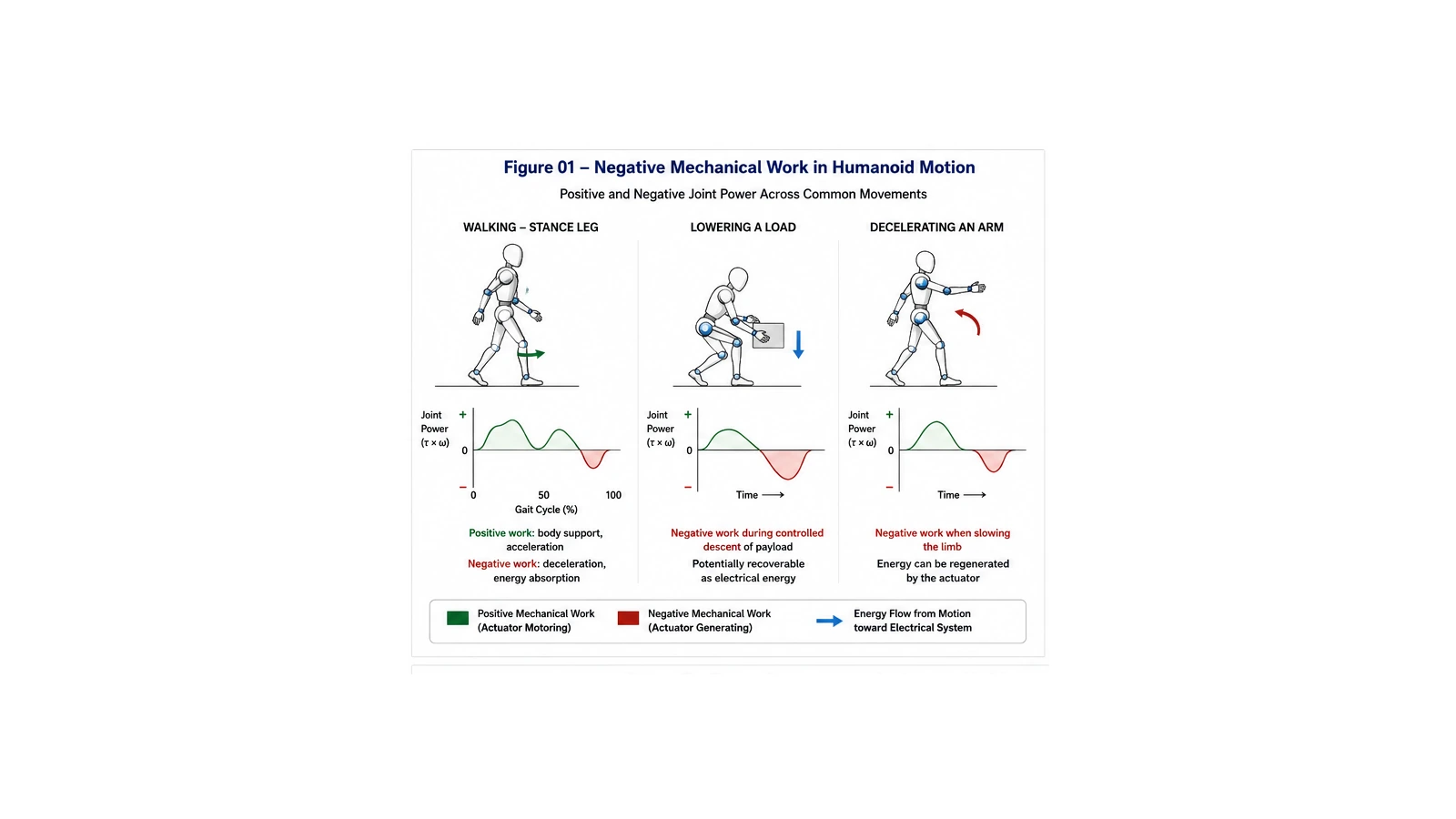
Humanoid robots are usually drawn as energy consumers: a battery feeds a DC bus, power electronics energize motors, and motors create motion. That picture is incomplete. A moving robot repeatedly enters phases in which its mechanisms absorb energy rather than produce it. At a joint, mechanical power is the product of joint torque and joint angular velocity. When torque acts in the direction of motion, the joint performs positive work. When torque opposes motion, the joint performs negative mechanical work. Human gait measurements show these alternating positive and negative phases at the hip, knee and ankle, and the amount of each changes with locomotion task and speed.[1]
For a robot, negative work appears during controlled deceleration, lowering a payload, absorbing a push, settling after a step, braking a swinging limb, or transferring energy between body segments. It is not automatically waste. If the electromechanical drivetrain is sufficiently backdrivable, the motor can operate as a generator and push electrical power back through the inverter. Recent measurements on a physical Unitree G1 arm explicitly identify negative net-power trajectories during coordinated motion, demonstrating that reverse electrical power flow is already observable in contemporary humanoid hardware.[2]
From Negative Work to Regenerative Energy
The central conversion is straightforward in principle. A permanent-magnet or other electric machine that produces torque from electrical current can also produce electrical power when mechanical motion drives it. The difficult part is making the surrounding system accept that power predictably. Humanoid actuator research emphasizes that transmission architecture, backdrivability, bandwidth and mechanical design strongly influence how naturally an actuator can exchange energy with the mechanism.[3] Energy-efficient humanoid leg research reaches the same broader conclusion: mechanism and actuator choices materially affect lower-body electrical energy demand and therefore the recoverable-energy opportunity.[4]
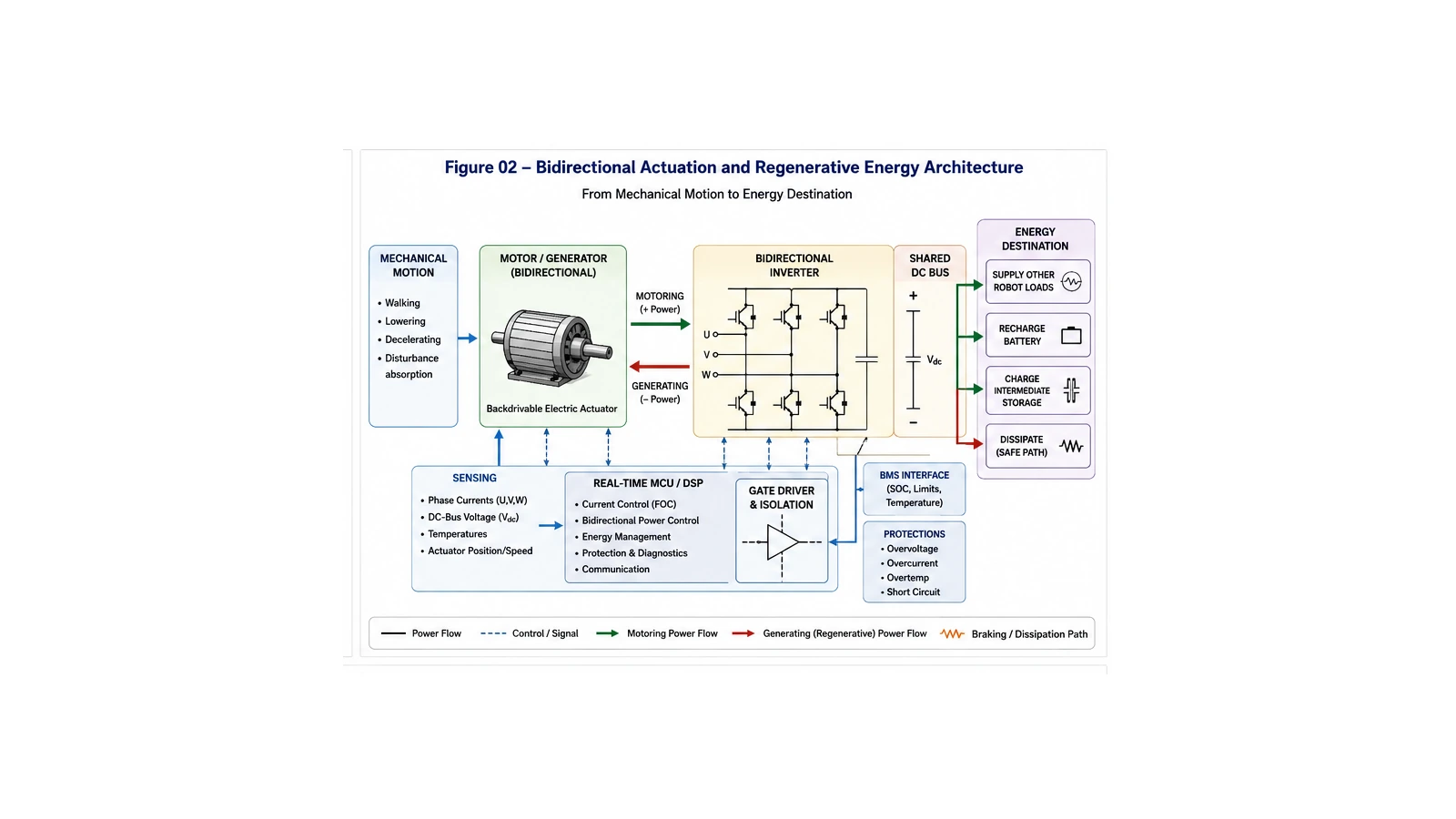
The useful electrical quantity is regenerative energy: energy returned toward the DC bus when an actuator operates as a generator. Regeneration does not require a special second motor. It requires a power stage and control strategy that can command current in both torque directions while managing reverse power flow. Automotive traction inverters provide a mature reference architecture. They regulate motor torque during propulsion and enable regenerative braking that returns energy toward the battery, using power switches, gate drivers, current sensing, real-time control and protection.[5]
Robotics adds a distinctive complication. A humanoid may have dozens of actuators entering motoring and generating states at different times. The robot power grid must therefore behave less like a passive harness and more like a shared energy network. One joint can be decelerating while another accelerates. If their timing overlaps and the bus architecture permits it, regenerated power can support an active load without first being stored chemically. This is often the most efficient destination because it avoids an additional battery charge-discharge conversion cycle.
The DC Bus Becomes the Coordination Point
Regenerative power first appears as a tendency for DC-bus voltage to rise. That makes bus-voltage sensing a primary control signal rather than merely a diagnostic. If the system has enough concurrent load, reverse power can be consumed immediately elsewhere. If not, the energy-storage system must accept it. A bidirectional DC/DC stage can deliberately control power between buses or between a DC bus and storage; Texas Instruments demonstrates this principle in a digitally controlled bidirectional buck-boost reference design intended for regeneration and battery-charging applications.[6]
The battery is not an infinite sink. Its charge acceptance depends on chemistry, state of charge, temperature, voltage, cell balance, aging and the duration of the power pulse. Peer-reviewed fast-charge work shows that safe lithium-ion charging boundaries change materially with temperature, cell voltage and pulse conditions.[7] A battery management system must therefore communicate more than an estimated state of charge. For regenerative operation it should expose a dynamic acceptance envelope: how much reverse power can be absorbed now, for how long, and with what margin.
If generated power exceeds all useful destinations, DC voltage continues to rise. That condition is DC-bus overvoltage, and it requires a deterministic protection response. A practical 24/48-V servo reference from STMicroelectronics includes dedicated circuitry to control bus voltage during regenerative braking and can divert power to an external resistor that clamps the bus at a safe level.[8] The resistor is energetically inefficient, but it is functionally essential when the alternative is overstressing power semiconductors, capacitors, connectors or battery interfaces.
Useful Energy Has a Priority Order
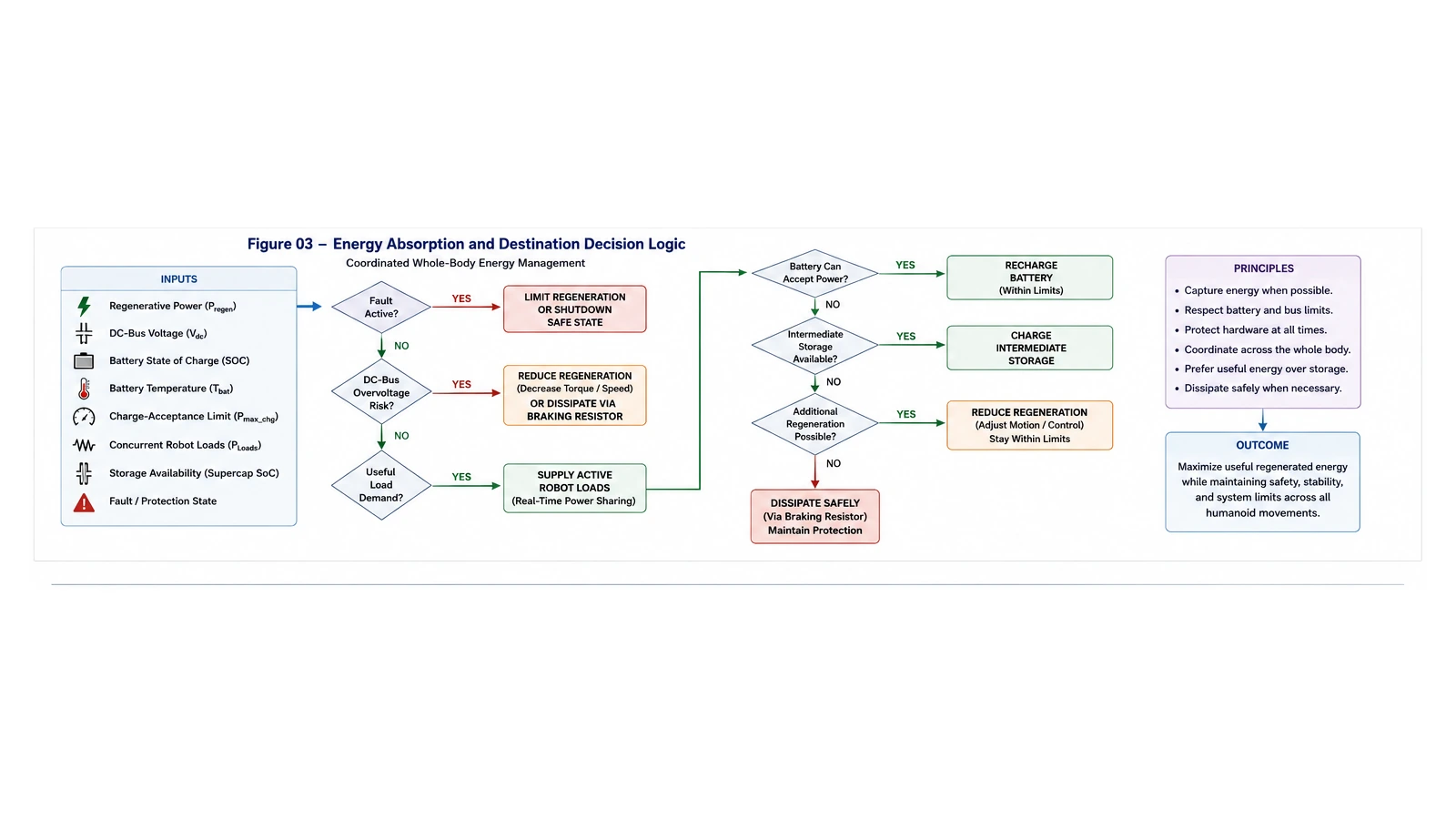
A robust humanoid should therefore treat regenerated energy through an explicit hierarchy. First, supply concurrent robot loads when the shared bus allows direct power exchange. Second, charge the main battery within its permitted acceptance envelope. Third, use intermediate storage where the architecture provides it; a supercapacitor or dedicated buffer can absorb short high-power bursts that a high-energy battery may reject. Fourth, reduce regenerative torque or reshape motion when the electrical system approaches its limits. Finally, dissipate residual energy through a controlled braking path when no reversible destination remains.
This hierarchy is not only an efficiency policy. It is a stability policy. The motion controller cannot demand unlimited negative torque independently of the power system. If the battery is cold and nearly full, the safe electrical regeneration limit may fall far below the mechanical braking capability. Conversely, if another set of joints is accelerating, the system may accept a large regenerative pulse because that power is immediately consumed. The permissible braking envelope is therefore state dependent.
Regeneration Is a Control Problem Before It Is an Efficiency Number
It is tempting to ask what percentage of humanoid energy can be recovered. A single universal percentage is misleading. Recovery depends on task, gait, transmission, motor efficiency, inverter losses, battery acceptance, the timing of positive and negative work, and whether mechanical elastic elements already recycle part of the energy internally. Human locomotion itself illustrates this complexity because negative and positive joint work coexist with elastic storage and return.[1]
Robot experiments reinforce the same point. Regenerative damping can improve energy-performance trade-offs, but its benefit depends on how impedance, damping and task dynamics are coordinated.[9] A rigid efficiency target can even work against motion quality if the controller delays braking or alters joint trajectories simply to maximize electrical recovery. The design objective should instead be to preserve task performance and safety while recovering energy whenever the system has a valid destination for it.
This changes the software architecture. The motor-control loop still regulates phase current and torque at high bandwidth, but a slower supervisory layer must continuously qualify the reverse-power envelope. It combines phase currents, motor speed, DC-bus voltage, temperatures, battery state, acceptance limits and protection status. Whole-body control can then treat available regenerative capacity as a physical constraint, just as it treats joint torque, friction cones and contact limits.
Semiconductor Architecture for Energy in Both Directions
The semiconductor implications are distributed. The inverter needs power switches that tolerate bidirectional current flow and provide low conduction and switching losses in both motoring and generating states. Gate drivers must manage switching transitions, undervoltage, overcurrent and fault responses. Phase-current sensing determines electromagnetic torque and therefore the quality of both motoring and regenerative control. DC-bus voltage sensing reveals whether the energy network is absorbing or accumulating power. Real-time microcontrollers coordinate field-oriented control, energy limits, diagnostics and communication with the BMS.
Protection devices and braking paths complete the architecture. A design that can regenerate but cannot safely handle a full battery, disconnected battery, failed communications link or bus fault is incomplete. Likewise, a system that always dumps negative work into a resistor throws away potential runtime and creates thermal load. The engineering objective is not regeneration at any cost, but controlled reversibility with deterministic fallback.
Power-semiconductor selection also changes the trade space. Lower switching and conduction losses increase the fraction of mechanical energy that survives the round trip into the electrical domain. Higher bus voltage can reduce current for a given power level, but raises insulation, switching, transient and safety requirements. Integrated current sensing, protected gate drivers and intelligent power stages can improve observability and fault containment. Bidirectional DC/DC conversion can decouple battery voltage from high-power actuator buses and create a controlled interface for buffer storage or charging.[6]
Whole-Body Timing Creates a New Optimization Layer
The largest architectural opportunity may be coordination across joints rather than optimization of each joint independently. During a walking step, one joint may absorb energy while another produces it. During manipulation, one arm may lower an object while torso and leg actuators consume power to maintain balance. A centralized or zonal energy manager can exploit these overlaps by monitoring aggregate bus power and making regenerative limits visible to motion planning.
This does not require every control decision to be centralized. Local drives should still protect themselves and regulate current deterministically. What changes is the information exchanged among layers: available reverse-power capacity, bus-voltage margin, battery acceptance, expected regenerative events and actual recovered energy become explicit state variables. The same measurements can support runtime estimation, thermal prediction, actuator diagnostics and energy-aware motion planning. The Unitree G1 power-model work is particularly relevant because it demonstrates that electrical power can be predicted across coordinated multi-joint trajectories rather than treated as a fixed actuator constant.[2]
Energy Recovery Must Remain Secondary to Safety
Humanoid braking is mechanically safety critical. A robot must not weaken a required stopping response merely because the battery cannot accept energy. If the electrical path saturates, control must transition to another safe mechanism: reduce commanded regeneration, use dynamic braking, divert energy to a resistor, alter motion while preserving stability, or employ mechanical braking where present. ST's servo reference demonstrates the simplest electrical form of that principle by clamping regenerative bus energy into a resistor when necessary.[8]
For this reason, regenerative capacity belongs inside the robot's minimum-risk reasoning but should never define it alone. The energy manager informs the control system about what the electronics can absorb; the safety architecture decides what motion is required. When those constraints conflict, protection and controlled motion take precedence over energy capture.
Designing for the Round Trip
The next generation of humanoids will be judged not only by peak torque or battery capacity, but by how efficiently energy circulates through the machine. Negative work is unavoidable in dynamic motion. Whether it becomes useful energy, unnecessary heat or an electrical hazard depends on architecture.
The practical design principle is simple: every actuator that can absorb mechanical energy should have an intentional electrical destination for it. The motor, inverter, DC bus, storage system, protection path and control software must be designed as one reversible chain. Automotive electrification already proves that large-scale bidirectional motor energy flow is practical.[5] Humanoid robotics extends that principle into a far more distributed machine with many simultaneous energy sources and sinks.
Energy efficiency therefore becomes a coordination property. Efficient humanoids will not merely consume less. They will know when motion is giving energy back, determine whether that energy is useful, route it through semiconductors that can handle both directions, and protect the system when there is nowhere safe for it to go. That is what it means for energy to flow both ways.
References
- Identification of a Physics-Based Electrical Power Consumption Model for the Unitree G1 Humanoid Arm. Nestor N. Deniz; Sebastian Vega; Simon Parsons; Fernando Auat Cheein. arXiv. 2026-06-14. https://arxiv.org/abs/2606.15915
- Design of Actuators for a Humanoid Robot with Anthropomorphic Characteristics and Running Capability. Chathura Semasinghe; Drake Taylor; Siavash Rezazadeh. Actuators / MDPI. 2025-05-13. https://www.mdpi.com/2076-0825/14/5/243
- The mechanics and energetics of human walking and running: a joint level perspective. Dominic J. Farris; Gregory S. Sawicki. Journal of the Royal Society Interface. 2011-05-04. https://pmc.ncbi.nlm.nih.gov/articles/PMC3223624/
- Energy regenerative damping in variable impedance actuators for long-term robotic deployment. Fan Wu; Matthew Howard. arXiv. 2018-10-26. https://arxiv.org/abs/1810.11246
- EV traction inverter. Infineon Technologies. Infineon Technologies. 2026-08-16. https://www.infineon.com/cms/en/applications/automotive/electric-drive-train/traction-inverter/
- EVLSERVO1. STMicroelectronics. STMicroelectronics. 2026-08-16. https://www.st.com/en/evaluation-tools/evlservo1.html
- TIDM-BUCKBOOST-BIDIR: Bi-Directional Non-Isolated Buck Boost Converter. Texas Instruments. Texas Instruments. 2015-01-22. https://www.ti.com/tool/TIDM-BUCKBOOST-BIDIR
- Fast Charging of Li-Ion Cells: Part IV. Temperature Effects and Safe Lines to Avoid Lithium Plating. Marco-Tulio Rodrigues; Ilya Shkrob; Andrew Colclasure; Daniel Abraham. NREL / Argonne National Laboratory / Journal of the Electrochemical Society. 2020. https://research-hub.nrel.gov/en/publications/fast-charging-of-li-ion-cells-part-iv-temperature-effects-and-quo
- A Biomimetic and Energy-Efficient Leg Design for a Humanoid Robot: An Exclusively Linear-Actuated Implementation. Junyang Wang; XueAi Li; Fenglei Ni; Baoshi Cao; Le Qi; Hong Liu; Xiangji Wang; Teng Zhang. IEEE Robotics & Automation Magazine. 2026-06-29. https://ramagazine.ieee.org/2026/06/29/a-biomimetic-and-energy-efficient-leg-design-for-a-humanoid-robot-an-exclusively-linear-actuated-implementation/