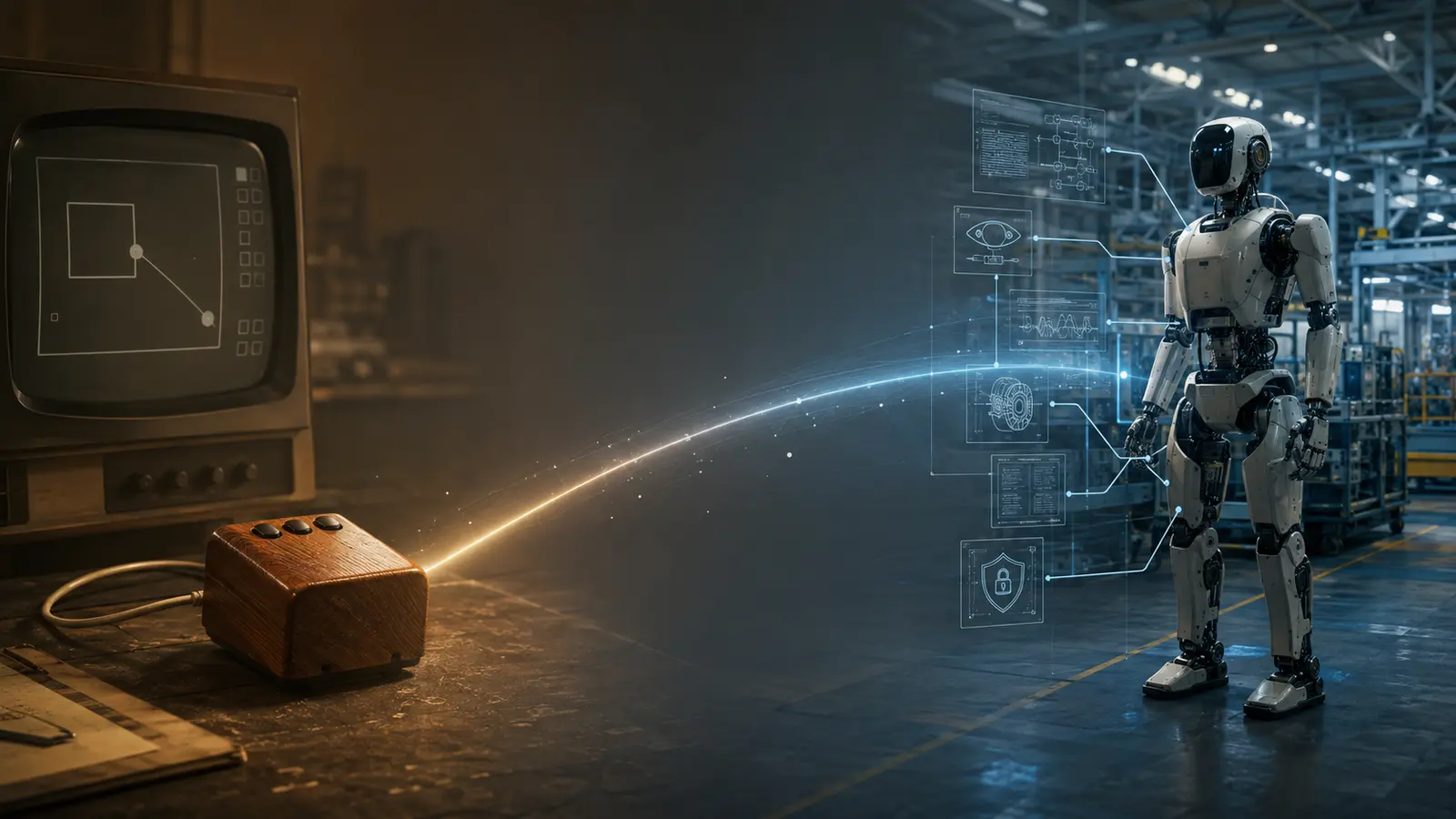
The Wooden Box Was Not the Breakthrough
On 9 December 1968, Douglas Engelbart sat at a custom console in San Francisco and controlled a computer located roughly 30 miles away at Stanford Research Institute. For about 90 minutes, he and his team demonstrated interactive editing, hierarchical navigation, hypertext, multiple views, shared-screen collaboration and video communication. The presentation later became known as “The Mother of All Demos” [3].
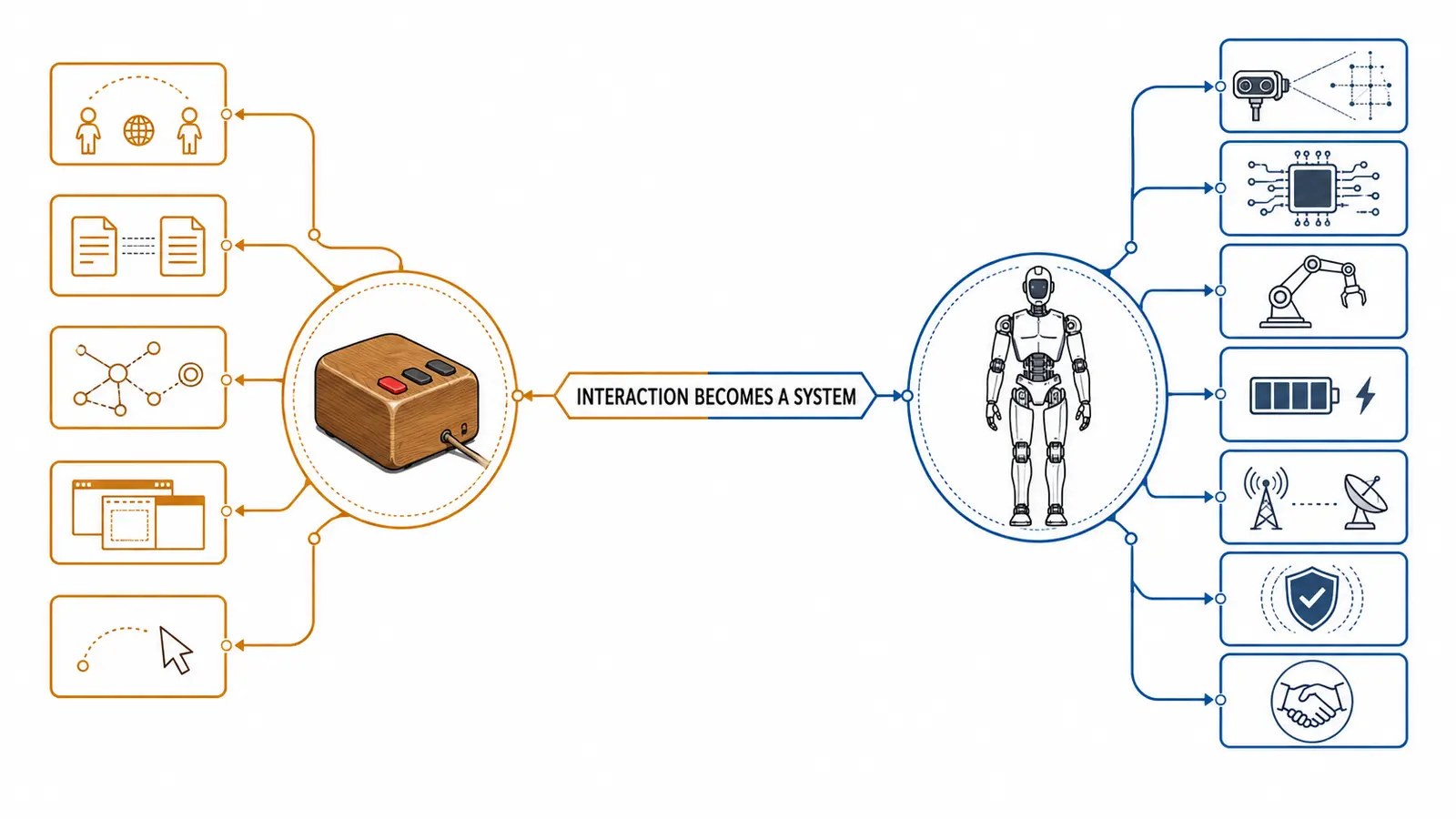
The object remembered most clearly is the wooden, three-button computer mouse. Yet the mouse was only one control element inside NLS, the oNLine System. Its meaning came from the information space, collaboration model, display system, remote computing infrastructure and working methods around it [2]. The Computer History Museum describes the demonstration as a convergence of hypertext, shared-screen collaboration, multiple windows, video teleconferencing and the mouse [4]. SRI’s own account similarly emphasizes the debut of interactive computing rather than the pointing device alone [5].
That distinction matters. Engelbart’s goal was to augment human intellect: improve how people comprehend complex situations, create knowledge, collaborate and solve problems. His 1962 framework explicitly treated the human and the means of augmentation as an interacting system whose components should be improved together [1]. The celebrated device was the visible surface of a system architecture.
Humanoid Robotics Is Still Demonstrating Devices
Humanoid robotics has no shortage of striking moments. Machines walk across stages, recover from pushes, lift boxes, sort parts and manipulate objects. Their human form makes progress easy to recognize. A new control architecture, diagnostic mechanism or power-distribution concept rarely creates the same reaction.
Public demonstrations therefore tend to emphasize the visible capability. The robot completes one prepared task, and the audience infers that general industrial usefulness is close. That inference is often too generous. A choreographed action can hide the preparation, environmental constraints, human intervention, network dependency, thermal margin, battery state and recovery procedures required to make it work.
Industrial readiness requires more than a successful motion. It requires a system demonstration that makes the operating chain and its limits visible. NIST frames robotics measurement science as a common language of performance metrics, information models, datasets, test methods and protocols. The objective is to verify that robotic systems meet expressed requirements and to expose capability gaps [6].
The proof points are repeatable uptime, throughput, safety and total cost at fleet scale. A useful demonstration must therefore answer questions that an isolated task video does not:
- Can the robot perform the task repeatedly across defined variation in payload, placement, lighting, surface and human activity?
- Can it maintain bounded timing while perception and network traffic change?
- Can it detect degraded sensors, actuators, communication paths and energy margins?
- Can it reduce capability in a controlled way instead of failing without explanation?
- Can it verify the final physical state and preserve evidence for engineering, safety and service?
The Interface Now Extends into the Physical World
Engelbart created a practical interface for acting inside a digital information space. A humanoid creates an interface between intelligence and physical reality. Its inputs include cameras, radar, inertial sensors, joint encoders, current measurements, force-torque sensors and tactile surfaces. Its outputs are not pixels. They are torque, contact, motion and energy.
This makes timing and failure behavior physical. A stale perception result can direct motion into a changed scene. A lost message can become a missed control cycle. Corrupted state data can destabilize balance. An overheated power stage can disable a supporting joint. A wrong action can damage equipment or injure a person.
Physical AI therefore needs a boundary between probabilistic interpretation and bounded execution. AI may propose an action. Real-time control must commit, execute and verify it within defined limits. Deterministic communication must carry time-sensitive state with controlled latency and jitter. Safety mechanisms must remain capable of constraining or stopping motion when the assumptions behind the action no longer hold.
The current ISO 10218 structure reinforces the distinction between the robot and the integrated application. Part 1 addresses the industrial robot as partly completed machinery, while Part 2 addresses its integration into complete applications and cells across design, commissioning, operation, maintenance and decommissioning [7] [8]. The standards do not solve humanoid safety by themselves, but the architectural lesson is clear: a capable robot component does not prove a safe and dependable operating system.
The Dependable Action Chain
A complete humanoid demonstration should expose one continuous chain from environment to verified motion. The environment creates conditions and disturbances. Sensing converts physical state into electrical evidence. Decision functions interpret that evidence and propose intent. Real-time controllers translate intent into bounded trajectories and actuator commands. Power electronics convert stored electrical energy into controlled mechanical action. Sensors then measure the result and close the loop.
Connectivity and a common notion of time hold the distributed system together. Safety, security and diagnostics surround the chain because they must observe and influence every stage. The architecture must support graceful degradation: a deliberate reduction of speed, force, reach or task scope when evidence or capability deteriorates.
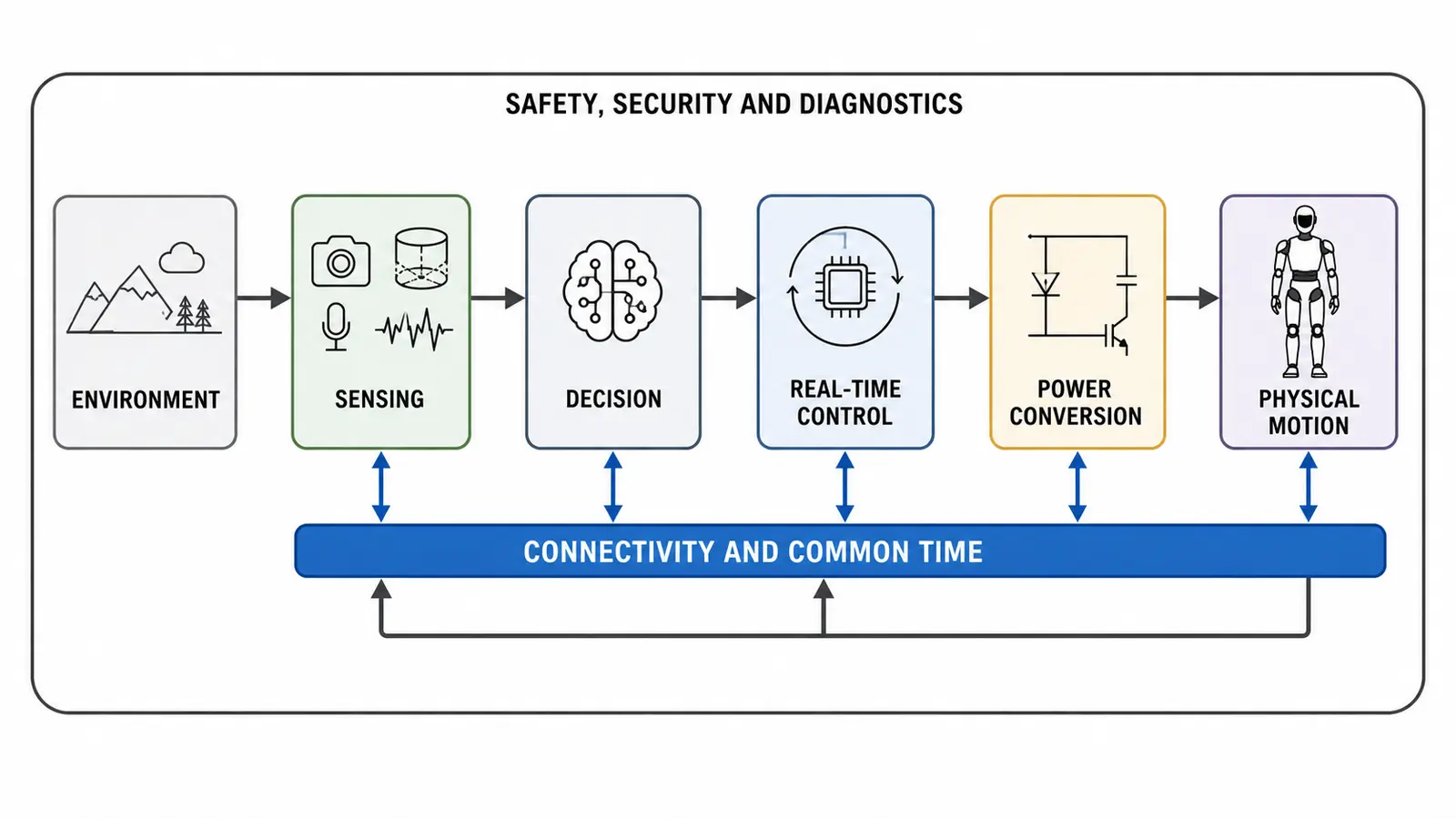
The semiconductor architecture beneath this chain spans environmental and inertial sensing, position and current measurement, analog signal conditioning, real-time microcontrollers, edge processing, memory, deterministic connectivity, hardware security, gate drivers, power switches, battery management and protected power distribution. Infineon’s humanoid architecture groups these requirements across motor control, sensing, dexterous hands, power, communication, memory, functional safety and hardware-based security [9].
The opportunity is not simply to place more semiconductors inside a robot. It is to make the interfaces between functions predictable. A torque command needs a qualified state estimate, synchronized timing, a known energy margin and a verified path to the motor. A safety response needs independent evidence and a controllable final element. A software update needs trusted identity, compatible configuration and a recovery path. A diagnostic event needs context that connects the component fault to the physical mission.
A Proposal for the Humanoid Mother of All Demos
The demonstration should begin with a useful industrial task rather than an acrobatic routine. Consider a humanoid assigned to move containers between a storage area and a workstation while people continue working nearby.
The robot receives a work order and authenticates its task, software and tool configuration. It localizes itself, identifies the correct container and approaches through a changing workspace. Before lifting, it estimates mass, center of gravity and grasp quality. It adapts posture, torque limits and gait to the load. A person enters its path, so the robot reduces speed and replans while preserving stability.
During transport, one joint begins to run warmer than its expected mission envelope. The system identifies the deviation, qualifies whether the measurement is trustworthy and redistributes effort within defined limits. If the remaining margin is insufficient, it places the load safely and reports the reason. If operation remains permissible, it completes the task in a declared degraded mode and schedules inspection.
The robot then reaches a charging or service point. It authenticates the connection, reports energy use and recovered energy, uploads signed diagnostic evidence and receives an approved configuration update. The next mission begins only after the relevant identities, calibrations, communications and protective functions pass their release checks.
The audience should see both the physical task and the system evidence: timing margin, state confidence, energy flow, safety mode, network status, thermal margin, intervention count and task quality. The demonstration becomes repeatable when its input conditions, mission profile, success criteria and failure injections are documented.
Minimum demonstration layers
| Layer | What the demonstration must prove | Representative evidence |
|---|---|---|
| Mission | Useful work under representative variation | Completion, cycle time, quality, interventions |
| Physical state | The robot knows body, load, contact and environment sufficiently for the task | Confidence, freshness, sensor health, residuals |
| Control | AI intent becomes bounded and verified motion | Latency, jitter, tracking error, limit margin |
| Energy | Power remains available, efficient and safely managed | Peak power, thermal margin, state of charge, regeneration |
| Trust | Identity, configuration and commands remain controlled | Secure boot, authenticated nodes, update and event records |
| Resilience | Faults lead to controlled adaptation, isolation or stop | Detection, containment, recovery and verification times |
From Demonstration to Architectural Grammar
The personal-computing revolution accelerated when reusable architectural patterns allowed displays, input devices, processors, operating systems, applications and networks to evolve without losing interoperability. Humanoid robotics needs a comparable grammar.
Morphology is one part: biped, wheeled humanoid, mobile manipulator or quadruped. The mission profile defines the workload, payload, speed, duration and environment. Electrical architecture adds voltage classes, power distribution, actuator topology and storage. Communication architecture defines bandwidth, latency, synchronization and redundancy. Safety and security define behavior when assumptions fail.
These choices are dependent. Payload changes torque, structural mass, peak power, thermal loading and stopping distance. More sensing increases bandwidth, processing and energy demand. Higher system voltage can reduce current and cable mass while changing insulation and service requirements. Distributed control can shorten loops while multiplying networked and security-relevant nodes.
A useful robot platform makes these dependencies visible. Common mission profiles, transparent morphological choices, reference architectures and standardized evidence let robot manufacturers, semiconductor suppliers, software companies, integrators and end users work on the same system problem.
The Architecture Will Change the World
Engelbart’s demonstration did not deliver the modern computer overnight. Many of its ideas took years or decades to become ordinary. The hardware became smaller, networks became faster and interfaces became easier. The rough experimental system eventually disappeared inside products people could use without understanding the architecture beneath them.
Humanoids are at an earlier stage. Their movements can be cautious, their batteries limited, their hands inconsistent and their architectures fragmented. That does not make the current machines irrelevant. Engelbart’s wooden mouse was awkward too. Its importance lay in the integrated future it made visible.
The next decisive humanoid demonstration will not be another isolated human task. It will show a scalable operating system for physical work: a machine that can perceive, decide, move, communicate, manage energy and remain trusted as one coherent platform.
The robot will attract the audience. The architecture behind it will change the world.