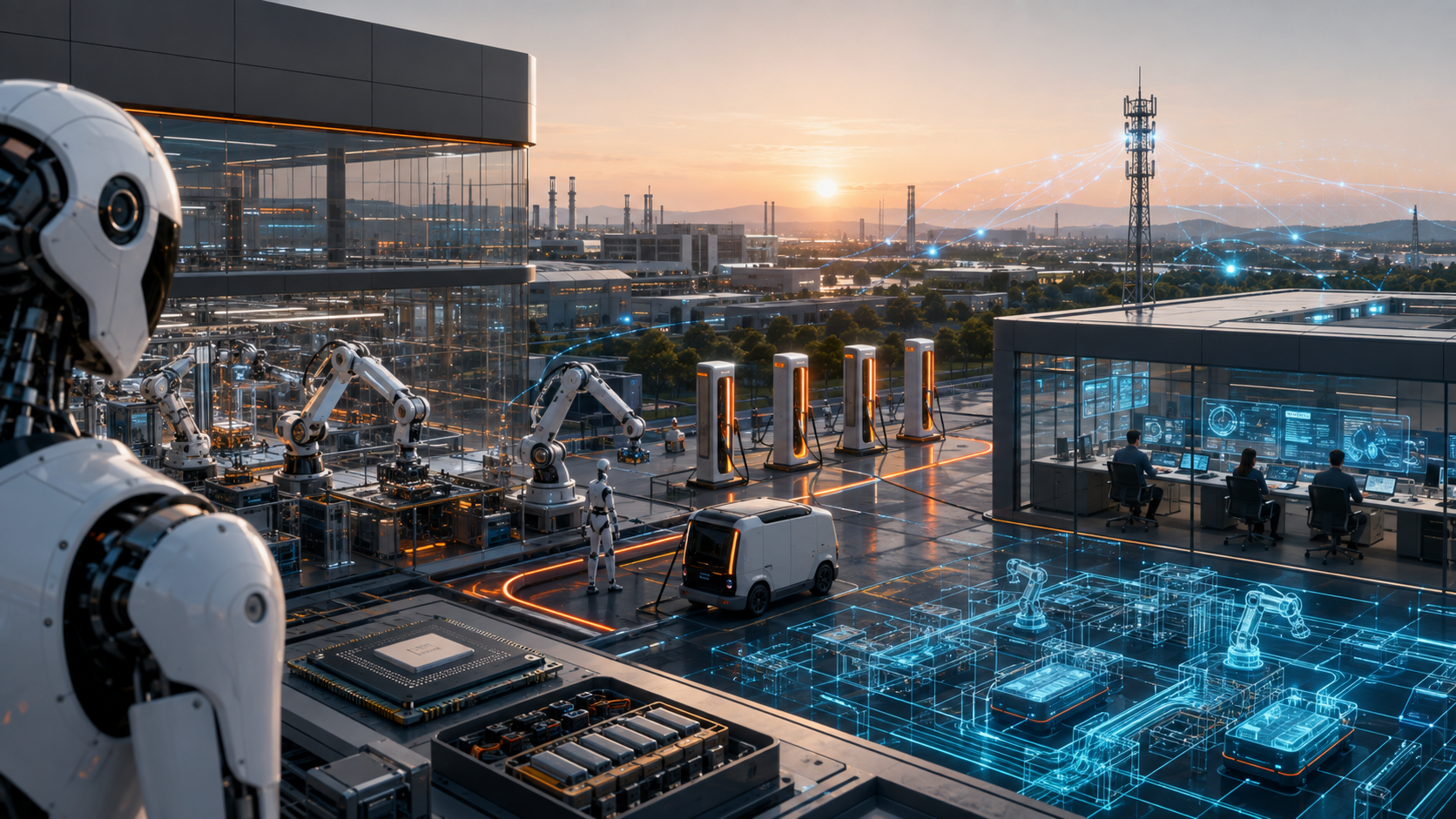
The night shift reveals the real product
At 2:17 in the morning, a production line does not care whether a machine resembles a person. It cares whether a part arrives before the next cycle, whether an error is detected before it becomes scrap, and whether the system can recover when the part is tilted by three degrees. The shift supervisor cares about something else as well: whether the machine will still be working at 5:30, whether a technician can restore it without calling the manufacturer, and whether anyone can explain why it made its last decision.
The popular story of Physical AI becomes smaller under production light. The public sees a humanoid walking, carrying a box or answering a spoken instruction. The business sees an operating system for physical work—or an expensive interruption. Intelligence is necessary, but intelligence alone is not the product. The product is reliable work delivered inside a living industrial system.
That distinction changes the size of the opportunity. If Physical AI is treated as a smarter robot, value is concentrated in the machine: actuators, sensors, compute, batteries, software and the final sale. If it is treated as an infrastructure for adaptable physical work, value expands before, around and long after the machine. It includes the supply chain that builds the robot, the systems that connect and charge it, the tools that train and validate it, the services that keep it productive, and the organisational design that determines what it should do.
The International Federation of Robotics reported 542,000 industrial robot installations in 2024, more than twice the volume ten years earlier. That installed base was built mainly around machines engineered for defined tasks and controlled environments. Humanoids enter a world in which automation is already mature, highly segmented and economically disciplined. Their opportunity is not to replace all of it. It is to reach the awkward remainder: work that matters, repeats and changes, but has resisted conventional automation because the environment, objects or sequence were designed around people.
The larger thesis follows from that remainder. Physical AI will matter most when it turns previously disconnected physical work into a manageable part of the digital enterprise. The robot is the visible endpoint. The transformation is the business architecture behind it.
The economy begins before the work
A humanoid creates economic activity before it performs one useful movement. It must first be manufacturable. That sounds obvious until the prototype is translated into thousands of machines expected to survive impacts, vibration, thermal cycles, contamination, variable payloads and imperfect maintenance.
A contemporary humanoid is a dense mobile system. Dozens of controlled joints convert electrical energy into precise motion. Cameras, inertial sensors, encoders, force sensors and sometimes tactile arrays estimate the state of the body and its surroundings. High-performance compute interprets scenes and plans behaviour while distributed controllers close fast real-time loops. Power electronics route energy from the battery to actuation, compute and auxiliaries. Wired and wireless networks carry time-sensitive control, safety and diagnostic traffic. None of these elements is new in isolation. Their integration into a compact, untethered, dynamically balanced machine is.
Scaling therefore creates a value chain across semiconductors, motors, gears, bearings, battery cells, connectors, structural materials, thermal systems, precision machining, calibration, end-of-line testing and contract manufacturing. It also creates pressure to standardise. A laboratory can tolerate hand-matched components and frequent intervention. A fleet cannot. Every unnecessary part variant becomes a procurement problem; every difficult-to-access component becomes service time; every unobservable failure becomes a fleet-level cost.
Agility Robotics opened RoboFab in 2023 with the stated intention of producing its Digit robots at industrial scale; the company describes a peak capacity of 10,000 robots annually. The number is a capacity claim, not evidence of realised output. The stronger signal is the movement from robotic invention to manufacturing system. Once volume becomes plausible, design priorities change. Supply assurance, test coverage, repairability, traceability and configuration management begin to compete with maximum laboratory performance.
This is familiar territory for industries such as automotive and industrial automation. Their methods—platform architectures, qualified components, diagnostic coverage, functional safety, production validation and lifecycle management—become part of the Physical AI economy. The winners may not be those that create the most dramatic demonstration. They may be those that remove one failure mode, one calibration step or one hour of service at a time.
The hardware economy is also broader than humanoids. The same technologies support autonomous mobile robots, mobile manipulators, quadrupeds and new forms not yet given a stable category. Investment in efficient motor control, compact power conversion, sensor fusion, deterministic communication and safety does not depend on a single morphology winning. It builds the electronic and manufacturing foundation for a family of adaptable machines.
The value layers expand outward from that foundation. Hardware makes motion possible. Infrastructure makes deployment possible. Operations make fleets dependable. Capability systems make improvement repeatable. Work design determines whether any of it creates an advantage.
Visual pending: Systems concept
Deployment creates a second economy
The first purchase order buys a robot. The next hundred decisions determine whether it becomes productive.
A deployed fleet needs charging strategy, connectivity, identity management, access control, cybersecurity, maps, task orchestration, software distribution, incident handling, spare parts and maintenance. It needs interfaces to manufacturing execution systems, warehouse management systems and enterprise planning. Someone must decide when a machine may enter a zone, which version of a skill is authorised there, what happens when confidence falls below a threshold, and which data may leave the facility.
This surrounding layer is already visible in early commercial models. In 2024, GXO and Agility Robotics announced a multi-year Robots-as-a-Service agreement that combines Digit with Agility Arc, a cloud platform for deployment, workflow definition, fleet operation and troubleshooting. The commercial unit is no longer only a machine. It is an operating service.
Operations will also expose a less glamorous but decisive requirement: common semantics. A fleet cannot be orchestrated well if every robot describes location, task state, fault severity and readiness differently. Enterprise software needs stable interfaces to ask whether work was accepted, started, completed or abandoned. Maintenance teams need comparable diagnostics across models. As fleets become heterogeneous, the translation layer between robots and business systems may become as important as the motion controller inside any one machine. Standards, middleware and integrators will compete to define that layer.
That model changes incentives. A hardware sale rewards shipment. A service contract rewards uptime and completed work. When the supplier carries more operational risk, reliability, remote diagnostics and maintainability become revenue-critical rather than merely desirable. Customers may gain a clearer path from pilot to operating expense, while suppliers gain recurring revenue—but only if their machines remain useful after the camera crew leaves.
A further economy forms around facilities. Charging stations must be placed where they do not interrupt flow. Wireless coverage must be engineered for moving machines. Digital maps and work instructions must remain synchronized with physical reality. Cybersecurity teams must treat a compromised robot not only as a data risk but as a machine capable of motion. Safety engineers must assess the application, not merely the robot. ISO 10218-1:2025 addresses the inherently safe design of industrial robots, while ISO 10218-2:2025 covers integration, commissioning, operation, maintenance and decommissioning of robot applications and cells. Adaptable mobile systems will force organisations to connect these disciplines more tightly.
The service opportunity extends into insurance, certification, audit, training and workforce enablement. A robot that can acquire new behaviour introduces a recurring need to establish that the behaviour is safe, compatible and economically worthwhile. A software update on a laptop changes information processing. A software update on a humanoid can change the forces, paths and decisions of a machine operating beside people. Validation becomes part of the product.
Capability becomes a product
The conventional machine is largely defined when it leaves the factory. It can be reprogrammed and retooled, but its economic identity is bound to the application for which it was integrated. The software-defined robot promises a different lifecycle: the body remains, while capabilities evolve.
A new skill cannot be downloaded like a phone application and trusted immediately. Physical behaviour depends on the robot body, payload, gripper, friction, lighting, spatial constraints and the people nearby. A policy that succeeds in one environment can fail in another for reasons invisible in a promotional video. The pathway from learned behaviour to productive capability therefore requires data collection, simulation, training, testing, constrained rollout, monitoring and recovery.
The tooling for such a pathway is becoming a market in its own right. NVIDIA’s Isaac Sim is designed for simulation, testing and synthetic-data generation in physically based virtual environments. Its GR00T platform combines data pipelines, foundation models, simulation and deployment components for humanoid development. These are vendor offerings, not proof that general-purpose robotics is solved. They nevertheless show where value is forming: between an abstract AI model and a behaviour trusted on a particular machine in a particular workflow.
Once a validated skill can be deployed across compatible machines, capability begins to behave like a recurring product. A robot may gain a new material-handling task, inspection routine or recovery behaviour without replacement of the complete asset. The commercial possibilities include subscriptions, usage-based fees, licensed skill libraries, integration packages and performance guarantees.
Not every part of that capability should be shared. A general grasping improvement may transfer across customers; a plant-specific sequence, product geometry or quality signature may embody sensitive manufacturing knowledge. Contracts will need to distinguish platform learning from customer-owned process data. The party that operates the learning pipeline could otherwise accumulate an unusually detailed picture of how a factory works, where it fails and how quickly it recovers. Data governance becomes commercial strategy.
Experience can also become a shared asset. One robot encounters a deformed container, unusual reflection or blocked aisle. The incident is captured, classified and reproduced in simulation. A revised policy is tested against known hazards and then released to a controlled group. If performance improves without creating new risks, the release expands. The fleet has learned—not because machines spontaneously exchanged wisdom, but because an engineered data and validation system converted experience into governed capability.
That distinction matters. The phrase “data flywheel” can conceal as much as it explains. Industrial data is contextual, sensitive and often sparse at the moment that matters most: the rare failure. More data does not automatically produce better physical behaviour. Useful learning depends on data rights, labelling quality, representative scenarios, embodiment compatibility and disciplined evaluation. The durable business may lie less in owning the largest raw dataset than in operating the most credible loop from incident to verified improvement.
The loop below makes the commercial and governance logic visible. Observation creates evidence, not permission. Training creates a candidate behaviour, not a released skill. Only validation against safety and performance criteria, followed by explicit human approval, turns experience into fleet capability.
Visual pending: Systems concept
The humanoid has to earn its complexity
The humanoid form has one powerful argument in its favour: the world has been built for the human body. Doors, stairs, tools, shelves, workstations and material flows encode human reach, width, height and dexterity. A machine that can use this environment without rebuilding it may unlock tasks that have remained stubbornly manual.
It also carries an unforgiving engineering bill. Legs consume energy and introduce fall risk. Hands add actuators, sensing, control complexity and fragile contact surfaces. A tall moving mass changes the safety case. Generality can dilute performance: a machine designed to do many things may be slower, less robust or more expensive than one optimized for a single task.
The evidence from early industrial deployments is useful precisely because it is narrow. BMW reported that Figure 02 supported production of more than 30,000 BMW X3 vehicles over ten months at Plant Spartanburg, inserting sheet-metal parts for a welding process. That is a meaningful operational result, but it is not a claim of general autonomy. It demonstrates value in a defined task, within an engineered environment, under industrial supervision.
Mercedes-Benz is testing Apptronik’s Apollo in production and has described applications around moving components and initial quality-check tasks. Amazon and Agility have explored Digit for warehouse work, while GXO’s commercial deployment began with repetitive material handling. The pattern is consistent: start where the task is repetitive, ergonomically difficult and structured enough to measure.
In many workflows, the correct answer will remain a conveyor, fixed industrial robot, cobot, automated guided vehicle or autonomous mobile robot. Wheels are generally more energy-efficient than legs on prepared floors. A fixed robot can deliver speed, stiffness and repeatability that a mobile generalist cannot. Infrastructure changes may be cheaper than humanoid capability. The economic comparison must include throughput, availability, supervision, integration, energy, maintenance, safety measures and the value of flexibility—not the hourly cost of labour alone.
A useful decision rule is severe: choose the least complex machine that can perform the required work reliably. The humanoid earns its place where human-compatible morphology avoids costly reconstruction, where tasks change enough to reward reconfigurability, and where mobility plus manipulation creates value that simpler machines cannot. Complexity is justified by system advantage, not visual familiarity.
The business case should therefore pass three gates. First, the morphology must solve an environmental problem that simpler automation cannot solve economically. Second, the complete operating system must meet a measurable service level for throughput, availability, intervention and safety. Third, the value of reassignment must be real rather than deferred into an undefined roadmap. Failure at any gate does not condemn Physical AI. It identifies a better machine for that job.
This test should be repeated over time. Early humanoids may enter a task because modifying the facility is unattractive. Once volume grows, however, the economics may favour changing containers, work heights or presentation fixtures and replacing the humanoid with simpler automation. The reverse can also occur: frequent product changes can make a previously efficient dedicated cell too rigid. Morphology is not a once-and-for-all strategic choice. It is an optimisation variable inside a changing production system.
The disappearing boundary of the digital enterprise
For three decades, companies have digitised planning, finance, customer relationships and supply chains. Yet much physical work remains separated from those systems by a person reading a screen, moving an object, inspecting a surface or recovering from an exception. Conventional automation has connected high-volume, stable processes. The gaps between them often remain human.
Physical AI can narrow that gap. An adaptable machine can receive a digital task, interpret a physical scene, act on objects and return evidence of completion. That creates a closed loop between enterprise intent and physical outcome. Inventory records can be reconciled with observed stock. A maintenance instruction can become an inspected asset. A production plan can reach a station whose material presentation changes from hour to hour.
The strategic asset is not the humanoid itself. It is the new observability and controllability of work. Once physical execution produces structured data, businesses can identify bottlenecks, compare methods, simulate alternatives and improve the system. The same machine that performs a task becomes a sensor for the workflow around it.
That changes the management cadence. Physical operations no longer have to wait for a quarterly lean workshop or a major automation project to become visible. Exceptions can be captured as they happen, compared across shifts and fed into simulation before equipment or instructions change. The digital enterprise acquires something it has often lacked: a continuously updated account of how physical work actually behaves.
This can change capital planning. Traditional automation projects often require confident forecasts because equipment is dedicated and integration is expensive. A more adaptable platform could lower the cost of changing a workflow after launch. That does not make the hardware cheap, but it may create option value: the same fleet can be reassigned as demand, product mix or labour availability changes. Financial evaluation should capture that flexibility while discounting the risk that promised future skills never become dependable.
This prospect is powerful and uncomfortable. Measurement can improve safety and quality; it can also turn work into surveillance. Optimisation can remove waste; it can also remove the informal flexibility by which people keep brittle systems alive. A robot may expose that the documented process and the real process are different. Management must decide whether to correct the deviation, learn from it or automate the wrong version more efficiently.
The largest value may therefore emerge from exception-rich environments rather than perfectly automated ones: intralogistics between islands of equipment, night-shift replenishment, inspection after a process disturbance, low-volume material presentation, infrastructure rounds and response to minor failures. These activities rarely produce the cinematic moment associated with humanoids. They produce continuity.
Do not automate the task. Redesign the work.
The common deployment question is: which human task can the robot take over? It is understandable, measurable and often too narrow.
A task is embedded in a workflow. Removing one manual step can move the bottleneck downstream, create new waiting time or eliminate the person who previously noticed an early warning. The better question is how work should be divided among people, conventional automation and adaptable machines when each is used for what it does best.
Consider material replenishment. A humanoid could carry a container from a cart to a workstation. But a redesigned system might use an AMR for long-distance transport, a fixed lift for vertical movement, a humanoid or mobile manipulator only for variable final placement, and a person for ambiguous exceptions. The value comes from the composition, not from maximising humanoid minutes.
People remain strongest where goals conflict, consequences are uncertain, social context matters and responsibility cannot be delegated. Conventional automation remains strongest where volume is high, variation is low and performance can be engineered into the cell. Physical AI occupies the changing middle: situations that are structured enough to constrain but variable enough to resist fixed programming.
This division will not be static. As capability improves, some exceptions become routine. As products and factories change, new exceptions appear. The operating model must therefore support continual reassignment of work. Job descriptions, training, safety cases, performance metrics and investment planning will all need to adapt.
Companies that merely purchase robots may gain local efficiency. Companies that develop the ability to redesign workflows repeatedly may gain a compounding advantage. They will know how to identify suitable work, prepare data, alter facilities, integrate systems, train people, validate behaviour and scale what works. That organisational capability is harder to copy than the machine.
The workforce implication is equally practical. Operators will need ways to teach, supervise and stop machines without becoming robotics programmers. Maintenance roles will combine mechanical, electrical, software and data skills. Process engineers will increasingly design both the physical flow and the evidence needed to train and validate behaviour. The strongest deployments will treat employees as sources of operational knowledge, not obstacles to automation. Much of what keeps production stable is tacit: the sound that precedes a jam, the container that is always slightly warped, the workaround used when a sensor is dirty. Capturing that knowledge respectfully is a prerequisite for useful automation.
This also changes the supplier landscape. Robot manufacturers will compete with automation integrators, software platforms, cloud providers, industrial service companies and specialist skill developers. Customers will demand interoperable systems but suppliers will seek control of the stack. Open interfaces can accelerate ecosystems; closed platforms can simplify accountability. The resulting market will be shaped as much by commercial architecture and governance as by technical performance.
The difficult question is control
As Physical AI reaches further into operations, the central question shifts from what the machine can do to what it is allowed to decide.
A robot may choose a path around a worker, reject an unstable grasp or pause when sensor confidence falls. Those are bounded operational decisions. A fleet orchestrator may then reassign tasks, alter priorities or recommend a process change. At some point, optimisation begins to influence management.
The system does not need consciousness or intention to acquire practical authority. It needs only to become the mechanism through which work is allocated and exceptions are judged. If its recommendations are consistently useful, people may stop challenging them. If its logic is opaque, responsibility becomes diffuse precisely when consequences become physical.
Governance must therefore be designed into the operating model. Which decisions require human approval? Which safety constraints cannot be changed by a learned policy? Who owns the data generated around workers? How is a capability version traced to its training evidence and validation result? Who can suspend a fleet, and how does work continue when the platform is unavailable? These are not compliance details to be added after deployment. They define whether the system can be trusted.
Cybersecurity belongs inside the same boundary. A compromised planning system can disrupt production. A compromised physical system can also move, collide, block or mis-handle. Identity, secure boot, signed software, protected communication, least-privilege access, monitoring and recovery must extend from cloud services to distributed controllers. The separation between information technology and operational technology becomes less defensible when AI decisions cross both.
The moral ambiguity is real. A system that refuses an unsafe instruction protects people. A system that continually narrows human discretion in the name of safety may also change the character of work. A fleet that reallocates tasks to reduce injuries may be beneficial; the same data could intensify performance pressure. The answer is not to stop measurement or autonomy. It is to retain explicit human authority over objectives, constraints and acceptable trade-offs.
The robot is only the beginning
Humanoids will not arrive as a single wave that replaces human labour. They will enter through selected tasks, constrained zones and carefully measured business cases. Many pilots will fail. Some will reveal that a simpler machine was the better choice. Others will succeed quietly, then spread from one shift to one line, from one plant to a network.
The economic effect will radiate outward. Manufacturing scale will create demand for electronic, mechanical and production platforms. Deployment will create markets for infrastructure, fleet operations, cybersecurity and service. Software-defined capability will create recurring products around training, simulation, validation and controlled release. Workflow integration will connect more physical execution to enterprise systems.
None of this removes the hard engineering. Energy, dexterity, reliability, safety and total cost must improve together. A robot that is impressive for twenty minutes but unavailable for two hours is not intelligent in the only sense the operation values. A machine that learns quickly but cannot be validated will remain a demonstration. A platform that captures data but cannot establish trust will meet resistance for good reason.
The deeper disruption begins when leadership stops asking how many humanoids to buy. The useful questions are different. Which physical gaps prevent the business from operating as one system? Which work should remain human because judgment and accountability matter? Which tasks belong to conventional automation because predictability is an advantage? Where does adaptable Physical AI justify its cost and complexity? What organisational capabilities are required to keep changing that boundary?
The future of work is unlikely to be a contest between humans and humanoids. It will be a continuing design problem involving people, specialised automation and increasingly capable machines. Businesses will choose the objectives. Engineers will encode the constraints. Workers will expose the difference between process diagrams and reality. Machines will perform a growing share of the physical execution and produce new evidence about how the system behaves.
The robot is only the beginning. The real transformation is the ecosystem it creates—and the operating discipline it forces us to build around physical intelligence. When that discipline is in place, redesigning work is no longer a one-time automation project. It becomes a repeatable business capability.