1. The Human Benchmark Is Difficult for the Wrong Reason
Humanoid robots invite comparison with humans because both occupy a similar physical envelope and are expected to move through infrastructure, use tools, and work around people. Energy is one of the most revealing comparisons, but only when the system boundaries are chosen correctly. Human skeletal muscle is not a high-efficiency electromechanical converter. Positive mechanical work is commonly associated with muscular efficiencies on the order of 20–25%, while whole-body efficiency varies with contraction mode, gait, speed, elastic energy storage, and the definition of mechanical work [1]. Modern electric motors, inverters, and DC–DC converters can exceed that component-level efficiency by a wide margin. A robot assembled from efficient electrical components can nevertheless require substantially more input energy than a human to achieve a similar physical outcome.
The explanation is architectural. Human locomotion exploits morphology, passive dynamics, compliant tissues, tendons, joint geometry, intermittent recruitment, and the exchange of kinetic and potential energy. The nervous system also allocates sensing and cognitive effort selectively rather than maintaining every function at a fixed maximum duty cycle. A person standing quietly does not solve the problem as dozens of continuously energized, identical high-bandwidth servos. The appropriate benchmark is therefore not muscle efficiency versus motor efficiency. It is whole-system energy economy: how much energy must be supplied to accomplish a defined physical task while preserving stability, perception, reaction capability, and safety.
Walking measurements illustrate the distinction. A systematic review of healthy adults reported a mean gross metabolic walking cost around 3.4 J kg−1 m−1 for younger adults, with a lower net value after subtracting resting metabolism [2]. The exact value changes with speed, age, stature, terrain, load, and measurement method. Robot locomotion should be treated with the same discipline. Kashiri et al. reviewed energy-efficient legged locomotion using specific resistance, closely related to cost of transport, and reported representative historical values of approximately 0.2 for human walking, about 2 for Honda ASIMO, and about 1 for DURUS in the systems discussed [3]. Those values are useful as historical evidence of a system-level gap, not as estimates of current commercial humanoids.
Recent measurements reinforce the need for mission-normalized benchmarking. Fraunhofer IPA reported approximately 154 W mean electrical power for a Unitree G1 standing, 272 W while walking on level ground, and 283 W while walking on a 10% incline under its defined test conditions [8]. The tested platform was a Unitree G1 EDU-4 with Dex3-1 hands and firmware version 1.04 [8]. The standing value is particularly informative: a substantial electrical baseline is present before translational locomotion begins. It can include actuator holding losses as well as compute, sensing, communication, control electronics, and thermal-management loads. Treating the difference between standing and walking as “the power of walking” would therefore be misleading, but so would ignoring the standing baseline when sizing a shift-level energy budget.
Commercial specifications provide additional boundary conditions without creating a standardized comparison. Unitree lists an 864 Wh battery for H1 [4]. The G1 family is specified with a 13-series, 9000 mAh quick-release battery and an advertised operating time of approximately two hours depending on configuration and use [5]. Figure states that its F.03 battery stores 2.3 kWh and is designed for five hours of runtime at peak performance [6]. These figures are not directly comparable because configuration, software state, task mix, payload, speed, thermal limits, and test procedures differ. Dividing stored energy by advertised runtime yields only an order-of-magnitude average input-power indication.
A useful engineering metric must connect energy to output. For locomotion, dimensionless cost of transport can be written as CoT = E/(mgd), with input energy E, mass m, gravitational acceleration g, and distance d. For industrial work, more relevant measures may be Wh per successful pick, Wh per kilogram transferred, Wh per assembly cycle, Wh per meter of loaded transport, or Wh per productive operating hour. Figure reports that F.02 accumulated more than 1,250 runtime hours while operating ten-hour weekday shifts at BMW, loading more than 90,000 parts and contributing to production of more than 30,000 vehicles [7]. Those deployment figures are operational evidence, not an efficiency benchmark, but they demonstrate why task mix and productive output belong inside the energy metric.
Visual pending: From job to end-effector architecture
2. A Humanoid Is a Distributed Power-Conversion System
Electrical energy in a humanoid does not travel directly from a battery to a motor. It passes through a distributed network of monitoring, protection, switching, conversion, regulation, inversion, and local storage. The battery is only the first node. At the opposite end are mechanical work, computation, sensing, communication, acoustic output, thermal management, and losses. Every architectural choice between those points affects runtime, mass, thermal behavior, fault containment, electromagnetic compatibility, and the ability to recover energy.
The battery-management system monitors cell voltage, temperature, pack current, state of charge, and operating limits. Depending on implementation, cell balancing, pack protection, precharge, fuses, contactors or solid-state disconnects, current measurement, isolation monitoring, and charging interfaces sit between the cells and the main DC backbone. These devices are not all conversion stages, but they define when the system may energize, how faults are isolated, and whether regenerative energy can be accepted. A power architecture that considers only steady-state efficiency but cannot absorb a regenerative pulse, discriminate a legitimate motion transient from a fault, or sequence startup safely is incomplete.
Downstream voltage domains multiply quickly. High-power joint inverters may connect directly to the main bus. Central compute often uses an intermediate regulated rail followed by multiple low-voltage point-of-load supplies. Sensors, safety controllers, network devices, encoders, hands, pumps, fans, microphones, displays, and external payloads can require distinct rails with different noise, isolation, availability, and transient requirements. Step-down stages are commonly implemented with synchronous buck conversion; buck-boost topologies are useful where the required rail must remain regulated across a battery range that crosses the target voltage. Isolated DC–DC conversion is justified where galvanic separation supports safety, noise control, or fault containment. Low-dropout regulators remain appropriate for low-current, noise-sensitive rails. High-current processors require multiphase point-of-load regulation because core voltages are low and load steps can be abrupt.
Joint inverters add a fundamentally different conversion regime. They transform DC-link energy into controlled multi-phase motor currents and, when the mechanical state permits, can operate in reverse as generators. The inverter therefore belongs to a bidirectional energy path, not merely an output stage. That distinction has consequences for DC-bus capacitance, battery charge acceptance, overvoltage protection, local energy sharing, and braking behavior.
Peak efficiency is an inadequate design criterion because the robot spends much of its time away from rated load. Joint torque changes every gait phase. A manipulation task may activate only part of the body. Compute demand rises and falls with perception, planning, model execution, and communication. Sensor rails can remain lightly loaded for long periods. Fixed losses—controller quiescent current, gate-drive power, magnetics loss, leakage, clocking, and housekeeping—become proportionally important at low load. A converter that reaches exceptional efficiency near rated power can consume more mission energy than a slightly less efficient alternative if its light-load behavior is poor. The relevant object is an efficiency map over input voltage, output current, switching mode, and temperature, weighted by the actual duty-cycle distribution.
The same duty-cycle logic applies to power density. Higher switching frequency can reduce passive-component size, but it can also raise switching loss and electromagnetic-interference constraints. Distributed capacitance improves local transient response but adds mass and volume. Higher bus voltage reduces current for a given power level, which can reduce conductor cross-section and resistive loss, but it increases insulation, protection, clearance, and safety requirements. There is no single optimum bus voltage or converter topology independent of robot size, power level, packaging, environmental requirements, and fault philosophy.
The consequential change in viewpoint is to treat power architecture as a robot-level control surface. Rails can be sequenced, gated, slowed, or placed into low-power modes according to task state. Joint electronics can be organized so that unused limbs do not remain fully energized. Sensor clusters can change acquisition rates. Compute voltage and frequency can follow workload. Communication links can preserve wake capability without maintaining full data-plane activity. The power tree then stops being passive infrastructure and becomes an active part of the robot’s energy-management strategy.
Visual pending: Complexity versus task coverage
3. Actuation Dominates Dynamic Power, but Holding Torque Matters Too
Whole-body motion places actuation at the center of humanoid energy design. Mechanical power at a joint is the product of torque and angular velocity, while electrical input also contains motor copper loss, iron loss, inverter loss, gearbox or transmission loss, bearing friction, cable loss, and control overhead. High-dynamic tasks can therefore create large instantaneous power peaks even when average shift power is moderate. Sizing only from average energy risks voltage droop, current-limit activation, connector heating, or protective trips during acceleration, disturbance recovery, lifting, stair negotiation, or coordinated whole-body motion.
Peak power is not the only actuation problem. A robot can consume significant energy while producing little or no external mechanical work. Static postures may require continuous torque to counter gravity. An arm held horizontally can demand sustained joint current even though joint velocity is zero and mechanical output power τω is therefore approximately zero. The electrical energy becomes heat in windings, power electronics, transmissions, and surrounding structure. Fraunhofer IPA reports that horizontally extending the G1’s arms without added payload could lead to actuator overheating and shutdown after roughly one to two minutes in the tested configuration [8]. This is not evidence that all humanoids share the same limitation, but it demonstrates why static-load support and thermal design are first-order architectural concerns.
Humans solve many static-load problems structurally. Skeletal alignment, joint geometry, passive tissue stiffness, and changes in posture shift loads toward configurations that require less muscular effort. Humanoid mechanisms can pursue analogous effects through counterbalances, springs, series or parallel elastic elements, non-backdrivable mechanisms where appropriate, variable mechanical advantage, brakes, clutches, latches, or geometry that supports common working postures. Each option changes other requirements—backdrivability, impact response, control bandwidth, mass, complexity, safety, and maintenance—so passive support is not automatically superior. The narrower principle is that continuous electrical torque should not be the default solution for every static load.
Transmission design is equally important. High gear ratios can reduce required motor torque but may raise reflected inertia and friction, reduce backdrivability, and complicate energy recovery. Lower ratios can improve transparency and regenerative potential but require motors and inverters capable of higher torque. Series-elastic actuation can store and return energy, reduce impact loads, and improve force control, yet adds compliance that must be managed dynamically. The optimal actuator is therefore task-dependent. A leg joint designed for repeated cyclic exchange of energy has different priorities from a wrist joint optimized for precision manipulation or a shoulder that must sustain extended payloads.
Control can materially change energy consumption without replacing hardware. The Duke Humanoid research used an end-to-end reinforcement-learning policy designed to exploit passive dynamics and reported reductions in cost of transport of up to 50% in simulation and 31% in real-world testing relative to the authors’ comparison policy [9]. The result should not be generalized as a universal saving for full-scale industrial humanoids, but it demonstrates that trajectory generation and body dynamics can be part of the energy solution rather than merely consumers of a fixed hardware budget. ECO extends the principle by formulating energy-related quantities as explicit constraints in reinforcement-learning-based humanoid walking instead of embedding them only in a multi-objective reward [10].
Energy-aware actuation consequently spans three layers. The electromechanical layer concerns efficient motors, low-loss inverters, appropriate transmissions, short current paths, and adequate thermal interfaces. The mechanical layer exploits structure and elasticity so the machine does not continuously pay electrical energy to oppose predictable forces. The algorithmic layer chooses motions, contact sequences, accelerations, and postures that reduce unnecessary positive and negative work while respecting stability and task constraints.
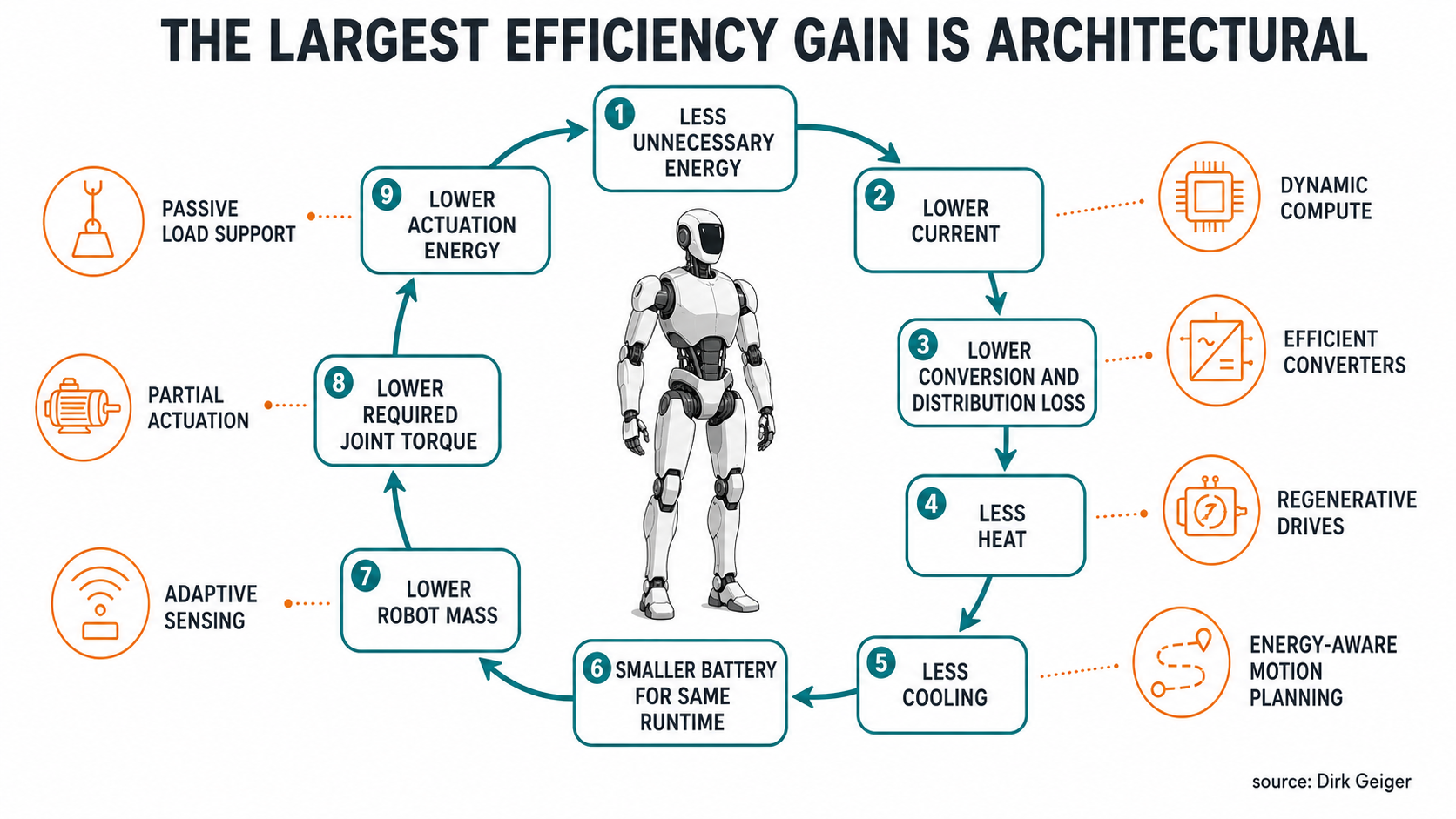
These layers interact. Lower distal mass reduces the torque required to accelerate limbs. Lower torque reduces current. Lower current reduces I2R loss in windings, conductors, connectors, and semiconductor paths. Lower loss reduces cooling demand, which can reduce mass again. Conversely, adding a heavy actuator to obtain more peak torque can increase the energy required to move the limb that carries it. Actuation efficiency is inseparable from mechanical architecture and mass distribution.
4. Compute, Perception, and Communication Create the Always-On Floor
Actuators dominate many high-motion intervals, but electronics establish a baseline that can persist through an entire shift. Central processors, AI accelerators, motor-control microcontrollers, cameras, depth sensors, inertial sensors, encoders, network switches, transceivers, safety controllers, battery supervision, storage devices, fans, pumps, and supporting power supplies consume energy whenever they remain active. In a robot that spends meaningful time waiting for material, observing a workcell, coordinating with other systems, or holding a safe state, this baseline can determine a substantial fraction of total mission energy.
The design challenge is not simply to minimize standby power. Industrial robots must remain safe, diagnosable, and able to react within defined time limits. A deep sleep state that saves energy but disables required safety monitoring or takes too long to wake is not an acceptable optimization. A more useful framework is a hierarchy of operating states tied to reaction-time requirements. Full active operation enables the subsystems needed for dynamic whole-body work. Task-active operation limits resources to the joints, sensors, and compute necessary for the current job. Attentive idle reduces actuator gains, sensor rates, and AI workload while preserving sufficient awareness for a deterministic transition back to work. Safe standby retains battery supervision, safety logic, wake-capable communication, and only the perception required by the deployment risk model. Deeper sleep is appropriate only when the environment and system state permit slower recovery.
This hierarchy is familiar in mobile computing, automotive electronics, and embedded systems, but humanoids make coordination more demanding because the energy states of mechanical and computational subsystems are coupled. Turning off a camera may change localization confidence. Reducing network activity may delay synchronization. Power-gating a limb controller can remove diagnostics or braking authority. Lowering central-compute frequency may change perception or planning latency. A valid state transition therefore requires an explicit contract: which functions remain available, how long wake takes, which signals can trigger wake, how outputs are initialized, how time synchronization is restored, and what behavior occurs if a subsystem fails to resume correctly.
Adaptive sensing can reduce persistent load without making the robot blind. Cameras need not always run the same frame rate and resolution. Depth sensing can be localized to the active workspace. High-rate tactile acquisition is unnecessary when a hand is not in contact or preparing to grasp. Microphones, displays, illumination, and auxiliary sensors can follow context. The savings per device may appear small relative to a high-power actuator, but always-on loads accumulate over hours and impose secondary losses in regulators and cooling.
Compute should follow the same principle. Not every control loop belongs on the largest processor, and not every AI workload requires the same performance state. Hard real-time motor control can remain on local controllers while computationally expensive perception or planning scales with environmental complexity. Dynamic voltage and frequency scaling, accelerator power states, model selection, event-driven processing, and workload placement can reduce energy if latency and determinism are characterized. The objective is not to maximize utilization of a central AI computer. It is to deliver the minimum computational service required to maintain task performance and safety.
Communication also creates a nonzero floor. A humanoid may contain multiple internal networks spanning joints, sensors, compute, safety, and payload interfaces. High-rate deterministic traffic is justified for some motion-control functions but not for every node at every moment. Link-level power states, traffic shaping, zonal aggregation, wake signaling, and careful partitioning can reduce unnecessary network activity. More importantly, architecture can reduce the number of interfaces and duplicated gateways that remain powered simply because subsystems were developed independently.
Fraunhofer IPA’s measured gap between G1 standing and walking illustrates why the baseline deserves direct measurement rather than assumption [8]. The standing condition consumed about 57% of the reported level-walking power. That ratio cannot be interpreted as a universal humanoid constant, and the benchmark does not publish a subsystem-by-subsystem decomposition. It nevertheless demonstrates a practical point: optimizing locomotion alone leaves a large energy domain untouched when the robot must remain electronically and mechanically ready even while stationary.
Visual pending: Distributed cyber-physical end effector
5. The Body Should Be a Bidirectional Energy Network
Humanoid motion repeatedly alternates between acceleration and deceleration. A joint that slows a link, absorbs landing energy, or controls a descending mass can operate mechanically in a generating quadrant. If the motor and inverter are bidirectional, part of that mechanical energy can return to the electrical domain. The important question is not whether a motor is theoretically capable of regeneration. It is whether the complete power network can accept, route, store, or immediately reuse the energy at the instant it becomes available.
A decelerating knee, for example, may raise the local DC-link voltage through its inverter. A shared DC backbone can allow another joint that is simultaneously accelerating to consume that energy, reducing the net current drawn from the battery. Local capacitors can buffer short pulses. The battery can absorb energy only when the BMS, state of charge, temperature, cell limits, and protection state allow charging. If no acceptable sink exists, the system must limit regeneration or dissipate energy. Regeneration is therefore constrained by timing, impedance, bus-voltage control, storage acceptance, and coordination across the body.
This is one reason centralized battery thinking is insufficient. The most efficient destination for recovered energy may be another actuator a few milliseconds later rather than the battery. Returning every joule through multiple conversion stages to electrochemical storage and then drawing it out again can add loss and impose charge-current constraints. Energy sharing on a DC backbone can be more direct, provided the architecture manages stability and fault propagation. The DC link becomes a dynamic exchange point: loads and generators appear continuously while supervisory logic maintains voltage within allowable limits.
Transmission mechanics strongly influence what can be recovered. Friction, high reduction ratios, non-backdrivable gearing, and deliberate damping can convert mechanical energy to heat before it reaches the motor. Highly backdrivable actuators can expose more recoverable energy but may require other means of holding loads or ensuring safe behavior when power is removed. Elastic elements can temporarily store mechanical energy and return it without electrical conversion at all. From an energy perspective, the preferred path may therefore be mechanical reuse first, electrical reuse second, battery return third, and dissipation only when no useful sink is available. Safety and controllability remain overriding constraints.
Regeneration also changes protection design. A power system sized only for load transients can experience unexpected overvoltage when several joints regenerate simultaneously. Battery disconnects, current limits, or high state of charge can remove the normal sink. A robot descending stairs, lowering a payload, or recovering from a perturbation may then produce energy exactly when its ability to store that energy is constrained. Bus capacitors, braking strategies, dump paths where justified, and control coordination must cover these cases explicitly.
Measurement should distinguish gross regenerated energy from useful recovered energy. Motor-side negative mechanical work does not equal battery energy recovered. Losses occur in the motor, inverter, conductors, converters, and battery. Some energy may be consumed by another joint before it reaches the pack. A meaningful test therefore records power at multiple boundaries: mechanical joint power, inverter DC power, main-bus power, battery-terminal power, and, where possible, state-of-charge change over a repeatable cycle. Public full-body measurements that separate these boundaries under representative industrial missions remain limited.
The strongest architecture treats regeneration as part of motion planning. If two functionally equivalent trajectories exist, the controller can prefer one that aligns negative work in one joint with positive demand elsewhere, avoids regenerative saturation, or uses elastic storage more effectively. Task timing and stability dominate, but the optimization space becomes larger than local motor efficiency. The humanoid then behaves less like independent drives connected to a battery and more like a coordinated bidirectional energy network.
Visual pending: Standardize the interface around the hand
6. Every Electrical Loss Becomes a Thermal and Mass Problem
Electrical efficiency in a humanoid cannot be separated from thermal design because nearly every electrical loss ultimately appears as heat. Motor copper loss, semiconductor conduction and switching loss, magnetic loss, processor dissipation, regulator loss, cable resistance, battery internal resistance, and communication electronics all raise component or enclosure temperature. Mechanical friction adds another heat source. The robot must transport that heat through compact limbs and a densely packaged torso while preserving mass, noise, ingress protection, reliability, and human-safe surface temperatures.
The distinction between peak and continuous performance is therefore critical. A motor may deliver a high torque briefly but be unable to sustain it thermally. A compute platform may reach maximum throughput for a burst and then throttle. A battery may provide peak current while temperature and state of charge are favorable but require derating later. A humanoid specification that lists only peak torque, peak compute, or nominal runtime cannot describe sustained productive capability. Thermal time constants convert repeated bursts into a cumulative operating constraint.
Fraunhofer IPA’s observation of G1 arm shutdown during sustained horizontal extension is an example of static electrical demand becoming a thermal limit [8]. The broader lesson is independent of one platform: holding torque can be thermally expensive because it produces copper and inverter loss without useful joint motion. The same effect appears in stalled or near-stalled actuators, prolonged gripping, crouched postures, and manipulation strategies that maintain unfavorable joint leverage. Energy-aware posture selection is therefore also thermal-aware control.
Cooling itself consumes energy and mass. Fans require electrical power, airflow paths, filters or openings, and acoustic management. Liquid cooling can improve heat transport but adds pumps, plumbing, seals, fluid, reservoirs, heat exchangers, control, maintenance, and leak risk. Passive conduction and natural convection are attractive for reliability but require sufficient surface area and low enough heat generation. The system consequence is recursive: higher loss requires more cooling; more cooling requires more energy and hardware; more hardware increases mass; greater mass raises actuation energy; additional actuation energy creates more loss.
This feedback loop explains why apparently small efficiency gains can be architecturally valuable. Reducing current lowers resistive loss quadratically in conductors and windings. Lower loss reduces local temperature rise and can permit smaller heat spreaders or lower airflow. A lighter thermal solution reduces the load carried by joints. Lower joint load reduces current again. The benefit is not guaranteed to cascade linearly—packaging, reliability margins, and minimum component sizes impose thresholds—but the direction is fundamental. Efficiency affects far more than battery runtime.
Power-electronics placement is part of thermal optimization. Integrating inverters close to motors shortens high-current phase paths and can reduce cable mass and loss, but it places semiconductors in mechanically and thermally challenging joint environments. Centralized power electronics can simplify cooling but increase conductor length and harness complexity. Zonal architectures offer a compromise by locating conversion near groups of actuators. The correct choice depends on continuous torque, ambient conditions, joint motion, cooling paths, serviceability, and electromagnetic constraints.
Thermal headroom should become a planned resource rather than a late protection function. Temperature estimates can influence task scheduling, gait choice, arm posture, compute load, and charging. A robot may distribute work across joints, alter acceleration, postpone a thermally intensive motion, or lower compute activity before a hard derating threshold is reached. This requires calibrated thermal models and reliable sensing, but graceful energy and thermal management is preferable to abrupt protective shutdown.
The business consequence is direct. A robot that nominally has enough battery energy for a shift but repeatedly derates because of thermal accumulation has insufficient usable energy architecture. Conversely, lowering losses can increase sustained throughput, reduce cooling maintenance, improve component lifetime, and shrink battery or thermal hardware. Electrical efficiency becomes a lever on total system cost, service burden, and productive availability rather than a component-level percentage.
7. Energy Must Become a Robot-Wide Control Variable
The electrical, mechanical, computational, and thermal constraints converge on one design requirement: energy cannot remain a passive consequence of motion plans, AI workloads, and hardware choices. A production humanoid needs a robot-wide estimate of where power is being consumed, which loads are optional, how much regenerative capacity is available, which thermal margins are narrowing, and how present task choices affect the remaining mission. Battery state of charge is necessary but insufficient because two robots with the same remaining energy can have very different usable capability if one is thermally constrained, carrying a payload, operating on an incline, or running a perception-heavy task.
The control hierarchy should therefore carry an explicit energy budget alongside time, safety, accuracy, and task-priority constraints. A mission planner can select between equivalent task sequences partly on expected energy cost. Whole-body control can avoid postures with poor leverage or excessive simultaneous acceleration. Local drive control can expose electrical and thermal limits upward instead of hiding them behind torque commands. Compute management can reduce performance states when perception demand is low. Sensor and communication subsystems can enter partial-active states when reaction-time requirements permit. The common requirement is observability: decisions improve only when power, temperature, state, and operating mode are measured at useful boundaries.
Mission-normalized measurement is the prerequisite for such control. A useful robot energy profile should record at least battery-terminal power, principal DC-bus power, actuator-domain power, compute and sensing power where measurable, relevant temperatures, state of charge, motion state, payload, terrain or workcell condition, and productive output. Sampling must be fast enough to capture meaningful transients while still supporting shift-level energy accounting. The result is not a single “watts” number but a distribution across operating states and task phases. Fraunhofer IPA’s standardized standing, walking, and incline measurements demonstrate the value of controlled scenarios [8]; industrial deployment requires extending that discipline to manipulation, waiting, recovery, charging, and productive-output metrics.
One practical representation is an energy-state vector maintained by the supervisory controller. It can include available battery energy, predicted energy-to-task-completion, instantaneous and rolling-average bus power, regenerative headroom, key actuator thermal margins, compute thermal margin, and permitted low-power states. Forecasts need not be perfect to be useful. A controller that recognizes a narrowing thermal margin or a high-energy task sequence early can adapt before a protective limit forces a stop. The same information can support fleet scheduling, charging decisions, maintenance diagnostics, and comparison between software releases.
Energy should also become a release metric for robot software. A motion-policy update that completes a task faster but raises Wh per successful cycle may be a regression for battery-limited operation. A perception model that improves accuracy while adding persistent compute load may reduce productive runtime. Conversely, an operating-state change that saves energy but increases wake latency beyond the safety or cycle-time budget is not an optimization. Software validation therefore needs a multi-objective acceptance envelope covering task success, cycle time, safety behavior, energy consumption, thermal accumulation, and recovery behavior under repeatable conditions.
This changes the economics of optimization. Improving one converter from 96% to 97% efficiency can be valuable, but the largest system gains may come from eliminating unnecessary conversion, reducing holding torque, lowering distal mass, gating unused functions, aligning regenerative and motoring events, or selecting a lower-energy motion. Semiconductor efficiency remains important because losses scale into heat, cooling, and mass, yet component selection should be evaluated inside the architecture and mission rather than in isolation. The relevant question is not which device has the best peak efficiency. It is which combination of devices, topology, control, mechanics, and operating states delivers the required productive work with the lowest total energy and sufficient margin.
For humanoid robotics, every watt has consequences beyond runtime. It influences conductor size, connector stress, thermal design, battery mass, actuator sizing, service intervals, charging infrastructure, and ultimately the amount of useful work a robot can deliver before it must stop or derate. The engineering target is therefore not a maximally efficient motor, converter, processor, or battery considered separately. It is an energy-coherent machine in which the complete path from stored electrical energy to productive physical work is measured, controlled, and optimized as one system.